
Motorsport photo's - A 'How To Do'
Discussion


Following on from my F1 Barcelona thread, rather than add to that thread with examples of good motorsport photo's, can those who know how to please share their pictures and knowledge to help those of us learning 
Please add if possible camera and lens data and photo data if you can.
I'll start off:
Canon 50D, 70-200 2.8 L
Exposure: 0.008 sec (1/125)
Aperture: f/14.0
Focal Length: 190 mm

Exposure: 0.008 sec (1/125)
Aperture: f/14.0
Focal Length: 70 mm

Panned by hand, unsharp mask, that's it.
Now I think these are OK, but as ever - over to the PH massive
Please add if possible camera and lens data and photo data if you can.
I'll start off:
Canon 50D, 70-200 2.8 L
Exposure: 0.008 sec (1/125)
Aperture: f/14.0
Focal Length: 190 mm
Exposure: 0.008 sec (1/125)
Aperture: f/14.0
Focal Length: 70 mm
Panned by hand, unsharp mask, that's it.
Now I think these are OK, but as ever - over to the PH massive
Edited by Bernie-the-bolt on Wednesday 20th May 20:05
All 20D w/70-300IS, IS switched on. Focusing set to AI-servo.
Both panning shots - handheld. PS'ing limited to sharpness and saturation.
1/125 @ 190mm

1/125 @ 160mm

And to break with Alfie Noakes 'rules (other thread, ~shutter-speed should be 1/3 - 2/3 of the focal length on an APS (small-size) sensor, 1/2 - 1x on a full-frame or 35mm), if you've got the right conditions a 'quicker' shutter speed can still work for you:
Slow handheld panning, very little PS
1/160 @ 100mm

Handheld panning, PS limited to sharpening and saturation.
1/200 @ 70mm

Both panning shots - handheld. PS'ing limited to sharpness and saturation.
1/125 @ 190mm
1/125 @ 160mm
And to break with Alfie Noakes 'rules (other thread, ~shutter-speed should be 1/3 - 2/3 of the focal length on an APS (small-size) sensor, 1/2 - 1x on a full-frame or 35mm), if you've got the right conditions a 'quicker' shutter speed can still work for you:
Slow handheld panning, very little PS
1/160 @ 100mm
Handheld panning, PS limited to sharpening and saturation.
1/200 @ 70mm

Canon 400D
Canon 70-300 DO IS Lens IS on I think but could well have been in the wrong mode ...
185mm
ISO 100
F14
1/60th
Needs rotating and cropping but otherwise the image has only been converted from RAW using LightZone and mildy re-lit and sharpened using the same software. Then crushed for web use.
Nice shots! Bernie, loving the first shot
All shot hand-held on full manual.
Canon 40D and 70-200f2.8IS, f/13, 70mm, 1/50, ISO100.

Same as above.

Canon 40D and 70-200f2.8IS, f/11, 200mm, 1/160, ISO200.

Canon 40D and 70-200f2.8IS, f/9, 200mm, 1/160, ISO100.

Canon 40D and 70-200f2.8IS, f/5? weird setting.., 200mm, 1/500, ISO100.

Just actually realised how little I use the 100-400, hmmm. Ebay
All shot hand-held on full manual.
Canon 40D and 70-200f2.8IS, f/13, 70mm, 1/50, ISO100.
Same as above.
Canon 40D and 70-200f2.8IS, f/11, 200mm, 1/160, ISO200.
Canon 40D and 70-200f2.8IS, f/9, 200mm, 1/160, ISO100.
Canon 40D and 70-200f2.8IS, f/5? weird setting.., 200mm, 1/500, ISO100.
Just actually realised how little I use the 100-400, hmmm. Ebay
Composition gentlemen, composition and of course Rule of thirds.
Motor sport shots don't need to be car in the centre all of the time.
Panning is the most simple form of action pic, from as little as 30th/sec up to 320th/sec the results can be good.
A steady hand, use the weight of the camera and your upper body and pan at the same speed as the car. A longer lens the better (80-200) is great for this.
Head on/front three quarter can be achieved easily with fast shutter speeds but can lack drama unless the subject is sideways or airborne.
A combined panning/front three quarter is a great thing to achieve but takes practice.

Camera: Nikon D300
Exposure: 0.001 sec (1/1000)
Aperture: f/5.6
Focal Length: 300 mm

Camera: Nikon D300
Exposure: 0.002 sec (1/640)
Aperture: f/4.5
Focal Length: 300 mm

Camera: Nikon D300
Exposure: 0.001 sec (1/1250)
Aperture: f/4.5
Focal Length: 300 mm

Camera: Nikon D200
Exposure: 0.001 sec (1/1000)
Aperture: f/3.5
Focal Length: 300 mm

Camera: Nikon D200
Exposure: 0.033 sec (1/30)
Aperture: f/22
Focal Length: 20 mm

Camera: Nikon D200
Exposure: 0.017 sec (1/60)
Aperture: f/9
Focal Length: 125 mm

Camera: Nikon D200
Exposure: 0.01 sec (1/100)
Aperture: f/11
Focal Length: 300 mm

Camera: Nikon D200
Exposure: 0.017 sec (1/60)
Aperture: f/14
Focal Length: 80 mm
Motor sport shots don't need to be car in the centre all of the time.
Panning is the most simple form of action pic, from as little as 30th/sec up to 320th/sec the results can be good.
A steady hand, use the weight of the camera and your upper body and pan at the same speed as the car. A longer lens the better (80-200) is great for this.
Head on/front three quarter can be achieved easily with fast shutter speeds but can lack drama unless the subject is sideways or airborne.
A combined panning/front three quarter is a great thing to achieve but takes practice.
Camera: Nikon D300
Exposure: 0.001 sec (1/1000)
Aperture: f/5.6
Focal Length: 300 mm
Camera: Nikon D300
Exposure: 0.002 sec (1/640)
Aperture: f/4.5
Focal Length: 300 mm
Camera: Nikon D300
Exposure: 0.001 sec (1/1250)
Aperture: f/4.5
Focal Length: 300 mm
Camera: Nikon D200
Exposure: 0.001 sec (1/1000)
Aperture: f/3.5
Focal Length: 300 mm
Camera: Nikon D200
Exposure: 0.033 sec (1/30)
Aperture: f/22
Focal Length: 20 mm
Camera: Nikon D200
Exposure: 0.017 sec (1/60)
Aperture: f/9
Focal Length: 125 mm
Camera: Nikon D200
Exposure: 0.01 sec (1/100)
Aperture: f/11
Focal Length: 300 mm
Camera: Nikon D200
Exposure: 0.017 sec (1/60)
Aperture: f/14
Focal Length: 80 mm


A good example:
http://news.bbc.co.uk/sport1/hi/motorsport/formula...
PS Love the shot of the Austin 7
http://news.bbc.co.uk/sport1/hi/motorsport/formula...
PS Love the shot of the Austin 7
Edited by Alfie Noakes on Thursday 21st May 11:14
One of the issues that is always a factor for ordinary trackside enthusiasts rather than accredited pros is how to get a decent shot for the album from any of the locations available to them. Even when fences and other paraphernalia don't actually get in the way the shot can look poor on an 'undressed' circuit. Panning can help to disguise the dross.
At 'typical' settings (f8 is optimal for this lens at longer focal lengths)

Canon 400D, 70-300 DO lens
ISO 400
1/1250th
f8
@230mm
Going for blur.

Same camera/Lens
ISO 100
1/60th
f18
@185mm
Getting a 'dressed' background can be so much better as a starting point

ISO 100
1/60th
f16
@130mm
These shots were taken at Donington Park on the inside of Redgate corner - a popular location because you have a relatively constant speed corner at a relatively constant distance thus making life easier for both focus (manual or auto) and panning activity. Expect a better hit rate.
You are also relatively close to the track with, as yet, no fences so usable and affordable lenses will work quite well. The downside is that it is a popular location so can get quite crowded.
Note also that the DoF on the first shot at least stops the background being too sharp at f8. Once you get to f18 in the second shot the movement is performing the same task more effectively. However the effect will vary a lot depending on the distance between subject and background and the relative speed of the two in the panning activity.
How you then take the captures to dress them up and make them more interesting is another matter. These are uncropped.
At 'typical' settings (f8 is optimal for this lens at longer focal lengths)
Canon 400D, 70-300 DO lens
ISO 400
1/1250th
f8
@230mm
Going for blur.
Same camera/Lens
ISO 100
1/60th
f18
@185mm
Getting a 'dressed' background can be so much better as a starting point
ISO 100
1/60th
f16
@130mm
These shots were taken at Donington Park on the inside of Redgate corner - a popular location because you have a relatively constant speed corner at a relatively constant distance thus making life easier for both focus (manual or auto) and panning activity. Expect a better hit rate.
You are also relatively close to the track with, as yet, no fences so usable and affordable lenses will work quite well. The downside is that it is a popular location so can get quite crowded.
Note also that the DoF on the first shot at least stops the background being too sharp at f8. Once you get to f18 in the second shot the movement is performing the same task more effectively. However the effect will vary a lot depending on the distance between subject and background and the relative speed of the two in the panning activity.
How you then take the captures to dress them up and make them more interesting is another matter. These are uncropped.

Pixel-Snapper said:
Second time out having a go at panning. Poor old 300d just cant hack it at 3fps and some sharper glass wouldnt go a miss.
HmmI don't think fps matters at all. One good shot will do the trick. However the number of shots you can take before the buffer fills is more critical in some situations.
Sharper glass will only give you real benefits for a small percent of the shots. Panning is inherently absolute sharpness free for the most part and there is more to be gained by getting close and using some planned clever sharpening for effect than there is paying big sums for sharp glass just for panning activity. Speed of auto focus is perhaps more important - but you can always go manual.
18-55 Kit lens:


I'll need to look up the exif later.
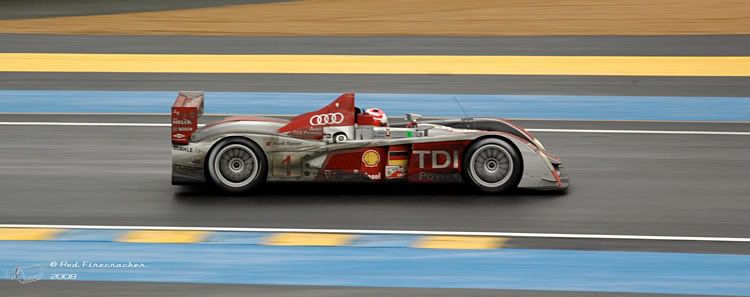
Canon EOS 10D, 35-350L 3.5-5.6 @ 150mm, 1/160, f9.0, ISO 100
Inside Tertre Rouge, Le Mans 24 2006

Canon EOS 10D, 35-350L 3.5-5.6 @ 135mm, 1/160, f14.0, ISO 100
Goodwood Festival of Speed 2006

Canon EOS 10D, 35-350L 3.5-5.6 @ 160mm, 1/800, f5.0, ISO 100
Goodwood Festival of Speed 2006

Canon EOS 30D, 35-350L 3.5-5.6 @ 120mm, 1/400, f5.0, ISO 800
Goodwood Festival of Speed 2008

Inside Tertre Rouge, Le Mans 24 2006
Canon EOS 10D, 35-350L 3.5-5.6 @ 135mm, 1/160, f14.0, ISO 100
Goodwood Festival of Speed 2006
Canon EOS 10D, 35-350L 3.5-5.6 @ 160mm, 1/800, f5.0, ISO 100
Goodwood Festival of Speed 2006
Canon EOS 30D, 35-350L 3.5-5.6 @ 120mm, 1/400, f5.0, ISO 800
Goodwood Festival of Speed 2008


2007 was my year for trying light trails
Canon EOS 400D
Exposure: 30sec
Aperture: f/32.0
Focal Length: 152 mm
ISO Speed: 100
Le Mans 2007

Canon EOS 400D
Exposure: 20sec
Aperture: f/16.0
Focal Length: 34 mm
ISO Speed: 400
Halfway, Wales Rally GB 2007. Not as sharp as I'd like as it was raining and blowing so much the tripod was swaying

Steve
Canon EOS 400D
Exposure: 30sec
Aperture: f/32.0
Focal Length: 152 mm
ISO Speed: 100
Le Mans 2007
Canon EOS 400D
Exposure: 20sec
Aperture: f/16.0
Focal Length: 34 mm
ISO Speed: 400
Halfway, Wales Rally GB 2007. Not as sharp as I'd like as it was raining and blowing so much the tripod was swaying
Steve
LongQ said:
Pixel-Snapper said:
Second time out having a go at panning. Poor old 300d just cant hack it at 3fps and some sharper glass wouldnt go a miss.
HmmI don't think fps matters at all. One good shot will do the trick. However the number of shots you can take before the buffer fills is more critical in some situations.
Sharper glass will only give you real benefits for a small percent of the shots. Panning is inherently absolute sharpness free for the most part and there is more to be gained by getting close and using some planned clever sharpening for effect than there is paying big sums for sharp glass just for panning activity. Speed of auto focus is perhaps more important - but you can always go manual.
An example of the 300d bust rate would be these 3 from bedford last friday.


Edited by Pixel-Snapper on Friday 22 May 09:30

Panning:
Camera Make: NIKON CORPORATION
Camera Model: NIKON D70s
Image Date: 2008:06:15 09:03:53
Flash Used: No
Focal Length: 120.0mm (35mm equivalent: 180mm)
Exposure Time: 0.0063 s (1/160)
Aperture: f/14.0
ISO equiv: 800
White Balance: Auto
Metering Mode: Spot
Exposure: shutter priority (semi-auto)
Comment: Curve: MediumHighD70
Head on:

f5.6
1/400
270mm
iso 800
Very slow:

Camera Make: NIKON CORPORATION
Camera Model: NIKON D70s
Image Date: 2008:06:01 10:02:55
Flash Used: No
Focal Length: 70.0mm
Exposure Time: 0.0031 s (1/320)
Aperture: f/9.0
ISO equiv: 800
Metering Mode: Matrix
Camera Make: NIKON CORPORATION
Camera Model: NIKON D70s
Image Date: 2008:06:15 09:03:53
Flash Used: No
Focal Length: 120.0mm (35mm equivalent: 180mm)
Exposure Time: 0.0063 s (1/160)
Aperture: f/14.0
ISO equiv: 800
White Balance: Auto
Metering Mode: Spot
Exposure: shutter priority (semi-auto)
Comment: Curve: MediumHighD70
Head on:
f5.6
1/400
270mm
iso 800
Very slow:
Camera Make: NIKON CORPORATION
Camera Model: NIKON D70s
Image Date: 2008:06:01 10:02:55
Flash Used: No
Focal Length: 70.0mm
Exposure Time: 0.0031 s (1/320)
Aperture: f/9.0
ISO equiv: 800
Metering Mode: Matrix
Pixel-Snapper said:
LongQ said:
Pixel-Snapper said:
Second time out having a go at panning. Poor old 300d just cant hack it at 3fps and some sharper glass wouldnt go a miss.
HmmI don't think fps matters at all. One good shot will do the trick. However the number of shots you can take before the buffer fills is more critical in some situations.
Sharper glass will only give you real benefits for a small percent of the shots. Panning is inherently absolute sharpness free for the most part and there is more to be gained by getting close and using some planned clever sharpening for effect than there is paying big sums for sharp glass just for panning activity. Speed of auto focus is perhaps more important - but you can always go manual.
The thing is that at 3 fps (your 300D) or just under 4fps (my 400D) you do at least get a chance at a relatively low shutter speed (potentially a constraint for really high fps rates anyway) to see whether of not you have a fairly constant point of focus on the moving object. If you can't see the object either because the mirror is always up or, on a bridge camera, the delay is to great, you are in guessing mode. Just give thanks then that you are not using film!
Potentially you would get better results for subject following with a Rangefinder camera. I might almost add even one of the very few pocket cams that have a separate viewfinder except they have other constraints for panning.
If you want a high hit rate find the inside of a nice constant radius curve and stand there a while until you get into the groove for the day. But remember to pan at different speeds for different sorts of subject. In the case of motor sport different types of vehicle even at the same place.
Try just one shot watching your point of focus as you follow. Also your sample shots look like they are at a challenging place anyway as you don't seem to have a constant distance but are quite close to the subject at the apex. Great if you pull it off but can be frustrating getting there unless it is a technique you are using several times a week.
All just my opinion of course.
Edited by LongQ on Friday 22 May 23:41
Edited by LongQ on Friday 22 May 23:48


Gassing Station | Photography & Video | Top of Page | What's New | My Stuff