
Government Borrowing Costs
Discussion


There doesn't seem to be a thread for this, but the consequences of higher borrowing costs/ bond yields affect every government decision, tax rise, spending cut, etc.
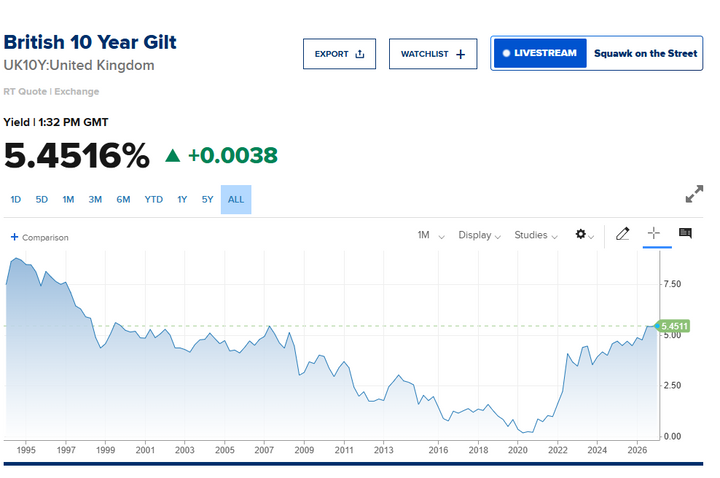
The UK 10 year is flirting with the highs of 2007, and beyond that the next highest high is 1999.
In the last financial year the government spent over 8% of it's income on interest payments (about £113bn) - about double the defence budget or £10bn more than we spend on education.
This year will be higher, maybe over 9% of government income on debt payments. In the space of about 5 years the interest bill has gone up by £40bn a year. We are in a better place than some countries, but there will have to be some kind of reckoning between spending and income to pay for this bill - clearly we cannot grow our way out of the debt like we did in the 80s and 90s, UK growth has been terrible since 2007 and shows no sign of speeding up.
The UK 10 year is flirting with the highs of 2007, and beyond that the next highest high is 1999.
In the last financial year the government spent over 8% of it's income on interest payments (about £113bn) - about double the defence budget or £10bn more than we spend on education.
This year will be higher, maybe over 9% of government income on debt payments. In the space of about 5 years the interest bill has gone up by £40bn a year. We are in a better place than some countries, but there will have to be some kind of reckoning between spending and income to pay for this bill - clearly we cannot grow our way out of the debt like we did in the 80s and 90s, UK growth has been terrible since 2007 and shows no sign of speeding up.
Condi said:
There doesn't seem to be a thread for this, but the consequences of higher borrowing costs/ bond yields affect every government decision, tax rise, spending cut, etc.
The UK 10 year is flirting with the highs of 2007, and beyond that the next highest high is 1999.
In the last financial year the government spent over 8% of it's income on interest payments (about £113bn) - about double the defence budget or £10bn more than we spend on education.
This year will be higher, maybe over 9% of government income on debt payments. In the space of about 5 years the interest bill has gone up by £40bn a year. We are in a better place than some countries, but there will have to be some kind of reckoning between spending and income to pay for this bill - clearly we cannot grow our way out of the debt like we did in the 80s and 90s, UK growth has been terrible since 2007 and shows no sign of speeding up.
huh? if the UK had debt levels like the 80s and 90s, the politicians would be jumping for joy and massively increasing spending. The UK 10 year is flirting with the highs of 2007, and beyond that the next highest high is 1999.
In the last financial year the government spent over 8% of it's income on interest payments (about £113bn) - about double the defence budget or £10bn more than we spend on education.
This year will be higher, maybe over 9% of government income on debt payments. In the space of about 5 years the interest bill has gone up by £40bn a year. We are in a better place than some countries, but there will have to be some kind of reckoning between spending and income to pay for this bill - clearly we cannot grow our way out of the debt like we did in the 80s and 90s, UK growth has been terrible since 2007 and shows no sign of speeding up.
if you meant the 50s and 60s, that would probably be a bit more accurate wrt to praying the growth would bail everyone out of the current mess.
To be fair much of the rise is down to rates rising in the US etc, but UK debt does carry a premium over US debt which it did not previously.
The problem is that no party which proposed to make the changes necessary to taxation and benefits to bring the deficit down meaningfully would ever get elected.
The problem is that no party which proposed to make the changes necessary to taxation and benefits to bring the deficit down meaningfully would ever get elected.
oyster said:
With inflation busting pension increases, what do we expect?
Plus more and more benefits being handed out.
It s what voters want.
Some voters, the ones getting the free stuff sure. Those of us paying for all the free stuff, not so much.Plus more and more benefits being handed out.
It s what voters want.
Anyway nothing to worry about. The foundations have been fixed, the country is in a better place than in 2024, freebies can continue (credit R Reeves the economic heavyweight who saved us).
Robertb said:
To be fair much of the rise is down to rates rising in the US etc, but UK debt does carry a premium over US debt which it did not previously.
The problem is that no party which proposed to make the changes necessary to taxation and benefits to bring the deficit down meaningfully would ever get elected.
Interest rates in the UK are influenced by other economies.The problem is that no party which proposed to make the changes necessary to taxation and benefits to bring the deficit down meaningfully would ever get elected.
The near zero real bond yield situation was a US thing as well as a UK thing.
We're now seeing sensible bond yields, the only problem is we have way too much debt.
Unfortunately the economic theory most economists believed without question was a load of b
 ks.
People are quick to blame benefits and the triple lock, but they are only one factor.
The heffalump in the room is public sector bloat. The overhead of way too many pen pushers.
Over 6 million public sector employees, despite huge number of actual public sector useful worker jobs being outsourced into the private sector.
Condi said:
There doesn't seem to be a thread for this, but the consequences of higher borrowing costs/ bond yields affect every government decision, tax rise, spending cut, etc.
The UK 10 year is flirting with the highs of 2007, and beyond that the next highest high is 1999.
In the last financial year the government spent over 8% of it's income on interest payments (about £113bn) - about double the defence budget or £10bn more than we spend on education.
This year will be higher, maybe over 9% of government income on debt payments. In the space of about 5 years the interest bill has gone up by £40bn a year. We are in a better place than some countries, but there will have to be some kind of reckoning between spending and income to pay for this bill - clearly we cannot grow our way out of the debt like we did in the 80s and 90s, UK growth has been terrible since 2007 and shows no sign of speeding up.
Can't grow our way out? Immigration levels the last 10 years may disagree. Will be interesting now that nett migration seems to be a lot lower. The UK 10 year is flirting with the highs of 2007, and beyond that the next highest high is 1999.
In the last financial year the government spent over 8% of it's income on interest payments (about £113bn) - about double the defence budget or £10bn more than we spend on education.
This year will be higher, maybe over 9% of government income on debt payments. In the space of about 5 years the interest bill has gone up by £40bn a year. We are in a better place than some countries, but there will have to be some kind of reckoning between spending and income to pay for this bill - clearly we cannot grow our way out of the debt like we did in the 80s and 90s, UK growth has been terrible since 2007 and shows no sign of speeding up.
Re the debt, can we move it over to zero interest like a credit card

TX.
Gassing Station | News, Politics & Economics | Top of Page | What's New | My Stuff