
EV Battery State of Health
Discussion


I guess knowing the state of health of the EV battery tells helps with buying and selling your car like when you buy second hand smart phone. Thinking about it, you don't want to be buying an EV that is heavily degraded. Yeah I have seen online that Kwik Fit have the facility at selected centres and thought if anyone had the test done and is it something people are generally considering? Unsure if I should consider checking my battery - I guess no harm.
stevemcs said:
Seems odd that people what battery checks on ev s but would never dare ask for a compression test on a petrol/diesel
As for Kwik Fit doing it they sometimes struggle fitting tyres correctly
Engines don’t degrade over time if looked after properly. Batteries just do albeit the degradation on EV’s is way overblown these days. Early ones sure but current ones seem fine. As for Kwik Fit doing it they sometimes struggle fitting tyres correctly
I did one of the Aviloo tests a few months back. Cost about £100 I think. It was South London / Surrey area of that s any use. The report was a piece of paper that really didn’t tell me much more than I could tell off some simple maths on what’s shown on the screen when I start the car.
I had to do it for the car to be accepted on a ship for export.
I had to do it for the car to be accepted on a ship for export.
p1stonhead said:
stevemcs said:
Seems odd that people what battery checks on ev s but would never dare ask for a compression test on a petrol/diesel
As for Kwik Fit doing it they sometimes struggle fitting tyres correctly
Engines don t degrade over time if looked after properly. Batteries just do albeit the degradation on EV s is way overblown these days. Early ones sure but current ones seem fine. As for Kwik Fit doing it they sometimes struggle fitting tyres correctly
Its a bit like getting a bore test before buying a Porsche.
stevemcs said:
Seems odd that people what battery checks on ev s but would never dare ask for a compression test on a petrol/diesel
As for Kwik Fit doing it they sometimes struggle fitting tyres correctly
They managed to fit directional tyres on a company car the wrong way round a few years ago. The fitter and the checker both missed it…As for Kwik Fit doing it they sometimes struggle fitting tyres correctly
They seem pointless to me as they re distorted by a number of factors such as cell balancing and BMS calibration. I know some examine actual battery cell voltages but that s only half the story. Tesla have the ability (albeit through a hidden service menu) to check the battery and it requires about 24 hours and a discharge and slow charge of the battery. Your average quick test doesn t do that and so 96% health v 92% could be the other way around after changing charging and journey habits
The second reason I wouldn t bother is because degradation is not a great measure of potential failure. Sure a battery that one day shows 95% then next 70% could be about to implode, but anecdotally failure is pretty rapid. It s like measuring the compression in an engine only for the big end or timing chain to fail
A third reason, depending on make, there are withheld buffers of capacity which the car releases to maintain a useable level of capacity. I think BMW started this with the i3 which generally appears to hold on very well to its capacity. Measure battery health on such a car and I think it s hard, if not impossible, to tell how much of the buffer capacity has been used. It s akin to a report saying over x% .
My hunch is the battery health industry came about to address a fear and in doing so make cash for themselves. Education seemed less important.
I m more than happy to be educated but I don t believe the figures I read, so may as well not bother asking.
Gone fishing said:
My hunch is the battery health industry came about to address a fear and in doing so make cash for themselves. Education seemed less important.
I m more than happy to be educated but I don t believe the figures I read, so may as well not bother asking.
To add to your list (that I agree with, BTW) a slightly apples vs pineapples data point: judging from other devices, modern batteries are pretty hardy. I m more than happy to be educated but I don t believe the figures I read, so may as well not bother asking.
I have a phone that has been "driven" the equivalent of 180,000km/112,000 miles (based on the 450+ cycles noted in the battery health). The reported SoH is still 94%, and three of those percentage points were lost during a three-week holiday where the daytime temperatures stayed above 35 degrees most of the day.
I set the charge limit to 80% and haven't run the battery empty, but the buffer is likely smaller than in EVs (nonexistent?), and the phone doesn't have temperature management.
My understanding (based on my own BMW I3) is that a accurate traction battery test needs a charge/discharge cycle whilst hooked up the manufacturer's kit, takes several hours and costs quite a bit.
BMW dealer laptop diagnostic software (ISTA) will do a quick test, and produce a report for the customer. Last time my car was serviced at 6 years and 60K miles, it showed 100%. Which is clearly incorrect.
So I'm not at all sure that there's a meaningful way of producing a battery health report just by interrogating the car's systems.
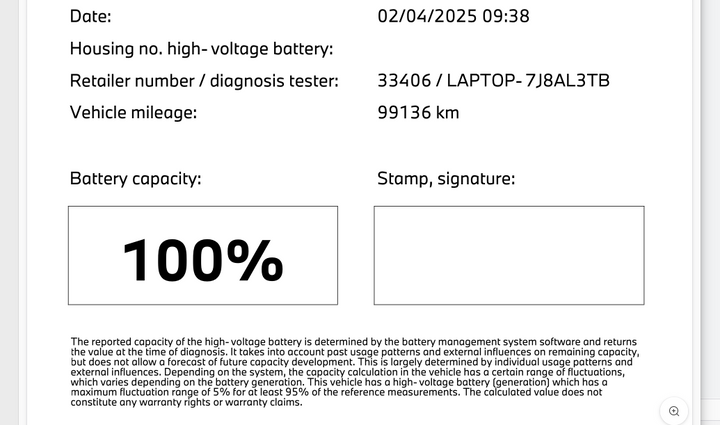
BMW dealer laptop diagnostic software (ISTA) will do a quick test, and produce a report for the customer. Last time my car was serviced at 6 years and 60K miles, it showed 100%. Which is clearly incorrect.
So I'm not at all sure that there's a meaningful way of producing a battery health report just by interrogating the car's systems.
Paul Drawmer said:
My understanding (based on my own BMW I3) is that a accurate traction battery test needs a charge/discharge cycle whilst hooked up the manufacturer's kit, takes several hours and costs quite a bit.
...
So I'm not at all sure that there's a meaningful way of producing a battery health report just by interrogating the car's systems.
Yes and no. You can tell quite a lot about a battery pack from a static evaluation, specifically checking the voltage of each individual cell to make sure they are closely matched. By querying the BMS you can also get specific numbers for things like the resistance between the cells and the casing, which can indicate damage or certain manufacturing flaws which wont directly affect how a car drives. ...
So I'm not at all sure that there's a meaningful way of producing a battery health report just by interrogating the car's systems.
So you can spot a lot of actual faults; what you can't do is accurately measure linear wear, although this is something the BMS should know quite a lot about from previous charge/discharge cycles as long as the battery has at some point recently been run to both moderately high and moderately low charge states.
With the packs I work with (which are UPSs so a lot smaller than car ones) we cannot completely flatten the batteries because we need them to be always available; instead, we run them through short, sharp discharge cycles, I think pulling around 10C from them for under a second to measure the internal impedance and voltage droop, which gives a reasonable approximation of SoH.
Edited by kambites on Wednesday 14th October 08:11
I have recently bought a used EV from a main dealership. They provide a battery health readout, including some of the stuff above, balance of cells , max voltage of pack etc .
It's in part related to the warranty on the car as a used approved and the overall battery warranty that is 8 years. The car is 3 years old.
For a first EV owner, rather than a leasing deal where you hand it back as someone else's problem, it's a bit of comfort.
It's in part related to the warranty on the car as a used approved and the overall battery warranty that is 8 years. The car is 3 years old.
For a first EV owner, rather than a leasing deal where you hand it back as someone else's problem, it's a bit of comfort.
p1stonhead said:
stevemcs said:
Seems odd that people what battery checks on ev s but would never dare ask for a compression test on a petrol/diesel
As for Kwik Fit doing it they sometimes struggle fitting tyres correctly
Engines don t degrade over time if looked after properly. Batteries just do albeit the degradation on EV s is way overblown these days. Early ones sure but current ones seem fine. As for Kwik Fit doing it they sometimes struggle fitting tyres correctly
Paul Drawmer said:
My understanding (based on my own BMW I3) is that a accurate traction battery test needs a charge/discharge cycle whilst hooked up the manufacturer's kit, takes several hours and costs quite a bit.
BMW dealer laptop diagnostic software (ISTA) will do a quick test, and produce a report for the customer. Last time my car was serviced at 6 years and 60K miles, it showed 100%. Which is clearly incorrect.
So I'm not at all sure that there's a meaningful way of producing a battery health report just by interrogating the car's systems.
It depends how its measured, Nissan for example have a 3-4kwh buffer so my Ariya has a 91 battery of which 87 is usable - the SOH is measured against the usable not the total so it will be a good few years of degradation to show under 100%.BMW dealer laptop diagnostic software (ISTA) will do a quick test, and produce a report for the customer. Last time my car was serviced at 6 years and 60K miles, it showed 100%. Which is clearly incorrect.
So I'm not at all sure that there's a meaningful way of producing a battery health report just by interrogating the car's systems.
PistonTim said:
Paul Drawmer said:
My understanding (based on my own BMW I3) is that a accurate traction battery test needs a charge/discharge cycle whilst hooked up the manufacturer's kit, takes several hours and costs quite a bit.
BMW dealer laptop diagnostic software (ISTA) will do a quick test, and produce a report for the customer. Last time my car was serviced at 6 years and 60K miles, it showed 100%. Which is clearly incorrect.
So I'm not at all sure that there's a meaningful way of producing a battery health report just by interrogating the car's systems.
It depends how its measured, Nissan for example have a 3-4kwh buffer so my Ariya has a 91 battery of which 87 is usable - the SOH is measured against the usable not the total so it will be a good few years of degradation to show under 100%.BMW dealer laptop diagnostic software (ISTA) will do a quick test, and produce a report for the customer. Last time my car was serviced at 6 years and 60K miles, it showed 100%. Which is clearly incorrect.
So I'm not at all sure that there's a meaningful way of producing a battery health report just by interrogating the car's systems.
The issue for owners is that the batteries charge to 100 and have 8/9 status bars showing, but given a steep hill the battery quickly drops it charge. So the range is a fractact of their expectation. The battery on paper works within spec. as it charges to 100% and condition is show ok, so it 50/50 if you get your car fixed under warranty.
The good new for them is that there are 3 party replacement batteries at reasonable cost and fixs too.
You may need to ask, and again unsure how accurate this is, but on my Renault 5 I have a bluetooth OBD2 reader that I connect with the Car Scanner app. This has a column for SOH that the car is reporting against. At delivery it was 99.99% in April and each month since has recorded, 99.96, 99.75, 99.62, 99.59, 99.38% as of end of September at 10k miles. I would say it's at least somewhat accurate due to it consistently going down and bigger monthly drops corresponding with a higher mile month. Unsure if all EV's would report this the same way but a the reader was only £6.99 off Amazon. Can also be used to read and clear engine codes too which I have done for friend's cars in the past. Mainly my mates Velar before it was due back which was always throwing up some fault to do with the EGR system.
ashenfie said:
PistonTim said:
Paul Drawmer said:
My understanding (based on my own BMW I3) is that a accurate traction battery test needs a charge/discharge cycle whilst hooked up the manufacturer's kit, takes several hours and costs quite a bit.
BMW dealer laptop diagnostic software (ISTA) will do a quick test, and produce a report for the customer. Last time my car was serviced at 6 years and 60K miles, it showed 100%. Which is clearly incorrect.
So I'm not at all sure that there's a meaningful way of producing a battery health report just by interrogating the car's systems.
It depends how its measured, Nissan for example have a 3-4kwh buffer so my Ariya has a 91 battery of which 87 is usable - the SOH is measured against the usable not the total so it will be a good few years of degradation to show under 100%.BMW dealer laptop diagnostic software (ISTA) will do a quick test, and produce a report for the customer. Last time my car was serviced at 6 years and 60K miles, it showed 100%. Which is clearly incorrect.
So I'm not at all sure that there's a meaningful way of producing a battery health report just by interrogating the car's systems.
The issue for owners is that the batteries charge to 100 and have 8/9 status bars showing, but given a steep hill the battery quickly drops it charge. So the range is a fractact of their expectation. The battery on paper works within spec. as it charges to 100% and condition is show ok, so it 50/50 if you get your car fixed under warranty.
The good new for them is that there are 3 party replacement batteries at reasonable cost and fixs too.
Paul Drawmer said:
My understanding (based on my own BMW I3) is that a accurate traction battery test needs a charge/discharge cycle whilst hooked up the manufacturer's kit, takes several hours and costs quite a bit.
BMW dealer laptop diagnostic software (ISTA) will do a quick test, and produce a report for the customer. Last time my car was serviced at 6 years and 60K miles, it showed 100%. Which is clearly incorrect.
So I'm not at all sure that there's a meaningful way of producing a battery health report just by interrogating the car's systems.
Possibly not correct - there's physical capacity and usable capacity, you might have lost the physical capacity but might still be above the usable capacity. My understanding is that the i3 (and Mini, which I have) have quite a lot of headroom between the 2, so degradation will impact physical capacity but it will maintain its usable.BMW dealer laptop diagnostic software (ISTA) will do a quick test, and produce a report for the customer. Last time my car was serviced at 6 years and 60K miles, it showed 100%. Which is clearly incorrect.
So I'm not at all sure that there's a meaningful way of producing a battery health report just by interrogating the car's systems.
AyBee said:
Paul Drawmer said:
My understanding (based on my own BMW I3) is that a accurate traction battery test needs a charge/discharge cycle whilst hooked up the manufacturer's kit, takes several hours and costs quite a bit.
BMW dealer laptop diagnostic software (ISTA) will do a quick test, and produce a report for the customer. Last time my car was serviced at 6 years and 60K miles, it showed 100%. Which is clearly incorrect.
So I'm not at all sure that there's a meaningful way of producing a battery health report just by interrogating the car's systems.
Possibly not correct - there's physical capacity and usable capacity, you might have lost the physical capacity but might still be above the usable capacity. My understanding is that the i3 (and Mini, which I have) have quite a lot of headroom between the 2, so degradation will impact physical capacity but it will maintain its usable.BMW dealer laptop diagnostic software (ISTA) will do a quick test, and produce a report for the customer. Last time my car was serviced at 6 years and 60K miles, it showed 100%. Which is clearly incorrect.
So I'm not at all sure that there's a meaningful way of producing a battery health report just by interrogating the car's systems.
Gassing Station | EV and Alternative Fuels | Top of Page | What's New | My Stuff