
Discussion


Not a super common topic on PH, people naturally mostly discuss capital markets and their country weights and here we go. Most people usually do not have access to alternative (private) in a great ability, but there has been a massive trend I would say for smart money at least to shift their allocations from usual stock bonds to alternatives.
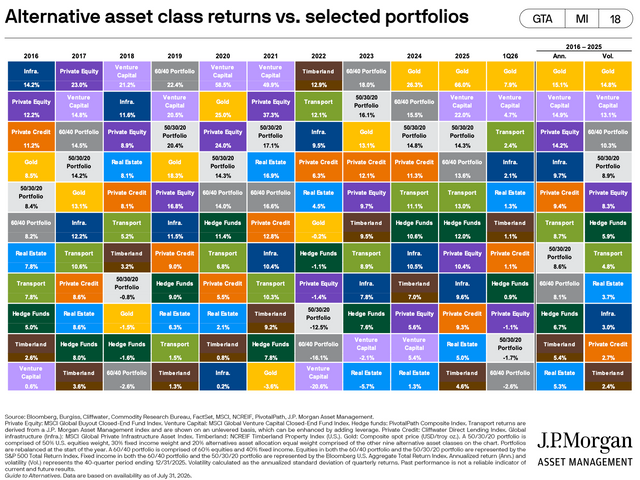
US Farmland, has probably one of the few asset classes that has zero capital loss in the last decade.
US Farmland, has probably one of the few asset classes that has zero capital loss in the last decade.
You’re swimming with sharks here so unless you are or have access to a reliable specialist, you will likely be the last buyer. I spent a good amount investigating buying the lease on small oil wells, it’s not uncommon to own a few of these. Anyway I did know someone who had experience and the bottom line was that after management costs and fees, it was just a headache, add in the risk of being ripped off and then in Colorado, it wasn’t for me.
ooid said:
Not a super common topic on PH, people naturally mostly discuss capital markets and their country weights and here we go. Most people usually do not have access to alternative (private) in a great ability, but there has been a massive trend I would say for smart money at least to shift their allocations from usual stock bonds to alternatives.
US Farmland, has probably one of the few asset classes that has zero capital loss in the last decade.
I guess it depends on what is considered "smart money". US Farmland, has probably one of the few asset classes that has zero capital loss in the last decade.
ooid said:
Not a super common topic on PH, people naturally mostly discuss capital markets and their country weights and here we go. Most people usually do not have access to alternative (private) in a great ability, but there has been a massive trend I would say for smart money at least to shift their allocations from usual stock bonds to alternatives.
US Farmland, has probably one of the few asset classes that has zero capital loss in the last decade.
When you look at a chart like that, the first question should be "how have they arrived at those numbers?".US Farmland, has probably one of the few asset classes that has zero capital loss in the last decade.
Broad brush categorisation can hide tremendous variability within each category.
Aside from the lack of accessibility (which just strikes me as a recipe for being the buyer of last resort) I think the problem many retail investors would have with these sorts of asset classes is that a lot of the return is really illiquidity premium for holding through the cycle, and they don't necessarily have the duration or temperament to want to hold them long enough to earn that premium. Hence you see in periods like 2022-24 all the infrastructure/renewables etc trusts getting absolutely whacked and discounts blowing out for ages.
Derek Chevalier said:
I guess it depends on what is considered "smart money".
Institutional investors.LooneyTunes said:
When you look at a chart like that, the first question should be "how have they arrived at those numbers?".
Broad brush categorisation can hide tremendous variability within each category.
Well, you can see the data source and relevant indices/index for each class, bottom left. Obviously volatility is missing and most of these valuations rather than market values, so they would look less volatile in comparison to equities.Broad brush categorisation can hide tremendous variability within each category.
ooid said:
Well, you can see the data source and relevant indices/index for each class, bottom left. Obviously volatility is missing and most of these valuations rather than market values, so they would look less volatile in comparison to equities.
Buying an index is quite a different proposition compared to buying the actual assets or a more focussed offering.Good summary here by Morgan Stanley.
https://www.morganstanley.com/im/en-us/individual-...
(Not all alternatives)
https://www.morganstanley.com/im/en-us/individual-...
(Not all alternatives)
I have yet to see compelling evidence that alternatives offer better (or even comparable) risk-adjusted returns than typical global equity and fixed income investments.
That's before you consider things like lack of product availability, manager selection risks, lack of liquidity, high fees, opaque pricing and reduced regulatory protections.
Investors (including Institutional) like to appear sophisticated but I generally find that simpler is better in the world of investing (except for the tax side of it).
That's before you consider things like lack of product availability, manager selection risks, lack of liquidity, high fees, opaque pricing and reduced regulatory protections.
Investors (including Institutional) like to appear sophisticated but I generally find that simpler is better in the world of investing (except for the tax side of it).
As a class of investments one obvious issue is the lack of data about their historic performance. Things that are not on an exchange or regulated might have little to no accurate price history. Those that fail might just be quietly forgotten about while the big winners are held up as being typical and are included in the (now skewed) average returns data.
And that’s before we even get to the question of what’s meant by the price.
And that’s before we even get to the question of what’s meant by the price.
SchillingTwo said:
As a class of investments one obvious issue is the lack of data about their historic performance. Things that are not on an exchange or regulated might have little to no accurate price history. Those that fail might just be quietly forgotten about while the big winners are held up as being typical and are included in the (now skewed) average returns data.
And that s before we even get to the question of what s meant by the price.
As if that wasn't bad enough, retail investors can't get the (skewed) average returns because there's no way for a retail investor to either buy the whole market or even access the best funds/managers/investments unless they get lucky.And that s before we even get to the question of what s meant by the price.
LeoSayer said:
I have yet to see compelling evidence that alternatives offer better (or even comparable) risk-adjusted returns than typical global equity and fixed income investments.
That's before you consider things like lack of product availability, manager selection risks, lack of liquidity, high fees, opaque pricing and reduced regulatory protections.
Investors (including Institutional) like to appear sophisticated but I generally find that simpler is better in the world of investing (except for the tax side of it).
Yes. The trouble is there are now so many vids on YouTube talking about how the old way of 60/40 stocks/bonds etc doesn't work and how you need to diversify into this and that 'alternative' without any solid proof that the simple long proven tried and tested methods are no longer valid. That's before you consider things like lack of product availability, manager selection risks, lack of liquidity, high fees, opaque pricing and reduced regulatory protections.
Investors (including Institutional) like to appear sophisticated but I generally find that simpler is better in the world of investing (except for the tax side of it).
Thanks for sharing, ooid.
The interesting but missing bit would be how do both price and volatility of each compare to the S&P500?
Re liquidity, there are ETFs to provide exposure to most of these, many with reasonably liquid options markets to limit exposure to specific risk as required.
Edit Perplexity says S&P500 with dividends reinvested was 14.8% annualised, at 15.7% volatility, so potentially better risk adjusted returns available in the alternative space, but not spectacularly compelling reasons given the equity bull run.
The interesting but missing bit would be how do both price and volatility of each compare to the S&P500?
Re liquidity, there are ETFs to provide exposure to most of these, many with reasonably liquid options markets to limit exposure to specific risk as required.
Edited by sideways sid on Friday 11th September 14:17
Edit Perplexity says S&P500 with dividends reinvested was 14.8% annualised, at 15.7% volatility, so potentially better risk adjusted returns available in the alternative space, but not spectacularly compelling reasons given the equity bull run.
Edited by sideways sid on Friday 11th September 14:25
sideways sid said:
Thanks for sharing, ooid.
The interesting but missing bit would be how do both price and volatility of each compare to the S&P500?
Re liquidity, there are ETFs to provide exposure to most of these, many with reasonably liquid options markets to limit exposure to specific risk as required.
Not so easy to compare as they are completely different asset types, different liquidity, business or counter-risk profiles. There is a really good intro guide below by JPM, its quite plain but informative at leastThe interesting but missing bit would be how do both price and volatility of each compare to the S&P500?
Re liquidity, there are ETFs to provide exposure to most of these, many with reasonably liquid options markets to limit exposure to specific risk as required.
Edited by sideways sid on Friday 11th September 14:25
https://am.jpmorgan.com/gb/en/asset-management/ins...
The interesting point here imho
In terms of ETF's I do not think they are there yet. If we look at historically, how much private market grown (and how many listed companies actually both in US and UK started to delist/private), the regulations and admin costs are simply big frictions for exchange traded assets. - and I'm saying this as someone personally who has large part of his savings/retirement in global ETFs.
One small example, Vanguard US Real Estate ETF has returned 3.0% in 2025. (USD). In comparison, if we look at private US real estate returns, its probably 5% or a bit more for the same period, average. Dispersion of returns could be quite large in private assets unlike exchange traded funds, there is "illiquidity premium" and benefit of active operational control/management.
Gassing Station | Finance | Top of Page | What's New | My Stuff