
Battery only for off-peak Elec tariffs and power-cuts!
Discussion


We have had several power cuts so far this year and for one of them, that was a bit of nuisance with all the Hive lights coming on in the middle of the night after the power was down for a few hours. Plus, with some of the changes the National Gird operator has recently made to its rights to suspend power, I am going to get some electricity certainty in place at home.
I did look at solar a year or two back but my roof has too many pitches on the south and west sides and I did think about battery only but on pure financial basis, it didnt really make sense. Power cuts change that and I might add a solar panel or two in the future if there is a need to get the EPC down.
British Gas offers a battery system for £3.6k and £0.11 per kW hour anytime fixed for 2 years and they control the load into power bank but you are sort of fixed to British Gas with that one.
Some internet research has narrowed it down to Tesla PW3 or a Sigenergy system and I am having a survey next week. The Sigenergy has a peak load on battery of 4.5kW, 9kW hour capacity and is £7.3k. The Tesla system is 11kW peak load, 13kW hour capacity and is £7.8k. Both should be fine for what I want. The guy doing the survey is also going to explain the Tesla Energy Business which is, apparently, launching soon.
Does anyone have any experiences of these systems or the electric only tariffs without electric cars please?
Thanks in advance
I did look at solar a year or two back but my roof has too many pitches on the south and west sides and I did think about battery only but on pure financial basis, it didnt really make sense. Power cuts change that and I might add a solar panel or two in the future if there is a need to get the EPC down.
British Gas offers a battery system for £3.6k and £0.11 per kW hour anytime fixed for 2 years and they control the load into power bank but you are sort of fixed to British Gas with that one.
Some internet research has narrowed it down to Tesla PW3 or a Sigenergy system and I am having a survey next week. The Sigenergy has a peak load on battery of 4.5kW, 9kW hour capacity and is £7.3k. The Tesla system is 11kW peak load, 13kW hour capacity and is £7.8k. Both should be fine for what I want. The guy doing the survey is also going to explain the Tesla Energy Business which is, apparently, launching soon.
Does anyone have any experiences of these systems or the electric only tariffs without electric cars please?
Thanks in advance
If you want to run your house from the battery during a power cut, you are going to need a "gateway".
A basic battery installation (which is what you'll get for £3k) will switch off when you lose the grid connection (power cut).
Some batteries can have an emergency power socket that will provide power during a power cut. You plug things in using an extension lead. My Fox battery/inverter has this.
If you spend more, you can get a proper EPS fitted, which is wired up to your consumer unit. It disconnects you from the grid in the event of a power cut, and provides power automatically to a few circuits - maybe lighting, a ring circuit.
You lose power for a short period, so computer stuff will probably reboot.
Next step up is a full UPS setup, which will switch your house seamlessly to run from the battery. Obviously things that use a lot of power (cooker, shower) can't be used, unless you get a massive inverter/battery setup.
I think that Tesla batteries come with a gateway as standard, others it's an optional extra.
Some will do the full UPS thing, others are just EPS (so you lose power for a split second).
We were quoted an extra £1500 for a proper EPS on our Fox battery.
If you want to do it properly, with full resiliance, Tesla or Sigenergy are probably the best options, but double-check exactly how they plan to install it, if you'll get seamless switching, and what circuits will be covered.
A basic battery installation (which is what you'll get for £3k) will switch off when you lose the grid connection (power cut).
Some batteries can have an emergency power socket that will provide power during a power cut. You plug things in using an extension lead. My Fox battery/inverter has this.
If you spend more, you can get a proper EPS fitted, which is wired up to your consumer unit. It disconnects you from the grid in the event of a power cut, and provides power automatically to a few circuits - maybe lighting, a ring circuit.
You lose power for a short period, so computer stuff will probably reboot.
Next step up is a full UPS setup, which will switch your house seamlessly to run from the battery. Obviously things that use a lot of power (cooker, shower) can't be used, unless you get a massive inverter/battery setup.
I think that Tesla batteries come with a gateway as standard, others it's an optional extra.
Some will do the full UPS thing, others are just EPS (so you lose power for a split second).
We were quoted an extra £1500 for a proper EPS on our Fox battery.
If you want to do it properly, with full resiliance, Tesla or Sigenergy are probably the best options, but double-check exactly how they plan to install it, if you'll get seamless switching, and what circuits will be covered.
clockworks said:
I think that Tesla batteries come with a gateway as standard, others it's an optional extra.
Some will do the full UPS thing, others are just EPS (so you lose power for a split second).
Quite a lot of brands do these days. We're about to have a Goodwe ESA setup installed which has a standard built-in 63amp UPS feature. Some will do the full UPS thing, others are just EPS (so you lose power for a split second).
Edited by kambites on Wednesday 19th August 16:41
kambites said:
Quite a lot of brands do these days. We're about to have a Goodwe ESA setup installed which has a standard built-in 63amp UPS feature.
Not heard of that brand before, but the specs look interesting.Edited by kambites on Wednesday 19th August 16:41
What size battery and inverter are you getting, and what's the installed cost?
clockworks said:
If you want to run your house from the battery during a power cut, you are going to need a "gateway".
A basic battery installation (which is what you'll get for £3k) will switch off when you lose the grid connection (power cut).
Some batteries can have an emergency power socket that will provide power during a power cut. You plug things in using an extension lead. My Fox battery/inverter has this.
If you spend more, you can get a proper EPS fitted, which is wired up to your consumer unit. It disconnects you from the grid in the event of a power cut, and provides power automatically to a few circuits - maybe lighting, a ring circuit.
You lose power for a short period, so computer stuff will probably reboot.
Next step up is a full UPS setup, which will switch your house seamlessly to run from the battery. Obviously things that use a lot of power (cooker, shower) can't be used, unless you get a massive inverter/battery setup.
I think that Tesla batteries come with a gateway as standard, others it's an optional extra.
Some will do the full UPS thing, others are just EPS (so you lose power for a split second).
We were quoted an extra £1500 for a proper EPS on our Fox battery.
If you want to do it properly, with full resiliance, Tesla or Sigenergy are probably the best options, but double-check exactly how they plan to install it, if you'll get seamless switching, and what circuits will be covered.
Thanks. I asked about switchover and its fractions of a second on the gateway they would provide with the Tesla and Sigenergy. The claim is most devices do not see it but some cooker clocks do. Interestingly, a couple of times, we have had very short power cuts during the day and the alarm sees it and the cooker and microwave sees it but the Hive lights have not come on. A basic battery installation (which is what you'll get for £3k) will switch off when you lose the grid connection (power cut).
Some batteries can have an emergency power socket that will provide power during a power cut. You plug things in using an extension lead. My Fox battery/inverter has this.
If you spend more, you can get a proper EPS fitted, which is wired up to your consumer unit. It disconnects you from the grid in the event of a power cut, and provides power automatically to a few circuits - maybe lighting, a ring circuit.
You lose power for a short period, so computer stuff will probably reboot.
Next step up is a full UPS setup, which will switch your house seamlessly to run from the battery. Obviously things that use a lot of power (cooker, shower) can't be used, unless you get a massive inverter/battery setup.
I think that Tesla batteries come with a gateway as standard, others it's an optional extra.
Some will do the full UPS thing, others are just EPS (so you lose power for a split second).
We were quoted an extra £1500 for a proper EPS on our Fox battery.
If you want to do it properly, with full resiliance, Tesla or Sigenergy are probably the best options, but double-check exactly how they plan to install it, if you'll get seamless switching, and what circuits will be covered.
clockworks said:
kambites said:
Quite a lot of brands do these days. We're about to have a Goodwe ESA setup installed which has a standard built-in 63amp UPS feature.
Not heard of that brand before, but the specs look interesting.What size battery and inverter are you getting, and what's the installed cost?
It's being installed along with a 10kW solar array so I'm not really sure of the cost breakdown.
TV8 said:
Thanks. I asked about switchover and its fractions of a second on the gateway they would provide with the Tesla and Sigenergy. The claim is most devices do not see it but some cooker clocks do. Interestingly, a couple of times, we have had very short power cuts during the day and the alarm sees it and the cooker and microwave sees it but the Hive lights have not come on.
From what I've seen they all switch over within a fraction of a second. The slower backups take about 1-200ms to switch over, which is enough to knock out many pieces of electronics like internet routers. Generally people seem to define systems as "UPS" if they switch over in less than about 10ms. I think the Goodwe ESA we're about to have installed guarantees 4ms which any reasonable quality power supply in a piece of electronics will easily be able to ride through on internal capacitance. Be aware that having a whole-home backup fundamentally limits your power draw even when the mains is working normally. For example the Goodwe setup we're going for can provide 10kW from the inverter, but has a maximum pass-through rating of 63amps (about 15kW) so any circuits we have protected by the UPS will be limited to a combined peak load of 15kW under normal operation. So you probably don't want every circuit behind the UPS. I think we'll put everything on ours except the EV charger, the rest of the garage circuits, and the utility room (which contains the washing machine and tumble drier). Unfortunately our main freezer is in the utility room so I'll need to do a bit of rewiring to move that onto the kitchen ring instead.
Edited by kambites on Wednesday 19th August 18:00
kambites said:
From what I've seen they all switch over within a fraction of a second. The slower backups take about 1-200ms to switch over, which is enough to knock out many pieces of electronics like internet routers. Generally people seem to define systems as "UPS" if they switch over in less than about 10ms. I think the Goodwe ESA we're about to have installed guarantees 4ms which any reasonable quality power supply in a piece of electronics will easily be able to ride through on internal capacitance.
Thanks. I saw the switch over time. Does it have any controls or configuration re the connected tariff you are going to use please?TV8 said:
Thanks. I saw the switch over time. Does it have any controls or configuration re the connected tariff you are going to use please?
I don't actually know which tariff I'll be moving to yet.Ours is complicated by the fact we have an EV and we're also having solar installed. I think we'll generate almost exactly what we use on average, but obviously that will vary hugely depending on the time of year and even when they balance on a given day, we will want to charge the car any any remaining battery capacity from the mains off peak, and discharge the battery during peak hours. We're on Octopus Intelligent Go at the moment, I think initially we'll just sign up for Octopus's export tariff on top of that; then give it a few months to see how things fall work out and whether another tariff could work better for us.
The Goodwe setup does have a built in API to talk to dynamic tariffs and home automation setups but since they're not a huge brand in the UK, not many (if any) tariffs here support it yet. It's on Octopus's "in development" list. On the local home automation front, Home Assistant supports it which I think is what I'll initially set up to decide when to shunt power on and off the grid, since I really don't want to be relying on a cloud service for it. Home assistant also supports Octopus's Agile Outgoing API so can get live pricing information and hence can be used to manage charge/discharge based on both the battery/solar's live information and live pricing information.
ETA: Oh it looks like Octopus DO now support the Goodwe API. As of a May this year. But it's not yet fully integrated into all of their tariffs.
Edited by kambites on Wednesday 19th August 18:27
We had a Tesla PW3 installed earlier in the year. I decided not to go for solar. We do have a small EV but that is irrelevant to the PW3 as I asked for the car charger it to be wired before the PW3 in the circuit (the PW3 can't see the EV).
I looked at Sigenergy but there were reports of some failures, and I had been leaning towards Tesla anyway. They were doing a rebate on the PW3 (not sure if they still are?) and that made the choice even easier.
We are on Intelligent Octopus Go which means that we pay 8p/kWh in our part of the country. The PW3 is normally enough to see us through the whole day, but do your calculations carefully.
One thing to consider is for the Tesla battery to cut in for a power cut (apart from the Gateway which I think is now standard) it will also have to have some charge in the battery. A longer powercut will need correspondingly more charge. As standard there is a backup reserve set up and I initially set this up as 10% - which meant our daily usable kWh were reduced accordingly. It's easy to change it on the Tesla app but after reducing it slowly ours is now set to zero. Its been a while since we've had any powercuts, but I will increase the reserve if this becomes an issue.
Quality of everything PW3 related seems top notch, and well thought through.
I looked at Sigenergy but there were reports of some failures, and I had been leaning towards Tesla anyway. They were doing a rebate on the PW3 (not sure if they still are?) and that made the choice even easier.
We are on Intelligent Octopus Go which means that we pay 8p/kWh in our part of the country. The PW3 is normally enough to see us through the whole day, but do your calculations carefully.
One thing to consider is for the Tesla battery to cut in for a power cut (apart from the Gateway which I think is now standard) it will also have to have some charge in the battery. A longer powercut will need correspondingly more charge. As standard there is a backup reserve set up and I initially set this up as 10% - which meant our daily usable kWh were reduced accordingly. It's easy to change it on the Tesla app but after reducing it slowly ours is now set to zero. Its been a while since we've had any powercuts, but I will increase the reserve if this becomes an issue.
Quality of everything PW3 related seems top notch, and well thought through.
Yes there's definitely a tradeoff between how long a power cut you want to be able to ride through, and how much capacity you're willing to let sit idle to achieve it! If you only want to be able to ride through the odd half-hour of no power, you will probably only need a few hundred Wh in reserve, but if you want to survive a two-day power cut you're going to need a pretty hefty battery left close to fully charged all the time.
I think we'll set ours up to bottom out at about 1kWh for backup purposes which would give us lighting, internet, power to the central heating pumps, etc. for a night (in the morning the solar will kick in and pick up the load anyway) without tying up too much of our 16kWh capacity which could be earning money. If the worst comes to the worst and we need more off-grid power, we can always Jerry-rig a V2L cable to the car.
I think we'll set ours up to bottom out at about 1kWh for backup purposes which would give us lighting, internet, power to the central heating pumps, etc. for a night (in the morning the solar will kick in and pick up the load anyway) without tying up too much of our 16kWh capacity which could be earning money. If the worst comes to the worst and we need more off-grid power, we can always Jerry-rig a V2L cable to the car.
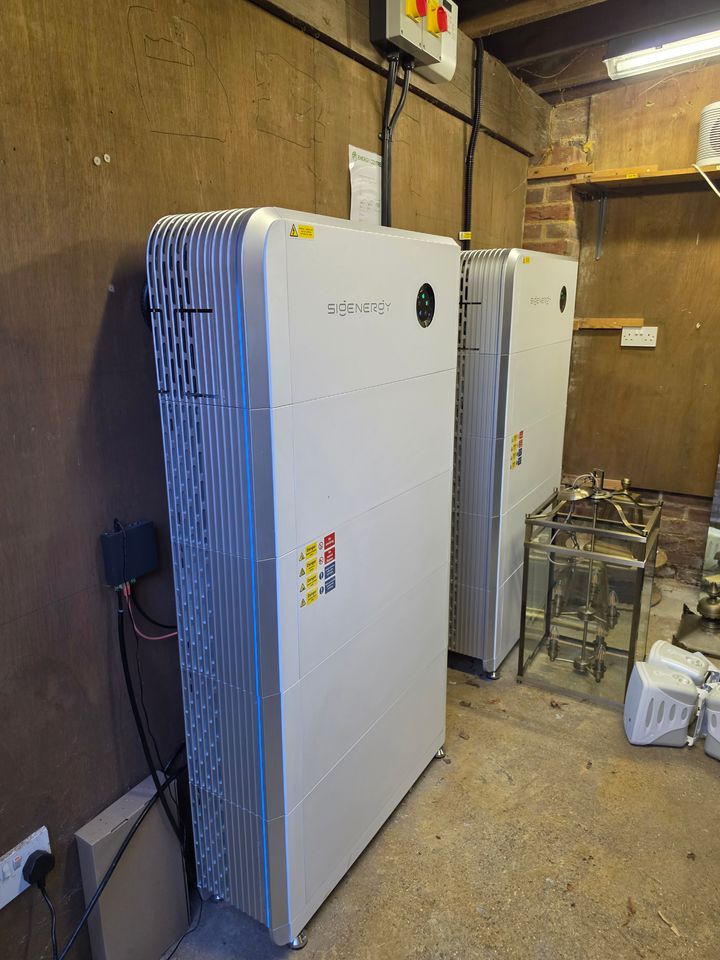
I went with a Sig system as we have regular power cuts, one being 4 hours about a week ago.l, only in surrey just outside a main town... I dont even know when were off grid until I get a notification via the app. Almost 1 year in and very impressed, we have 3ph power so can charge the system in about 4/ 5 hours overnight and run completely off batteries.
A big risk with automatic switch-over to battery is that you might not notice the power-cut. So you keep on happily running the oven/kettle/shower, then after a few hours you're down to 0%.
Several ways to handle this, if you think it's a potential problem. My current simple approach is to have a single battery-backed circuit/sockets, which runs freezers & low-power IT. If there's an extended power cut, I can easily connect up more things if necessary.
Several ways to handle this, if you think it's a potential problem. My current simple approach is to have a single battery-backed circuit/sockets, which runs freezers & low-power IT. If there's an extended power cut, I can easily connect up more things if necessary.
Just be aware that if you're tariff tarting, your battery might be pretty flat at the start of a power cut?
A battery is an expensive thing to keep charged 'just in case'.
Personally I think that off-peak tariffs will level out more as time goes on, as more people get home batteries and EVs.
There may be cheap power on sunny, windy Sundays, rather than every night.
For power cuts, you might be relatively comfortable with a fairly small battery and inverter that will run a few things.
E.g. fridge, CH pumps and boiler, lights TV, internet.
Add in a small generator and you can be full redneck prepper for a couple of grand.
You have to put limits on the calamity you're planning for.
Personally the last time I was inconvenienced by a power cut I just went to bed with a book and a torch.
Time before that, I was forced to change my lunch plans from 'go to pub' to 'drink wine on mate's boat'.
Seriously, if you get lots of power failures, the next one might be a long one.
It's different in the boondocks of Devon from the suburbs of commuterland. If I was in the McBoondocks of Scotland, I'd probably keep my generator serviced. As it is, I hope I have enough battery lights to get the genny going if needed!
It's different if you have tangible business costs with being offline for an hour or something.
I have a mate with a few business interests involving online presence and refrigerated food. If his lights go out, the rest of us are probably dead already.
A battery is an expensive thing to keep charged 'just in case'.
Personally I think that off-peak tariffs will level out more as time goes on, as more people get home batteries and EVs.
There may be cheap power on sunny, windy Sundays, rather than every night.
For power cuts, you might be relatively comfortable with a fairly small battery and inverter that will run a few things.
E.g. fridge, CH pumps and boiler, lights TV, internet.
Add in a small generator and you can be full redneck prepper for a couple of grand.
You have to put limits on the calamity you're planning for.
Personally the last time I was inconvenienced by a power cut I just went to bed with a book and a torch.
Time before that, I was forced to change my lunch plans from 'go to pub' to 'drink wine on mate's boat'.
Seriously, if you get lots of power failures, the next one might be a long one.
It's different in the boondocks of Devon from the suburbs of commuterland. If I was in the McBoondocks of Scotland, I'd probably keep my generator serviced. As it is, I hope I have enough battery lights to get the genny going if needed!
It's different if you have tangible business costs with being offline for an hour or something.
I have a mate with a few business interests involving online presence and refrigerated food. If his lights go out, the rest of us are probably dead already.
OutInTheShed said:
Personally I think that off-peak tariffs will level out more as time goes on, as more people get home batteries and EVs.
There may be cheap power on sunny, windy Sundays, rather than every night.
There may be cheap power on sunny, windy Sundays, rather than every night.
 There will always be the need for staggered tariffs to balance demand against supply, but I don't think we're going to see overnight rates an eighth of daytime ones again! I think buying a battery primarily for energy arbitrage is at risk of significant diminishing returns over its lifespan.
 Thanks everyone. Re tariffs and day night differences, that just makes the man maths easier to justify and I dont know what is out there yet.
I was fine with power cuts until I had a longish one earlier this year. Went to bed with torches and when the power came back, it woke me up with lights and other stuff on in the middle of the night. Quite a shock that I am keen not to repeat!
I was fine with power cuts until I had a longish one earlier this year. Went to bed with torches and when the power came back, it woke me up with lights and other stuff on in the middle of the night. Quite a shock that I am keen not to repeat!
We went Sig partly because of the app and anti fire measures - ours is fitted internally in the attached garage. A plus is its stackable units so can be added to at a later date if the wiring is laid out correctly to allow for expansion. We have 3 batteries, inverter on top, plus a separate Sig gateway - if the Goodwe above has a built in gateway it sounds like a neater option.
We’ve had power cuts since it’s been installed and the only way we’ve noticed is all the neighbours alarms going nuts.
We WFH and have had zero interruption to PC power etc, but you’d get that with a UPS for a few hundred quid.
I was told the Tesla can cause a brief dropout during switchover to battery power long enough to reset oven clocks etc - not sure if that’s correct but it’s worth clarifying.
You could do it way cheaper with Ecoflow, Fox etc, just depends on specs.
We’ve had power cuts since it’s been installed and the only way we’ve noticed is all the neighbours alarms going nuts.
We WFH and have had zero interruption to PC power etc, but you’d get that with a UPS for a few hundred quid.
I was told the Tesla can cause a brief dropout during switchover to battery power long enough to reset oven clocks etc - not sure if that’s correct but it’s worth clarifying.
You could do it way cheaper with Ecoflow, Fox etc, just depends on specs.
andy43 said:
If the Goodwe above has a built in gateway it sounds like a neater option.
It does, but it's only 63amp so not perfect for whole-home backup for heavy users. I believe they do do an external 100amp gateway as well. I believe Goodwe use a very similar fire suppression system to Sig too - a pack-level aerosol extinguisher on top of all the usual passive stuff (ours will also be mounted inside an integral garage). Not sure what Tesla have. Mind you, thermal runaway in LFP batteries is extremely rare anyway.
Edited by kambites on Thursday 20th August 09:49
kambites said:
OutInTheShed said:
Personally I think that off-peak tariffs will level out more as time goes on, as more people get home batteries and EVs.
There may be cheap power on sunny, windy Sundays, rather than every night.
There may be cheap power on sunny, windy Sundays, rather than every night.
There will always be the need for staggered tariffs to balance demand against supply, but I don't think we're going to see overnight rates an eighth of daytime ones again! I think buying a battery primarily for energy arbitrage is at risk of significant diminishing returns over its lifespan. A while back, to get a sensible price per kWh, you needed to be looking at 310Ah or so cells, which meant a 16kWh battery, costing well over grand just for the cells.
Now you can get a packaged 50Ah 48V battery for not much more than £300.
If you have a time of use tariff that penalises a couple of hours in the evening peak, you could use a small battery every day.
From what I've seen of wholesale electricity pricing, evening peak is much more 'real' than cheap overnight rates.
A small battery cycled often may pay for itself much quicker than a big battery that's lightly used.
You have to look at your own use patterns though, if your evening use is mostly a few bursts of a 10kW induction hob, or an electric shower, that's mostly coming from the mains regardless.
On the UPS side of the OP's question, it's a matter of what value you place on reliability of power.
I don't dismiss the value of the 'feelgood factor' that comes with knowing your lights are not going out and your computer won't stop working at a key moment. Putting a £number to it is a dark art though!
The company I spoke with said the sig has a lot more control features on the app than the Tesla. He didnt mention the fire stuff on any of them and I am planning on putting the battery outside on the external wall of the garage, so a fire would not be ideal but a lot better than inside the internal garage with my car in it and underneath the bathrooms and my bedroom!
Gassing Station | Homes, Gardens and DIY | Top of Page | What's New | My Stuff