
15A fuse to radiator fan relays 1 & 2 keeps blowing
Discussion


Hi,
Aside from my suspension issues, after putting the clutch and subframe back into the car, when I go to turn the key to the on position the 15A fuse feeding the radiator fan relays blows - it’s done this twice now. My electronics knowledge on cars is limited so I’ve got a guy coming out on Friday, but had anyone else here experienced a similar issue?
My guess is it’s an earthing issue but I was careful to reinstall everything. I’m worried I may have pinched or damaged a wire somewhere, or coolant may have damaged wires when it spilt out upon my changing the thermostat.
If there are some basic test I can do without trying the ecu I don’t mind giving it a go. Google suggest numerous options but don’t know where to start!
I have found a doc that has wiring diagrams and slowly trying to figure it out. The fuse is called INJ - here is the wiring diagrams doc:
https://fixmycarinfo.com/wp-content/plugins/pdfjs-...
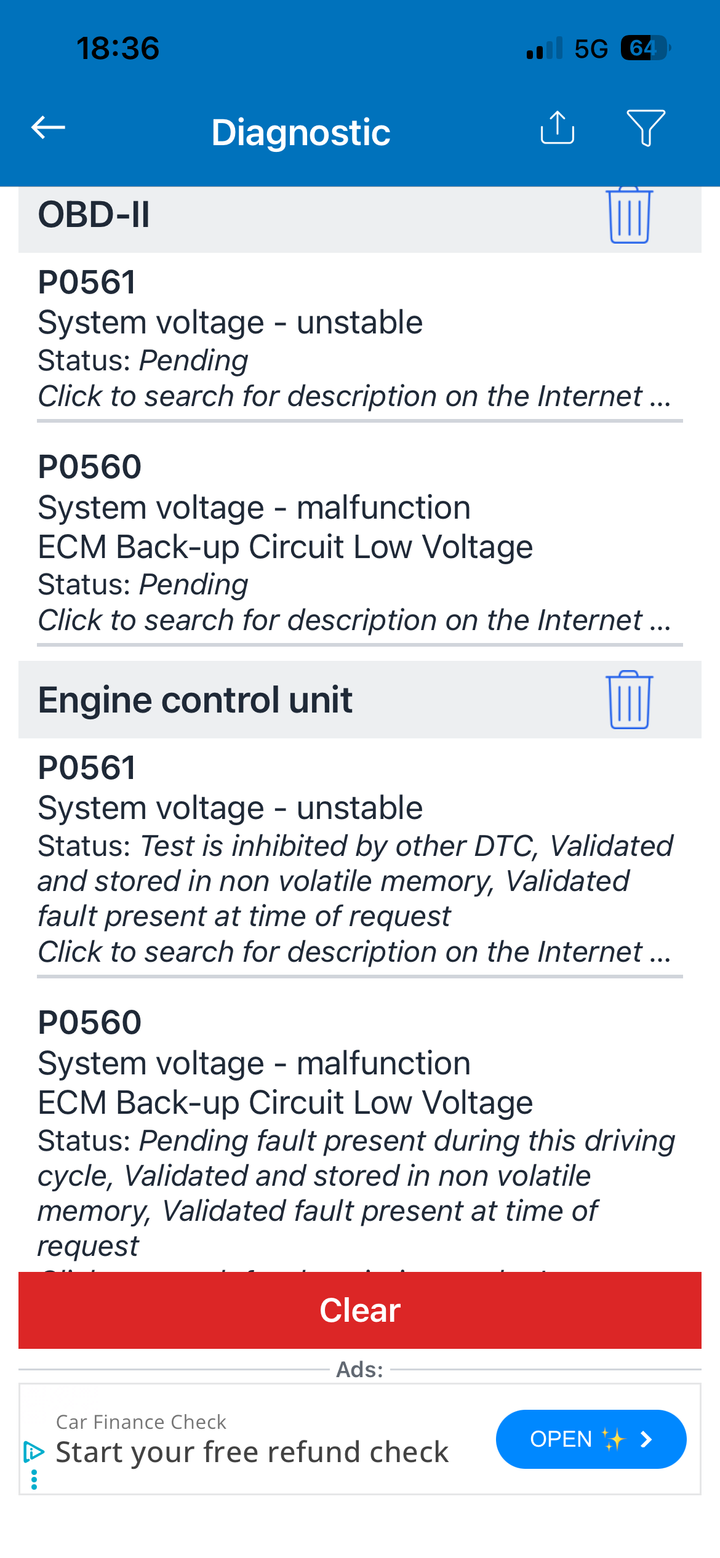
These are the error codes I’m getting:
Aside from my suspension issues, after putting the clutch and subframe back into the car, when I go to turn the key to the on position the 15A fuse feeding the radiator fan relays blows - it’s done this twice now. My electronics knowledge on cars is limited so I’ve got a guy coming out on Friday, but had anyone else here experienced a similar issue?
My guess is it’s an earthing issue but I was careful to reinstall everything. I’m worried I may have pinched or damaged a wire somewhere, or coolant may have damaged wires when it spilt out upon my changing the thermostat.
If there are some basic test I can do without trying the ecu I don’t mind giving it a go. Google suggest numerous options but don’t know where to start!
I have found a doc that has wiring diagrams and slowly trying to figure it out. The fuse is called INJ - here is the wiring diagrams doc:
https://fixmycarinfo.com/wp-content/plugins/pdfjs-...
These are the error codes I’m getting:
Can we assume that this wasn't a problem before the clutch work?
If so, a fuse blowing means an overload, which likely means a short to ground somewhere. Given that a lot of work has been done, and it is a new problem, I'd check the previous work done looking for a damaged wire/connector.
If so, a fuse blowing means an overload, which likely means a short to ground somewhere. Given that a lot of work has been done, and it is a new problem, I'd check the previous work done looking for a damaged wire/connector.
Thanks yes that’s correct it was fine before I did the work.
It’s such a small engine bay I’m dreading having to un do a lot of the work but it looks as though I’ve no option.
Would it make sense to start with the radiator fan wires or could it literally be anywhere? I have a cheap inspection camera I can try and use in hard to reach areas.
It’s such a small engine bay I’m dreading having to un do a lot of the work but it looks as though I’ve no option.
Would it make sense to start with the radiator fan wires or could it literally be anywhere? I have a cheap inspection camera I can try and use in hard to reach areas.
Peanut Gallery said:
Sounds like a wire trapped between two things - bellhousing and block - subframe and "frame" - I vote have a feel around and see if the wires going to the fan are stuck somewhere.
Great I’ll try this first.Is it possible there is another circuit on this fuse that’s causing the car not to start? I find it unusual a fan not working would stop the car from starting unless I have 2 issues.
bayzoo said:
Peanut Gallery said:
Sounds like a wire trapped between two things - bellhousing and block - subframe and "frame" - I vote have a feel around and see if the wires going to the fan are stuck somewhere.
Great I ll try this first.Is it possible there is another circuit on this fuse that s causing the car not to start? I find it unusual a fan not working would stop the car from starting unless I have 2 issues.
Richard-D said:
Please leave those wires alone. That fuse feeds the control side of the fan relay (amongst other things) and has nothing to do with the wires going to the fan. Being labelled INJ suggests to me it feeds the control side of more delays and probably the engine ECU. I haven't looked through the rest of the diagrams but you should follow the splice labelled SD120-5 in the I/P junction box (page 11).
Thanks - when you say follow the splice do you mean physically in the car or try to find another diagram in the doc? bayzoo said:
Thanks - when you say follow the splice do you mean physically in the car or try to find another diagram in the doc?
Follow in the diagram to see what else the fuse feeds.Whenever you have an electrical fault it's really important not to go touching wires and disconnecting things. If the fault disappears you won't know what you've done. This is particularly important with intermittent faults like yours. You need to find out what that fuse feeds so you can come up with a plan to chase the fault down.
And now this
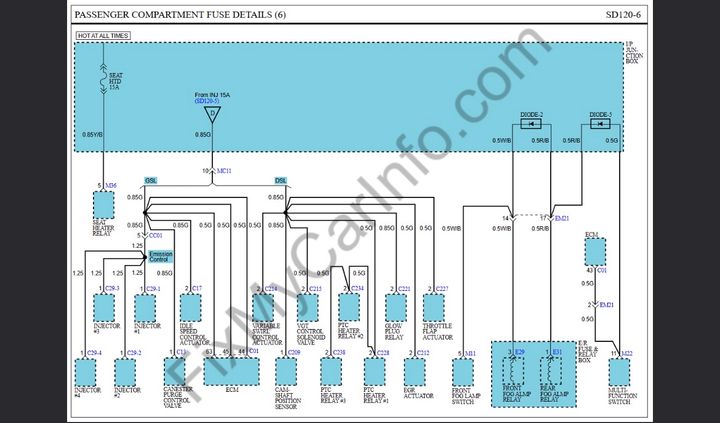
During this current job I did replace the idle speed control actuator. Could it be faulty? Thanks to your help though I’ve narrowed it down either the injectors, ECM, IAC valve, or emission control.
During this current job I did replace the idle speed control actuator. Could it be faulty? Thanks to your help though I’ve narrowed it down either the injectors, ECM, IAC valve, or emission control.
Edited by bayzoo on Monday 20th April 23:52
Edited by bayzoo on Monday 20th April 23:54
How consistently does it blow the fuse? Is it as soon as you turn the ignition on?
If so, at this point the easiest way to proceed (if you're not too hot with electronic diagnostics) would be to unplug all the items that run off that fuse except the ECU. Hopefully you can then turn the ignition on without blowing the fuse. Most of those should be easy enough to access (depends on the engine of course).
Once you've confirmed the ignition can be left on you can then test and/or reconnect items one by one until you find the short. It's better to test if possible as some of those are ECU controlled circuits, earth side switched from the ECU. It's possible to damage the ECU if it is switching a component that is shorted/draws excessive current.
If so, at this point the easiest way to proceed (if you're not too hot with electronic diagnostics) would be to unplug all the items that run off that fuse except the ECU. Hopefully you can then turn the ignition on without blowing the fuse. Most of those should be easy enough to access (depends on the engine of course).
Once you've confirmed the ignition can be left on you can then test and/or reconnect items one by one until you find the short. It's better to test if possible as some of those are ECU controlled circuits, earth side switched from the ECU. It's possible to damage the ECU if it is switching a component that is shorted/draws excessive current.
Richard-D said:
How consistently does it blow the fuse? Is it as soon as you turn the ignition on?
If so, at this point the easiest way to proceed (if you're not too hot with electronic diagnostics) would be to unplug all the items that run off that fuse except the ECU. Hopefully you can then turn the ignition on without blowing the fuse. Most of those should be easy enough to access (depends on the engine of course).
Once you've confirmed the ignition can be left on you can then test and/or reconnect items one by one until you find the short. It's better to test if possible as some of those are ECU controlled circuits, earth side switched from the ECU. It's possible to damage the ECU if it is switching a component that is shorted/draws excessive current.
Thanks - yes it’s a soon as the key is turned round to the one position (but not actually starting the car) that the fuse blows.If so, at this point the easiest way to proceed (if you're not too hot with electronic diagnostics) would be to unplug all the items that run off that fuse except the ECU. Hopefully you can then turn the ignition on without blowing the fuse. Most of those should be easy enough to access (depends on the engine of course).
Once you've confirmed the ignition can be left on you can then test and/or reconnect items one by one until you find the short. It's better to test if possible as some of those are ECU controlled circuits, earth side switched from the ECU. It's possible to damage the ECU if it is switching a component that is shorted/draws excessive current.
Will the above method mean I potentially have to go through quite a few fuses? I read also I can use a multimetre to check continuity so if it had a really low resistance then I know there is a short, I then unplug stuff one by one and once the resistance goes higher I’ve found my short?
bayzoo said:
Thanks - yes it s a soon as the key is turned round to the one position (but not actually starting the car) that the fuse blows.
Will the above method mean I potentially have to go through quite a few fuses? I read also I can use a multimetre to check continuity so if it had a really low resistance then I know there is a short, I then unplug stuff one by one and once the resistance goes higher I ve found my short?
Good, you have a permanent fault, that will make it easier.Will the above method mean I potentially have to go through quite a few fuses? I read also I can use a multimetre to check continuity so if it had a really low resistance then I know there is a short, I then unplug stuff one by one and once the resistance goes higher I ve found my short?
Some components will be testable with a multimeter whilst unplugged. For everything else it should only take 1 fuse as you'll be putting the ignition on and off every time you plug something in.
Remember the fan relays count as items too (the coil could be shorted) so that also needs to be unplugged.
The important thing is to first confirm that you can put the ignition on with the ECU connected (without the fuse blowing). So long as that's the case, it's likely to be something relatively easy/cheap.
bayzoo said:
Thanks - yes it s a soon as the key is turned round to the one position (but not actually starting the car) that the fuse blows.
Will the above method mean I potentially have to go through quite a few fuses? I read also I can use a multimetre to check continuity so if it had a really low resistance then I know there is a short, I then unplug stuff one by one and once the resistance goes higher I ve found my short?
Replace the fuse with a light bulb temporarily - something like an indicator bulb. It will light brightly as long as there is a short.Will the above method mean I potentially have to go through quite a few fuses? I read also I can use a multimetre to check continuity so if it had a really low resistance then I know there is a short, I then unplug stuff one by one and once the resistance goes higher I ve found my short?
You can then, carefully and gently, move sections of loom whilst watching for the bulb to go out.
If you can’t find a short on the loom, unplug the modules you have identified as being fed from the fuse one by one, again looking for the bulb to go out.
I was suspicious because it was one of two electrical items I replaced - the other being the reserve lamp switch on the gearbox. Once I discovered the IAC was on this circuit it do make me think the part might be defective. It was an unbranded part from eBay. Any non OEM parts generally make me suspicious! But they are worth the risk to save on paying dealer prices.
I replaced because the old one looked blocked up and it had a rough idle. It was a cheap part to replace (so I thought) so went ahead and changed it. Lesson learned…
I replaced because the old one looked blocked up and it had a rough idle. It was a cheap part to replace (so I thought) so went ahead and changed it. Lesson learned…
I thought you might say 'ebay part'. There are some things where lower quality parts are an option. My suggestion would be that engine sensors and control components are not in that list. A short on an ECU controlled item can easily destroy the driver within the ECU.
Fully understand why it seems worth the risk but for this type of component it just makes the inevitable purchase of the OEM part (at best) a bit more expensive.
Fully understand why it seems worth the risk but for this type of component it just makes the inevitable purchase of the OEM part (at best) a bit more expensive.
Gassing Station | Home Mechanics | Top of Page | What's New | My Stuff