
Sanding and refinishing floor help
Discussion


The finish on the flooring in our kitchen is quite tatty in high traffic/high UV areas and could really do with being sanded and refinished with something.
It was down when we moved in and I know nothing about flooring, below is a profile shot from under the kitchen cabinets.
What type of flooring is it? Is it safe to sand? It looks like there's a reasonably thick "top layer"?
For refinishing I was thinking something from Osmo? I used one of their products before when I redid the worktops and seemed like a good product.
Thanks in advance
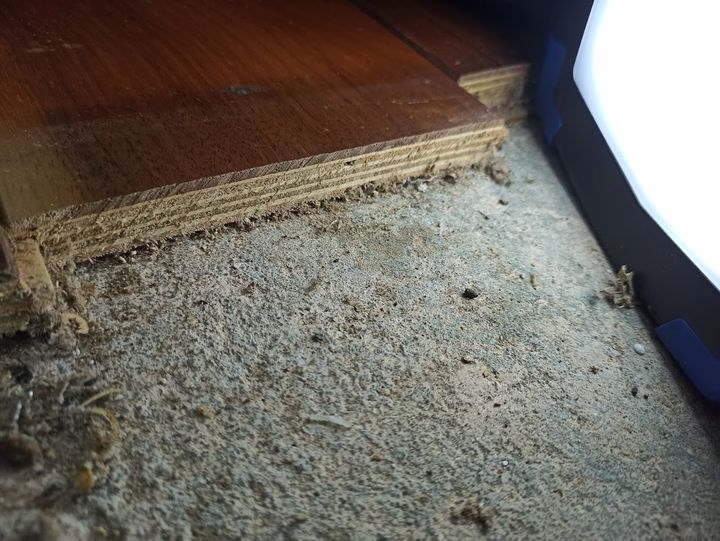
It was down when we moved in and I know nothing about flooring, below is a profile shot from under the kitchen cabinets.
What type of flooring is it? Is it safe to sand? It looks like there's a reasonably thick "top layer"?
For refinishing I was thinking something from Osmo? I used one of their products before when I redid the worktops and seemed like a good product.
Thanks in advance
I'd agree, it does look like engineered flooring with a couple of mm solid wood top. Steady away with sanding, as the big hire machines and coarse paper with gouge through in no time i'd have thought. I used osmo in our flat years ago, kitchen floor, solid maple. it gave a nice finish, but I personally didn't find it that hard wearing. I suppose the benefit is you can reapply with minimal fuss in the future.
The video link might show something you could tackle.
The benefit to you being that machine sanding and the potential pitfalls are avoided.
It should result in a good finish.
It's easy and quick to do.
Plus, if you weren't satisfied, it could still be sanded at a later point by yourself or if you wanted to get someone in to do the sanding.
https://www.youtube.com/watch?v=9IYkh4E2VUA
Yeah that's engineered flooring, but it looks to have a relatively thin top-layer so you'd have to be careful not to take too much off it or you'll go through to the plywood underneath.
I resanded and finished our engineered oak living room floor old and it's an easy enough job with the right tools (you'll want to hire a big drum sander for most of the floor and something smaller but still pretty beefy for the detail work), but it's VERY dusty. Extraction gets rid of the majority of the dust, but even 1% of a huge amount of dust is still quite a lot of dust! Ours had a 6mm top layer and I think sanding it back took off about 1-1.5mm of that.
I've used Treatex Hard Wax oil on all of our floors and can't really fault it. It was still fine in our living room after 15 years; I sanded it because I was extending it and didn't want an obvious join (it does darken significantly with age).
I resanded and finished our engineered oak living room floor old and it's an easy enough job with the right tools (you'll want to hire a big drum sander for most of the floor and something smaller but still pretty beefy for the detail work), but it's VERY dusty. Extraction gets rid of the majority of the dust, but even 1% of a huge amount of dust is still quite a lot of dust! Ours had a 6mm top layer and I think sanding it back took off about 1-1.5mm of that.
I've used Treatex Hard Wax oil on all of our floors and can't really fault it. It was still fine in our living room after 15 years; I sanded it because I was extending it and didn't want an obvious join (it does darken significantly with age).
Edited by kambites on Sunday 8th February 10:15
A lot may depend on two things.
How bad is it to start with?
What compromises in the finish will you accept?
Very often, a varnish (etc) finish that looks badly scratched will look vastly better with just a light rub down (400 grit?) and a coat or two of fresh varnish.
You can get a 'preview' of how it might look by wiping a section with white spirit, before it dries it will fill the surface as varnish does.
If the floor has had certain oil or wax treatments, then a clean with white spirit can do a lot.
I've had good results scraping wood floors rather than sanding. Sanding creates heat which melts wax and grime into the surface, scraping pulls the dirt out.
It's very easy to go too far with sanding machines, or to get an uneven surface.
One solid floor I did, there were a few deep gouges, would have taken a lot of sanding to get rid. So I just cleaned them out with a Dremel and varnished.
It looked fine, in the context of an 80 year old house.
Hand scraping a floor sounds like a lot of work, but really it's not so many hours.
A variation is scraping off the old varnish using a hot air gun.
Carbide scrapers are good. I have one which takes an old blade from an electric plane, cut in half with a dremel and the corners 'eased' a bit.
You have to experiment and see what works for you, on the actual job at hand.
These days I would use one of the water based floor varnishes, and aim to sand it back before the wear gets through the varnish.
My back ground includes wooden boats, so sanding, scraping and varnishing is seen as normal winter activity.
The best use of a belt sander is sharpening scrapers according to one of more skilled mates.
Another tip, get some samples of flooring from a shop and see how the various tools go.
How bad is it to start with?
What compromises in the finish will you accept?
Very often, a varnish (etc) finish that looks badly scratched will look vastly better with just a light rub down (400 grit?) and a coat or two of fresh varnish.
You can get a 'preview' of how it might look by wiping a section with white spirit, before it dries it will fill the surface as varnish does.
If the floor has had certain oil or wax treatments, then a clean with white spirit can do a lot.
I've had good results scraping wood floors rather than sanding. Sanding creates heat which melts wax and grime into the surface, scraping pulls the dirt out.
It's very easy to go too far with sanding machines, or to get an uneven surface.
One solid floor I did, there were a few deep gouges, would have taken a lot of sanding to get rid. So I just cleaned them out with a Dremel and varnished.
It looked fine, in the context of an 80 year old house.
Hand scraping a floor sounds like a lot of work, but really it's not so many hours.
A variation is scraping off the old varnish using a hot air gun.
Carbide scrapers are good. I have one which takes an old blade from an electric plane, cut in half with a dremel and the corners 'eased' a bit.
You have to experiment and see what works for you, on the actual job at hand.
These days I would use one of the water based floor varnishes, and aim to sand it back before the wear gets through the varnish.
My back ground includes wooden boats, so sanding, scraping and varnishing is seen as normal winter activity.
The best use of a belt sander is sharpening scrapers according to one of more skilled mates.
Another tip, get some samples of flooring from a shop and see how the various tools go.
OutInTheShed said:
These are from the sun damaged area.
Not sure what's going on here, the top layer which is flaking looks very thick to be a varnish?
Annoyingly, the half which doesn't get direct sun still looks fine.
Gassing Station | Homes, Gardens and DIY | Top of Page | What's New | My Stuff