
I've scratched the glass somehow! Ideas on cost to repair
Discussion


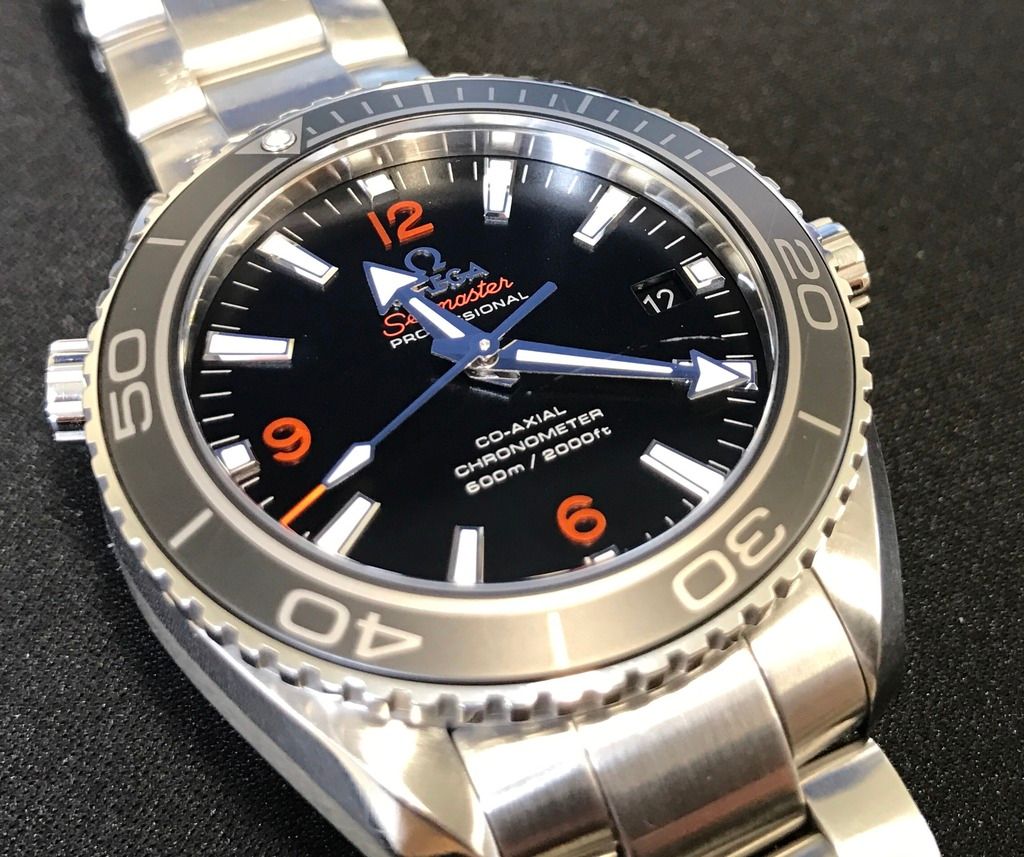
As you can see in the picture I've scratched the glass on my Seamaster PO right on top of the 4 o'clock marker and for a good 10mm. I haven't got a clue how I've done it and thought this glass was supposed to be bomb proof? Anyway, does anyone have an idea of how much I'm looking at to get it sorted? Ta.

counterofbeans said:
Will do. Thank you for thatIf that's a sapphire glass, as I suspect, then the polywatch, which is basically a polish, won't touch it because it is designed for softer plastic watch faces. Not many things will scratch a sapphire glass, the favourite is that possibly you have brushed against your wife's engagement ring and the diamond has scratched it. By all means try it though, or something like Solvol.
Jewellers use "jewellers' rouge" which is a polish containing extremely hard abrasives in various grades. They remove the initial scratch then go finer and finer until the marks are gone.
Jewellers use "jewellers' rouge" which is a polish containing extremely hard abrasives in various grades. They remove the initial scratch then go finer and finer until the marks are gone.
'Battered' above is correct.
Polywatch will not make a dent on sapphire (which that crystal is). It really takes a diamond, silicate or something of that ilk to scratch sapphire, so no amount of Polywatch & elbow grease will polish it out. If you want to have a bash, then first use brasso or some other abrasive polish that you already have lying around, rather than wasting money on the Polywatch.
How deep is the scratch? Is it finger-nail deep?
You might be lucky & have just scratched the Anti-Reflective (AR)Coating on top of the crystal. I have no idea though if Omega coat the outside of their crystal with AR, but if they do it's a thin layer to lessen light glare, and is much softer than the sapphire it rests on, so sometimes the AR coating can scratch but the sapphire below remain unblemished. If that's the case, then an abrasive polish might take-off the rest of the AR and leave just the untouched sapphire below. Rolex don't use an outside AR coating for this reason (and others).
If that fails, then it's a crystal replacement. No idea how much a Swatch service centre will charge for that - probably £100-£200 I'd have thought. A good watch-repairer could do it cheaper, but Swatch are becoming tighter with supplying their OEM parts to Third Parties. I suppose a none-OEM crystal would work, but you need to be sure it's done right, with the right gasket seal & proper pressure-testing etc., otherwise you run the expensive risk of a leaky dive-watch.
How old is the watch? If it hasn't been serviced in a while, then you'd be better waiting until the next overall service is due, and getting all the work done then, instead of being without it for two periods. That would require you to live with it for a while though, which is a pain.
Mr_C said:
That's going to be anti-reflective coated on both sides so I'd not take anything abrasive to it
Removing the outer layer of AR will still leave the inner, dial-side AR coating intact.Outer AR coating looks nice when new and does help reduce glare, and can even have a slightly coloured tint, but on the downside, it is softer than the sapphire crystal below, and prolonged hard use can leave scratches, spots & blemishes, which are unsightly.
It's really a trade-off - clearer & less glare, but prone to scratching vs. more 'blingy' crystal with more glare but harder to mark.
Plenty of watches (including some more expensive than Omega) do not apply an outer layer of AR coating on top of the crystal, for these reasons.
I agree, it's normally best left alone, but in the OP's case, it's perhaps worth a try if the alternative is forking-out for a whole new crystal anyway. If he plans to replace it anyway, nothing will have been lost, and removing the outer layer of AR will not cause harm, just leave a slightly more reflective surface look.
I suspect that the scratch is too deep to solve by just removing AR though.
Thanks for the information guys.
The scratch is deeper just above the 4 marker for about 3mm then fades out. Not sure on depth but it's minimal
I've had it about 3 years (I think) and it's never been in for service so perhaps I should get it booked in and have the glass repaired at the same time.
The scratch is deeper just above the 4 marker for about 3mm then fades out. Not sure on depth but it's minimal
I've had it about 3 years (I think) and it's never been in for service so perhaps I should get it booked in and have the glass repaired at the same time.
frg530 said:
Thanks for the information guys.
I've had it about 3 years (I think) and it's never been in for service so perhaps I should get it booked in and have the glass repaired at the same time.
That's what I did when I did something similar to my Rolex SD - think a new glass/crystal was around £70 so not the end of the worldI've had it about 3 years (I think) and it's never been in for service so perhaps I should get it booked in and have the glass repaired at the same time.
Do nothing!
It's not that noticeable, you just know it's there so it'll bother you for a little while until you come to terms with it and thank it for getting you past the "first damage" point.
Replace the glass and sod's law says you'll scratch the new one. It's a sure bet!!
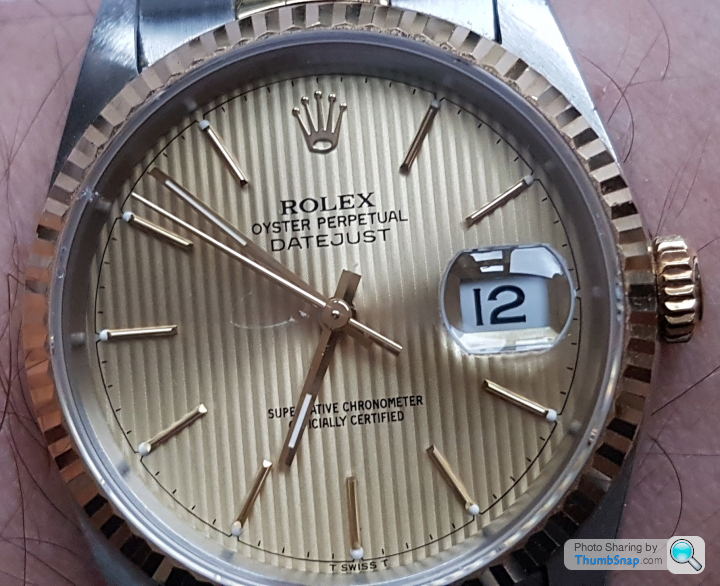
My OP DJ is my daily wearer, and it has a scratch in the centre and chips around the edge. Once you have your first scratch/chip you don't notice the others arriving - saves a bundle on new glass!...
It's not that noticeable, you just know it's there so it'll bother you for a little while until you come to terms with it and thank it for getting you past the "first damage" point.
Replace the glass and sod's law says you'll scratch the new one. It's a sure bet!!
My OP DJ is my daily wearer, and it has a scratch in the centre and chips around the edge. Once you have your first scratch/chip you don't notice the others arriving - saves a bundle on new glass!...
That is the best policy. Watches live on your wrist, they will get worn and occasionally scratched. In the case of a dive watch, you can wear them in very hostile envirnments. So scuffs are to be expected. Wear it until it needs a service, then sort it out if necessary.
I have a daily wear Seiko, it's a field watch. I really like it but after 4 years or so it's collecting a few scuffs. Wear them with pride. I might be concerned if it were a JLC Reverso, where "strenuous use" means taking the stairs to the office, but for outdoorsy watches they *should* have a mark or two after a couple of years.
I have a daily wear Seiko, it's a field watch. I really like it but after 4 years or so it's collecting a few scuffs. Wear them with pride. I might be concerned if it were a JLC Reverso, where "strenuous use" means taking the stairs to the office, but for outdoorsy watches they *should* have a mark or two after a couple of years.

frg530 said:
Yes, it's due a service, 3-5 years is the Omega recommendation. There's nothing else wrong with it, I hope.
I'm in the "if it ain't broke..." camp.14 years without a service and my Rolex hasn't missed a beat.
But I'd probably do the same if I decided to get the glass replaced. Get it serviced at the same time. Or vice-versa.
There's quite a bit of wear/damage that can still be taking place even if a watch is running well, outside the recommended service period. Even Rolex, renowned for their bullet-proof movements, suffer from a known issue whereby the auto-winding system wears more quickly (as for efficiency/quietness of winding reasons, their most common movements don't use the more robust ball-bearing rotor support that most others do), which can lead to the rotor sagging & hitting the movement plates.
I do generally agree though with the "if it ain't broke" approach, so if nothing was untoward, I'd stretch the service interval to 7-10 years, especially so on a watch used only lightly in rotation.
The co-axial escapement used by Omega in that Planet Ocean is *supposedly* in need of servicing less often than the industry-standard 5 years, but that's debated (and even if so, the rest of the movement is still wearing like a regular movement, if to a slightly lesser degree), and the co-axial needs to be accurately oiled to function well, so a general 4-year service along with the crystal replacement isn't the worst idea in the world.
Whilst normally I'd say wait a couple of years until servicing, at four years you're on the cusp of considering a movement service in the near future anyway, so unless you're happy to stare at the scratch for another 12-18 months, you may as well just do the whole lot now, rather than have the hassle of two service waits, one for the crystal change, and another in 2-3 years for the general service.
A bit of a pain, and expensive, but at least you'll be good to go for another 7 years or so (unless you have another mishap!).
As an aside, if you use that watch in the water at all, you're recommended to have a seals/pressure check by now anyway, so at least you'll have the peace of mind that the watch is water-tight & warrantied as such.
It's a lovely watch as well.
UnclePat said:
There's quite a bit of wear/damage that can still be taking place even if a watch is running well, outside the recommended service period. Even Rolex, renowned for their bullet-proof movements, suffer from a known issue whereby the auto-winding system wears more quickly (as for efficiency/quietness of winding reasons, their most common movements don't use the more robust ball-bearing rotor support that most others do), which can lead to the rotor sagging & hitting the movement plates.
I do generally agree though with the "if it ain't broke" approach, so if nothing was untoward, I'd stretch the service interval to 7-10 years, especially so on a watch used only lightly in rotation.
The co-axial escapement used by Omega in that Planet Ocean is *supposedly* in need of servicing less often than the industry-standard 5 years, but that's debated (and even if so, the rest of the movement is still wearing like a regular movement, if to a slightly lesser degree), and the co-axial needs to be accurately oiled to function well, so a general 4-year service along with the crystal replacement isn't the worst idea in the world.
Whilst normally I'd say wait a couple of years until servicing, at four years you're on the cusp of considering a movement service in the near future anyway, so unless you're happy to stare at the scratch for another 12-18 months, you may as well just do the whole lot now, rather than have the hassle of two service waits, one for the crystal change, and another in 2-3 years for the general service.
A bit of a pain, and expensive, but at least you'll be good to go for another 7 years or so (unless you have another mishap!).
As an aside, if you use that watch in the water at all, you're recommended to have a seals/pressure check by now anyway, so at least you'll have the peace of mind that the watch is water-tight & warrantied as such.
It's a lovely watch as well.
Thanks for the information there, I like my watches but I'm not so clued up when it comes to understanding what's required aside from just wearing them. I do generally agree though with the "if it ain't broke" approach, so if nothing was untoward, I'd stretch the service interval to 7-10 years, especially so on a watch used only lightly in rotation.
The co-axial escapement used by Omega in that Planet Ocean is *supposedly* in need of servicing less often than the industry-standard 5 years, but that's debated (and even if so, the rest of the movement is still wearing like a regular movement, if to a slightly lesser degree), and the co-axial needs to be accurately oiled to function well, so a general 4-year service along with the crystal replacement isn't the worst idea in the world.
Whilst normally I'd say wait a couple of years until servicing, at four years you're on the cusp of considering a movement service in the near future anyway, so unless you're happy to stare at the scratch for another 12-18 months, you may as well just do the whole lot now, rather than have the hassle of two service waits, one for the crystal change, and another in 2-3 years for the general service.
A bit of a pain, and expensive, but at least you'll be good to go for another 7 years or so (unless you have another mishap!).
As an aside, if you use that watch in the water at all, you're recommended to have a seals/pressure check by now anyway, so at least you'll have the peace of mind that the watch is water-tight & warrantied as such.
It's a lovely watch as well.
I rotate them so the PO only really gets worn for a week every 4 weeks or so. I tend not to use it in water as I can't be doing with the stainless bracelet on it when I'm on holiday, it doesn't have a fine adjuster and my wrist swells a bit with the heat so it becomes hard to wear it.
Whizz it over in the post to http://www.swisstimeservices.co.uk
They've repaired mine a couple of times and I've always been pleasantly surprised at the costs.
They've repaired mine a couple of times and I've always been pleasantly surprised at the costs.
UnclePat said:
There's quite a bit of wear/damage that can still be taking place even if a watch is running well, outside the recommended service period. Even Rolex, renowned for their bullet-proof movements, suffer from a known issue whereby the auto-winding system wears more quickly (as for efficiency/quietness of winding reasons, their most common movements don't use the more robust ball-bearing rotor support that most others do), which can lead to the rotor sagging & hitting the movement plates.
I do generally agree though with the "if it ain't broke" approach, so if nothing was untoward, I'd stretch the service interval to 7-10 years, especially so on a watch used only lightly in rotation.
The co-axial escapement used by Omega in that Planet Ocean is *supposedly* in need of servicing less often than the industry-standard 5 years, but that's debated (and even if so, the rest of the movement is still wearing like a regular movement, if to a slightly lesser degree), and the co-axial needs to be accurately oiled to function well, so a general 4-year service along with the crystal replacement isn't the worst idea in the world.
Whilst normally I'd say wait a couple of years until servicing, at four years you're on the cusp of considering a movement service in the near future anyway, so unless you're happy to stare at the scratch for another 12-18 months, you may as well just do the whole lot now, rather than have the hassle of two service waits, one for the crystal change, and another in 2-3 years for the general service.
A bit of a pain, and expensive, but at least you'll be good to go for another 7 years or so (unless you have another mishap!).
As an aside, if you use that watch in the water at all, you're recommended to have a seals/pressure check by now anyway, so at least you'll have the peace of mind that the watch is water-tight & warrantied as such.
It's a lovely watch as well.
Now I have more than one watch I'm a little concerned about not wearing the DJ and it "going off", hence buying a watch winder recently. A bit like having a Porsche and not driving it regularly. We'll see...I do generally agree though with the "if it ain't broke" approach, so if nothing was untoward, I'd stretch the service interval to 7-10 years, especially so on a watch used only lightly in rotation.
The co-axial escapement used by Omega in that Planet Ocean is *supposedly* in need of servicing less often than the industry-standard 5 years, but that's debated (and even if so, the rest of the movement is still wearing like a regular movement, if to a slightly lesser degree), and the co-axial needs to be accurately oiled to function well, so a general 4-year service along with the crystal replacement isn't the worst idea in the world.
Whilst normally I'd say wait a couple of years until servicing, at four years you're on the cusp of considering a movement service in the near future anyway, so unless you're happy to stare at the scratch for another 12-18 months, you may as well just do the whole lot now, rather than have the hassle of two service waits, one for the crystal change, and another in 2-3 years for the general service.
A bit of a pain, and expensive, but at least you'll be good to go for another 7 years or so (unless you have another mishap!).
As an aside, if you use that watch in the water at all, you're recommended to have a seals/pressure check by now anyway, so at least you'll have the peace of mind that the watch is water-tight & warrantied as such.
It's a lovely watch as well.
Gassing Station | Watches | Top of Page | What's New | My Stuff