
Discussion


Hi Max. The part number would have been on a sticky label or plastic tag. Neither were on mine but in any event they would have related to the vehicle it was intended for. There is a number stamped on the edge of the casing. It’s not very clear but it looks like 5750 2b but at a guess I’d say this is a batch number not a part number.
What you're looking for is a Fiesta Mk3 servo. The Ford identification label should show the number 4049404 89FB-DB. Like this.
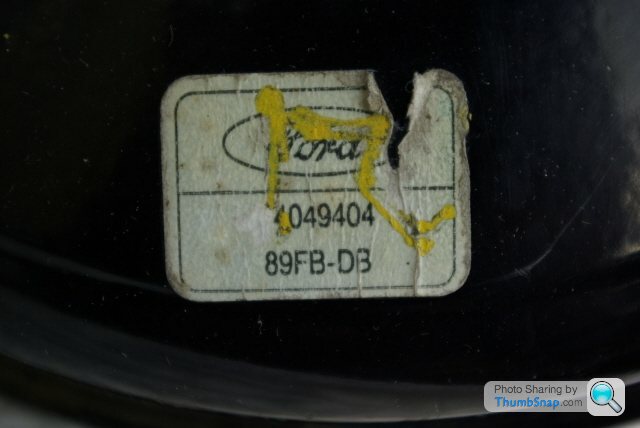
As you know the master cylinder needs to have a 22.2mm bore (it's stamped on the mounting bracket).
There were probably many 100’s of thousands of these “cans” made for different applications so it’s should just be a matter of tracking one down and (hopefully!) swapping the plunger. I can’t believe they would have had different spring rates for different applications.
What you're looking for is a Fiesta Mk3 servo. The Ford identification label should show the number 4049404 89FB-DB. Like this.
As you know the master cylinder needs to have a 22.2mm bore (it's stamped on the mounting bracket).
There were probably many 100’s of thousands of these “cans” made for different applications so it’s should just be a matter of tracking one down and (hopefully!) swapping the plunger. I can’t believe they would have had different spring rates for different applications.
Edited by v8s4me on Saturday 31st August 20:56
PeteGriff is looking at alternatives servos for the Griff/Chim/S. He's starting with the Ka servo as this is used on the later cars.
I'd drop him a link to this thread on his update thread - http://www.pistonheads.com/gassing/topic.asp?h=0&a...
Sure he'd be interested to take a look.
Gary
I'd drop him a link to this thread on his update thread - http://www.pistonheads.com/gassing/topic.asp?h=0&a...
Sure he'd be interested to take a look.
Gary

v8s4me said:
I found this at an autojumble last weekend. The “can” is right but clearly the “spike” has to come off. These units were obviously made for a wide range of vehicles with just the plunger arrangement being changed to suit the application. Does anyone know how to get this off?


JoeThat is the same one I purchased from my local motor factors, they had it in their "unidentifiable parts" box but said it most probably came off a van, as you would expect with a long input shaft. I got a friend to cut down the shaft and make a sleeve that went over the cut down shaft, with the U-shaped end of the old servo welded to it. Obviously one could not weld the servo directly as it would kill the diaphragm.
v8s4me said:
So presumably the new fork is just held in place by the pedal and the cut off end of the old rod? Is there ant play between the new sleeved fork and the end of the rod or were you super accurate with the measuring?
JoeThe sleeve is bolted to the shaft. The measurement was quite precise but upon can adjust the actuator on the servo.
v8s4me said:
How did you bolt the sleeve to the shaft? have you got a photo?
Potentially then, the solution is to make up a batch of sleeved forks which owners can attach to the shaft of what ever servo they can find with the right mountings at a sensible price?
Sorry Joe it is up inside the footwell now; but just a bolt through the sleeve and the shortened shaft, if that makes sense.Potentially then, the solution is to make up a batch of sleeved forks which owners can attach to the shaft of what ever servo they can find with the right mountings at a sensible price?
AutoAndy said:
What are they like without servos though? Its not a heavy car, so wouldn't sorted (ie bled and non spongy brake lines) regualr unservo'd brakes work well enough?
Try telling your insurance company that!When I replaced my servo the old (saab) master cylinder actually fitted on the new ford servo but it stuck the brakes on, just because it fits doesn't mean it will work without the right master cylinder?
phillpot said:
Have you ever been towed, engine not running?
Try clamping the vacuum hose flat and take a little (cautious) test drive ?
But why.Try clamping the vacuum hose flat and take a little (cautious) test drive ?
My old triumph didn't have a servo and it would have been a heavier car. Brakes were ok, and even better when the rubber hoses were replaced with braded ones
You’d need a different type of master cylinder. One which would give you the pressure you need without servo assistance.
Just had a quick trawl on Ebay for “Ford servo”. There’s loads on there and here’s just three
http://www.ebay.co.uk/itm/FORD-FIESTA-MK6-MK7-BRAK...
http://www.ebay.co.uk/itm/2003-FORD-FOCUS-LX-BRAKE...
http://www.ebay.co.uk/itm/BRAND-NEW-BRAKE-SERVO-FO...
I can’t believe one of these couldn’t be adapted to suit.
Just had a quick trawl on Ebay for “Ford servo”. There’s loads on there and here’s just three
http://www.ebay.co.uk/itm/FORD-FIESTA-MK6-MK7-BRAK...
http://www.ebay.co.uk/itm/2003-FORD-FOCUS-LX-BRAKE...
http://www.ebay.co.uk/itm/BRAND-NEW-BRAKE-SERVO-FO...
I can’t believe one of these couldn’t be adapted to suit.
What sort of Triumph?
Servo's became common place with the arrival of disc brakes although many cars (smaller/cheaper) didn't have one or it was optional.
With a twin leading shoe drum brake once the lining contacts the drum the rotation of the drum in effect pulls the lining against the drum, you don't get that effect with discs so a greater pedal pressure is generally required.
Don't think a lot of race cars use a servo but that is a very different type of driving and braking?
Similarly a lot (all?) older cars didn't have a brake balance valve between front and rear but perhaps brakes weren't so good back then, you needed all the brakes you could get front and back

Gassing Station | S Series | Top of Page | What's New | My Stuff