
Who invented the Shuttle?
Discussion


Simpo Two said:
Think what we might have achieved had two world wars not bankrupted us and destroyed the empire.
Kaiser Bill has a lot to answer for.
Then again, a hell of a lot of what we have achieved in terms of engineering and scientific research is a direct result of the two world wars (and the cold war of course).Kaiser Bill has a lot to answer for.
Perhaps if that work had started a few years earlier, the RAF could have retained the deterrent force by replacing the V-bombers with an orbital bombardment system? Given what's been spent on Polaris, Chevaline and Trident over the years it doesn't seen that farfetched. That way the UK would have retained and built on all the work done on Blue Steel/Black Prince/ELDO and been well-placed to cash in on the satellite boom.
The notion of a manned, orbital or semi-orbital bomber goes back to World War 2. As ever in rocketry, there were two approaches, winged or ballistic.
The winged concept came from the minds of Eugene Sanger and Irene Bredt

The ballistic concept came (naturally) from the Von Braun team at Peenemunde and was based on developments of the V2 -
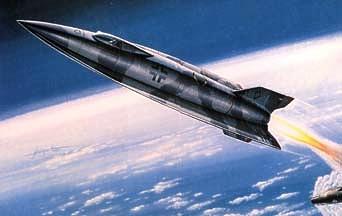
I wouldn't have fancied my chances in either of them.
The winged concept came from the minds of Eugene Sanger and Irene Bredt
The ballistic concept came (naturally) from the Von Braun team at Peenemunde and was based on developments of the V2 -
I wouldn't have fancied my chances in either of them.
I think it would have got a bit toasty on the way back into the atmosphere. The one thing that was a complete unknown in the 1940s was the protection of a vehicle from the heat or re-entry.
And as we saw with Columbia, it is not something you can ignore even when you have designed a workable heat shield.
And as we saw with Columbia, it is not something you can ignore even when you have designed a workable heat shield.
Eric Mc said:
I think it would have got a bit toasty on the way back into the atmosphere. The one thing that was a complete unknown in the 1940s was the protection of a vehicle from the heat or re-entry.
For along time many sci-fi authors, some of whom should have known better, stuck with the 'turn round and come down backwards slowly' idea.Forgetting completely that to do that they would have to carry into orbit the same fuel load, and weight, that they had used to carry themselves into orbit in the first place.
In fact, they would need to carry even more weight into orbit because the initial launch weight would also need to go up in order to carry the weight of the descent fuel. In other words, launch weight would spiral out of control.
In fact, they would need to carry even more weight into orbit because the initial launch weight would also need to go up in order to carry the weight of the descent fuel. In other words, launch weight would spiral out of control.
I was reading 'Fifth Planet' by Geoffrey Hoyle recently. It featured a rocket that took off from Earth, travelled to a planet in another solar system, landed backwards, then they made a new rocket from the old one, took off, travelled back to Earth and, yep, landed backwards onto a prepared landing site.
It was written in 1963, when things like escape velocity and gravitation were well known.
It was written in 1963, when things like escape velocity and gravitation were well known.
Eric Mc said:
Forgetting completely that to do that they would have to carry into orbit the same fuel load, and weight, that they had used to carry themselves into orbit in the first place.
In fact, they would need to carry even more weight into orbit because the initial launch weight would also need to go up in order to carry the weight of the descent fuel. In other words, launch weight would spiral out of control.
No you don't. You winch down from an orbital body, using CNT 'rope' ;DIn fact, they would need to carry even more weight into orbit because the initial launch weight would also need to go up in order to carry the weight of the descent fuel. In other words, launch weight would spiral out of control.
I wish people wouldn't keep blathering on about Space Elevators. They may happen, one day, but they are a long way away in the futuire and for the moment (at least the next 50 years - perhaps longer) rockets will be the way into space.
I've been interested in the Space Elevator idea since I read Arthur C Clarke's "The Fountains of Paradise" way back in 1979 - so I don't discount the idea at all.
I've been interested in the Space Elevator idea since I read Arthur C Clarke's "The Fountains of Paradise" way back in 1979 - so I don't discount the idea at all.
Eric Mc said:
I think it would have got a bit toasty on the way back into the atmosphere. The one thing that was a complete unknown in the 1940s was the protection of a vehicle from the heat or re-entry.
And as we saw with Columbia, it is not something you can ignore even when you have designed a workable heat shield.
What's a little heat when you have men in sheds.And as we saw with Columbia, it is not something you can ignore even when you have designed a workable heat shield.
http://en.wikipedia.org/wiki/Starlite
PRTVR said:
Eric Mc said:
I think it would have got a bit toasty on the way back into the atmosphere. The one thing that was a complete unknown in the 1940s was the protection of a vehicle from the heat or re-entry.
And as we saw with Columbia, it is not something you can ignore even when you have designed a workable heat shield.
What's a little heat when you have men in sheds.And as we saw with Columbia, it is not something you can ignore even when you have designed a workable heat shield.
http://en.wikipedia.org/wiki/Starlite
MartG said:
PRTVR said:
Eric Mc said:
I think it would have got a bit toasty on the way back into the atmosphere. The one thing that was a complete unknown in the 1940s was the protection of a vehicle from the heat or re-entry.
And as we saw with Columbia, it is not something you can ignore even when you have designed a workable heat shield.
What's a little heat when you have men in sheds.And as we saw with Columbia, it is not something you can ignore even when you have designed a workable heat shield.
http://en.wikipedia.org/wiki/Starlite
hidetheelephants said:
What, no orbital space gun then?  Presumably we've still got the bits; some of it is in Duxford IWM. All we need is a budding Gerald Bull to put it together!
That wasn't a space gun, just a f Presumably we've still got the bits; some of it is in Duxford IWM. All we need is a budding Gerald Bull to put it together!  k off big barrel to fire stuff at Israel or wherever.
I don't think a space gun could really work - you'd have to accelerate from 0 to some phenomenal velocity in the space of the length of the barrel in order to be at something like 20,000mph at orbital height. And that's AFTER flying through all the drag associated with the denser air at low altitudes.
Gassing Station | Boats, Planes & Trains | Top of Page | What's New | My Stuff