
Shooting Jupiter
Discussion


Whilst walking my daughter back from school this evening, I noticed that the brightest star in the sky was not twinkling....so it was not a star.
When home I checked it's position with my Ipad and it is Jupiter. I was amazed that I could see it so clearly. So I rushed upstairs and got my camera, tripod and zoom lens and set it up.
Here are the images that I came up with. I realise that some on here will have far better pics, but I am still in awe of the fact that I have seen the planet with my naked eye, yet alone taken a pic of it.


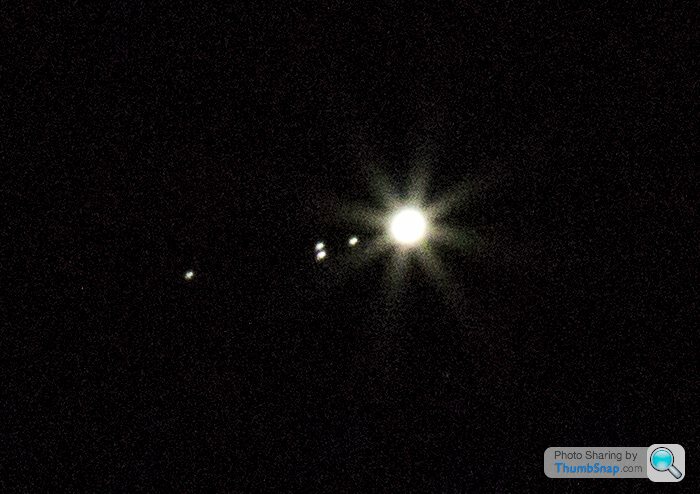
Are the dots to the left some of Jupiters moons? If so I will be amazed that my standard equipment has managed to capture them.
Here is a quick pic of one of our moons.

When home I checked it's position with my Ipad and it is Jupiter. I was amazed that I could see it so clearly. So I rushed upstairs and got my camera, tripod and zoom lens and set it up.
Here are the images that I came up with. I realise that some on here will have far better pics, but I am still in awe of the fact that I have seen the planet with my naked eye, yet alone taken a pic of it.
Are the dots to the left some of Jupiters moons? If so I will be amazed that my standard equipment has managed to capture them.
Here is a quick pic of one of our moons.
They are 4 of the 60 odd moons, Io, Callisto, Europa and Ganymede.
Jupiter is particularly good tonight, through the telescope I can quite clearly see the Great Red Spot in one its cloud bands
Just out of interest, focal length and settings for the Jupiter pics?
Jupiter is particularly good tonight, through the telescope I can quite clearly see the Great Red Spot in one its cloud bands
Just out of interest, focal length and settings for the Jupiter pics?
Edited by nellyleelephant on Monday 5th December 18:44
Simpo Two said:
I may not do astronomy but I'm fairly sure we only have one moon!
We have two moons apparentely, well according to QI. Not sure how genuine this is.Edited to add that it is highly disputed, but there are up to seven objects that follow our orbit, but they are not strictly moons.
Edited by Zaxxon on Monday 5th December 18:38
Kit used:
Cannon 550d
100-400 4.5- 5.6
Manfrotto 190
Edited by Zaxxon on Monday 5th December 18:41
Thems the four Galileo have named after him. Not individually but as the four that most can see with a bit of help.
We only have 1, QI was being a bit pedantic as they do at times.
Here is the culprit
http://www.orbitsimulator.com/gravity/articles/cru...
We only have 1, QI was being a bit pedantic as they do at times.
Here is the culprit
http://www.orbitsimulator.com/gravity/articles/cru...
Edited by jmorgan on Monday 5th December 18:46
ben_h100 said:
Great pics Zaxxon!
I'm hoping this clear weather lasts another night or so as I'm planning on heading out tomorrow to get (attempt!) some moon shots. Should be okay with a 300mm?
Thankyou, 300 should be great but there are threads here by those who know far more than I do ref taking moon shots.I'm hoping this clear weather lasts another night or so as I'm planning on heading out tomorrow to get (attempt!) some moon shots. Should be okay with a 300mm?
Settings that I used were
F/14
ISO 1600
.8 sec
Zaxxon said:
Thankyou, 300 should be great but there are threads here by those who know far more than I do ref taking moon shots.
Settings that I used were
F/14
ISO 1600
.8 sec
You want a faster shutter than .8 really. Settings that I used were
F/14
ISO 1600
.8 sec
The moon is a very bright object 1/500 would be better for a sharper image.
DIW35 said:
And just to let you know that the reason stars usually twinkle is because of poor atmospheric conditions. It has nothing to do with whether you are looking at a genuine star or planet.
Whhhhaaattttt? Bugger. Any other cornerstone facts from my childhood that you want to demolish? 
The planets zip across the view of a telescope eyepiece rediculously quickly at high magnifications. One of the best ways to capture shots of planets is to use a modified webcam and capture video then stack the images in to one picture:
http://stargazerslounge.com/imaging-planetary/1653...
http://stargazerslounge.com/imaging-planetary/1653...
Nuclearsquash said:
The planets zip across the view of a telescope eyepiece rediculously quickly at high magnifications. One of the best ways to capture shots of planets is to use a modified webcam and capture video then stack the images in to one picture:
http://stargazerslounge.com/imaging-planetary/1653...
Webcams are the easiest ways to get the planets.http://stargazerslounge.com/imaging-planetary/1653...
This was from 2 minutes ish of exposures then 15 ish minutes of PP

Gassing Station | Photography & Video | Top of Page | What's New | My Stuff