
Rolling roads and transmission losses?
Discussion


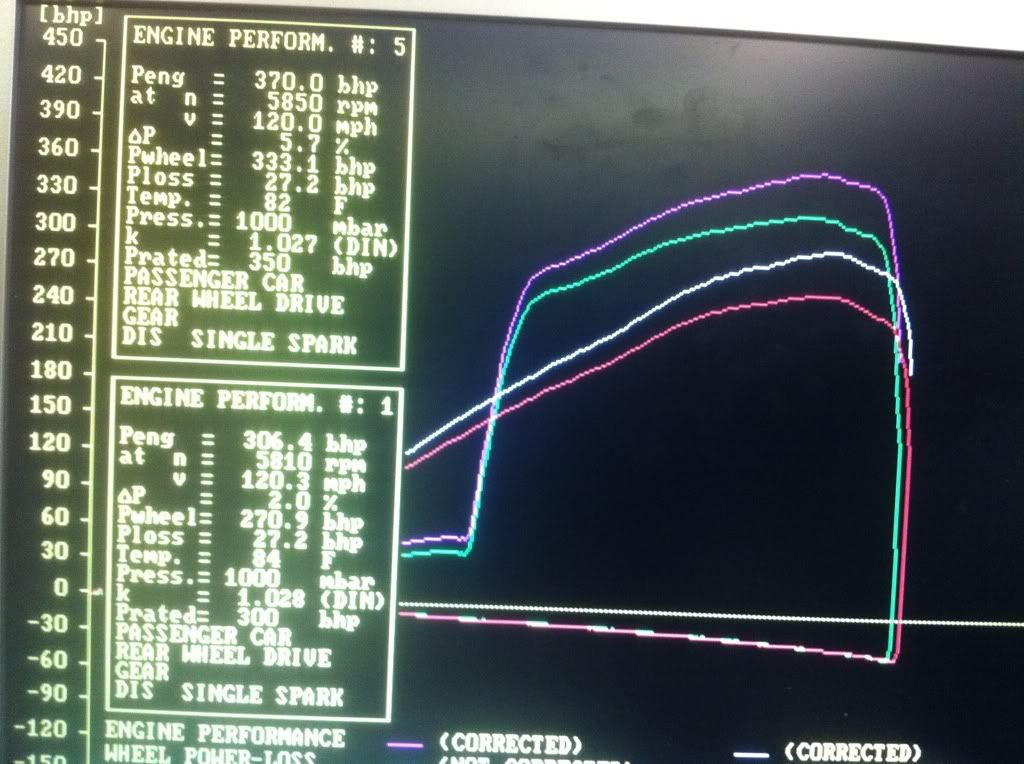
The bottom box seems to suggest a loss of 27BHP - although Ploss is exactly the same in both runs...? (seems far too low for the nitrous run?)
The non-nitrous run looks like Pwheels=270 and Pengine=306, which suggests a loss of 36BHP...
36/270 is a bit more than 13%, but it would still appear to be less than 16% as you say...
O/T - what cam is this BTW?
Dom
The non-nitrous run looks like Pwheels=270 and Pengine=306, which suggests a loss of 36BHP...
36/270 is a bit more than 13%, but it would still appear to be less than 16% as you say...
O/T - what cam is this BTW?
Dom
dbv8 said:
As i remember the coast down procedure ran each power run.
I had to lift a wheel arch to keep the exhaust mounting from scoring the rollers
I'd hate to get into a physics argument. But.... Would that reduce the rolling resistance of the tyre on that corner, and thus skew the result?I had to lift a wheel arch to keep the exhaust mounting from scoring the rollers
Munter said:
I'd hate to get into a physics argument. But.... Would that reduce the rolling resistance of the tyre on that corner, and thus skew the result?
Hmmm? I doubt it would have a great effect. I actually lifted the car just slightly from the front wheel arch. It was enough to stop the nasty noise as the car coated down.It wasnt necessary on every run.
Interesting note... i had a closer look at the plots i have here and the nitrous system gave an initial bhp increase of 85 bhp from activation tailing to 65 bhp at peak.
The torque curve literally shoots to 419.7 @ 3500 dropping to about 300 lb @ 6000.
It certainly felt impressive on the drag strip Saturday for what is a mild shot of gas.
dvs_dave said:
Coast down is not a very good measure of transmission losses as the transmission is unloaded. A fully loaded transmission as when on the power run absorbs more power.
So are you saying the wheel bhp is correct and the corrected flywheel numbers may be artificially low?Cool. Maybe i should see what numbers i get at certain other TVR specialists

Alexdaredevilz said:
If your that worried just try 3 different rolling roads and take a average
I dont worry about the RR numbers too much Alex. As long as you go to the same place and its consistant then you know the results.It does seem to me that bigger numbers can be had by choosing your RR carefully however
I leave the 1/4 mile to do my talking.
dbv8 said:
So are you saying the wheel bhp is correct and the corrected flywheel numbers may be artificially low?
Cool. Maybe i should see what numbers i get at certain other TVR specialists
Wheel hp is the only number worth paying any attention to on any dyno as it's an absolute measure of the actual power the car is capable of delivering to the road surface. Afterall, it's the power delivered to this interface and only this interface that results in the car moving down the road.Cool. Maybe i should see what numbers i get at certain other TVR specialists
Any attempt to calculate back to the flywheel hp has so many sources of error and fudge factors, it's a waste of time.
dbv8 said:
As i remember the coast down procedure ran each power run.
I had to lift a wheel arch to keep the exhaust mounting from scoring the rollers
If some thing was dragging on the power run, then you lift the car you may scew it, you would be taking load off the tyres also?I had to lift a wheel arch to keep the exhaust mounting from scoring the rollers
this would give you lower losses.
Brummmie said:
If some thing was dragging on the power run, then you lift the car you may scew it, you would be taking load off the tyres also?
this would give you lower losses.
Not on the power run but on the coast down Paul.this would give you lower losses.
For the pub i will take the wheels bhp and divide by .84 to allow 16% drivetrain losses.
So 270.9 @ wheels NA = 322.5 @ fly
and 333.1 @ wheels on gas = 396.5 @ fly

dbv8 said:
Not on the power run but on the coast down Paul.
For the pub i will take the wheels bhp and divide by .84 to allow 16% drivetrain losses.
So 270.9 @ wheels NA = 322.5 @ fly
and 333.1 @ wheels on gas = 396.5 @ fly
The coast down gives you the loss calculation!!For the pub i will take the wheels bhp and divide by .84 to allow 16% drivetrain losses.
So 270.9 @ wheels NA = 322.5 @ fly
and 333.1 @ wheels on gas = 396.5 @ fly
If you put your red budgie smugglers on the outside, and lifted the whole car on coast down, the losses would calculate zero.. Capeesh?
Edited by Brummmie on Wednesday 5th October 09:13
Brummmie said:
The coast down gives you the loss calculation!!
If you put your red budgie smugglers on the outside, and lifted the whole car on coast down, the losses would calculate zero.. Capeesh?
I agree with the second point but 'loss calculation'??? The rollers cant measure at the fly then take it off for the wheels.If you put your red budgie smugglers on the outside, and lifted the whole car on coast down, the losses would calculate zero.. Capeesh?
Edited by Brummmie on Wednesday 5th October 09:13
The coast down is an estimation of drivtrain losses that is then added to the wheel bhp to give a flywheel figure surely.
Hence my comments above.

Brummmie said:
Use the same dyno, and use the power at the wheels every time you do a mod...
I concur 
Its the point i was making about all the pub talk about flywheel figures.
All rolling roads are different, some more so than others and i think some garnish there results to please.
It all comes out in the wash in the end.
Gassing Station | General TVR Stuff & Gossip | Top of Page | What's New | My Stuff