
PCV or Crankcase Ventilation present
Discussion


Hi,
I have a 2013 Renault Master van (UK model) it has 96,000 miles on clock and I need to service it again soon. I would like to know if this vehcile has a PCV or some sort of pressure control\ventilation valve on the engine\crankcase please? If so, can you help me identify it please - perhaps send a link to one? Is it possible to service it or will it need replaced? There is a littlle oild here and there around the engine when I look under the bonnet\hood, also, sometimes there is some fluid leaking a very little that appears to be from where the sump is
Thank you
Alan
I have a 2013 Renault Master van (UK model) it has 96,000 miles on clock and I need to service it again soon. I would like to know if this vehcile has a PCV or some sort of pressure control\ventilation valve on the engine\crankcase please? If so, can you help me identify it please - perhaps send a link to one? Is it possible to service it or will it need replaced? There is a littlle oild here and there around the engine when I look under the bonnet\hood, also, sometimes there is some fluid leaking a very little that appears to be from where the sump is
Thank you
Alan
Thanks for reply. I think it is a RENAULT Master III Van 2.3 dCi FWD Diesel 125 hp. Thats what shows when I put my regsitration into a site like autodoc
Can you send me a link or image so I know what to loof for please? How do I know if it needs replaced? can it be serviced\cleaned?
Thanks
Can you send me a link or image so I know what to loof for please? How do I know if it needs replaced? can it be serviced\cleaned?
Thanks
Hi,
I have no experience directly of this van, but when you search its showing this as a general description/image
https://www.autodoc.co.uk/swag/23277250
They are always generally a round plastic part with a thin hose coming out of it, on the top of the engine on or around the valve cover, on the ones you can remove and that aren't build into the rocker cover they are simply a push/pull fit. But it looks like on your van it may be build into the plastic rocker cover which is also common.
An easy way to check is to remove the oil filler cap while the engine is running and place the palm of your hand or a piece of paper over the filler and see if there is a vacuum there, you want a slight vacuum where you can feel it sucking on your hand or the sheet of paper, but not excessive, likewise if there is positive pressure and not a vacuum thats also a sign of a failed PCV.
Generally you tend to have sluggish performance with a feeling like the car may stall and a lot of oil in air intake pipes, you can also get a smoky exhaust. It's a common part that needs replacing with a lot of different symptoms. Generally a sluggish running car with signs of excessive oil use, or a lot of oil residue around air intake areas is a sign it needs replacing. The push/pull ones tend to be really cheap so are a good easy part to swap out to see if it solves problems, but not such a cheap part to swap out when its build into the rocker cover. They have a life and they do need replacing over the life of a vehicle.
I hope that helps a little, maybe post a photo of the valve cover in your vehicle if my google search didn't help and we can try to circle it, but look on the valve cover and check where all the small diameter pipes connect to it and you will find it, not so easy on a build in one as a simple push/pull one, so that may be why its not so obvious to you.
I have no experience directly of this van, but when you search its showing this as a general description/image
https://www.autodoc.co.uk/swag/23277250
They are always generally a round plastic part with a thin hose coming out of it, on the top of the engine on or around the valve cover, on the ones you can remove and that aren't build into the rocker cover they are simply a push/pull fit. But it looks like on your van it may be build into the plastic rocker cover which is also common.
An easy way to check is to remove the oil filler cap while the engine is running and place the palm of your hand or a piece of paper over the filler and see if there is a vacuum there, you want a slight vacuum where you can feel it sucking on your hand or the sheet of paper, but not excessive, likewise if there is positive pressure and not a vacuum thats also a sign of a failed PCV.
Generally you tend to have sluggish performance with a feeling like the car may stall and a lot of oil in air intake pipes, you can also get a smoky exhaust. It's a common part that needs replacing with a lot of different symptoms. Generally a sluggish running car with signs of excessive oil use, or a lot of oil residue around air intake areas is a sign it needs replacing. The push/pull ones tend to be really cheap so are a good easy part to swap out to see if it solves problems, but not such a cheap part to swap out when its build into the rocker cover. They have a life and they do need replacing over the life of a vehicle.
I hope that helps a little, maybe post a photo of the valve cover in your vehicle if my google search didn't help and we can try to circle it, but look on the valve cover and check where all the small diameter pipes connect to it and you will find it, not so easy on a build in one as a simple push/pull one, so that may be why its not so obvious to you.
Hi,
Thanks for this feedback - really helpful. I am a new DIY mechanic, simply because repairs frim garages in UK are very expensive. Hence I want to know some more things to do when I next service the van.
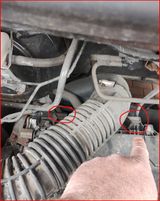
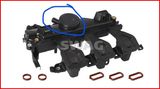
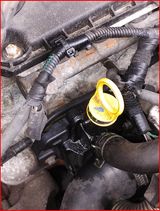
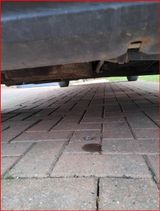
See images - one is what I think is same PCV valve as you found in link at autodoc, you can see the two areas that resemble the one in link, plus behind the pipe from air filter there is the part circled in blue in image of new PCV valve. I have attached images of oil leaking around the oil check level, plus there is a consisitent fluid leak from around roughly where sump is but this does NOT really leave an oil stain - it dries fairly clean.
I plan to replace the sump and gasket soon. I did as you said - started engine then removed the oil filler cap and used a thick piece of paper I covered the filler cap opening. There was no suction pressure in the way or push pressure out the way. What does this mean please? Although the engine was only just started and not running hot
Thanks in advance
Thanks for this feedback - really helpful. I am a new DIY mechanic, simply because repairs frim garages in UK are very expensive. Hence I want to know some more things to do when I next service the van.
See images - one is what I think is same PCV valve as you found in link at autodoc, you can see the two areas that resemble the one in link, plus behind the pipe from air filter there is the part circled in blue in image of new PCV valve. I have attached images of oil leaking around the oil check level, plus there is a consisitent fluid leak from around roughly where sump is but this does NOT really leave an oil stain - it dries fairly clean.
I plan to replace the sump and gasket soon. I did as you said - started engine then removed the oil filler cap and used a thick piece of paper I covered the filler cap opening. There was no suction pressure in the way or push pressure out the way. What does this mean please? Although the engine was only just started and not running hot
Thanks in advance
Gassing Station | Home Mechanics | Top of Page | What's New | My Stuff