
Anyone got a water softner?
Discussion


I'm thinking of getting a water softner but a plumber has told me i need a seperate cold supply for drinking water- not a problem i thought until i started thinking about the cold going to the bathrooms for teeth brushing, plumbing another cold feed to them off the main would be a nightmare.
He said that they are filtered with salt which i understand but surely it doesnt make the water into saltwater otherwise the salt would leave worse residues than the limescale.
Anyone have one? How does it work?
He said that they are filtered with salt which i understand but surely it doesnt make the water into saltwater otherwise the salt would leave worse residues than the limescale.
Anyone have one? How does it work?
Until Ferg gets here:
You only need one 'normal' cold water supply, usually a single tap in the kitchen. You can drink softened water, but some people think it tastes funny. The tap also means that if the softener goes bang, you still have water.
The calcium ions that cause hardness are removed by an ion-exchange process. After a while the resin involved gets saturated and the salt is used to replenish it. It doesn't get into the water supply.
You only need one 'normal' cold water supply, usually a single tap in the kitchen. You can drink softened water, but some people think it tastes funny. The tap also means that if the softener goes bang, you still have water.
The calcium ions that cause hardness are removed by an ion-exchange process. After a while the resin involved gets saturated and the salt is used to replenish it. It doesn't get into the water supply.
I had one which packed up so I removed it. Wish I'd replaced it and probably will, soon.
How do they work? God wills it.
Or, the salt somehow softens the water by beating the lime and chlorine molecules against tinytinytiny rocks until they tenderise. The casing of the softener is lined with insulation so you can't hear the molecules screaming.
Next week, nukuler fission.
How do they work? God wills it.
Or, the salt somehow softens the water by beating the lime and chlorine molecules against tinytinytiny rocks until they tenderise. The casing of the softener is lined with insulation so you can't hear the molecules screaming.
Next week, nukuler fission.
Thanks for the help, it makes my life a lot easier.
So in reality all i need to do is tee off into the softner after the tap cold feed.
The water is really hard round here, a ph of just over 8 iirc from my days of keeping corals. I have a black ceramic sink and when its clean it looks stunning (i,m not joking i actually polish and wax it) , however literally a few drops of water and it looks filth, i,m hoping to put a stop to that, along with the nasty marks on the taps etc.
So in reality all i need to do is tee off into the softner after the tap cold feed.
The water is really hard round here, a ph of just over 8 iirc from my days of keeping corals. I have a black ceramic sink and when its clean it looks stunning (i,m not joking i actually polish and wax it) , however literally a few drops of water and it looks filth, i,m hoping to put a stop to that, along with the nasty marks on the taps etc.
I installed a Tapworks AD11 softener recently. It comes with a set of valves that allow you to bypass the softener in case of problems. It works out when it needs to regenerate according to use (has a flowmeter inside, so it doesn't needlessly use the salt supply up).
I also bought a 3 way kitchen tap that allows unsoftened water for drinking, plus the usual hot and cold (softened) taps. The tap came with an inline filter, a bit like a Brita, for the drinking water tap feed as an added feature, though this isn't strictly necessary.
The water in the softener passes through a chamber containing resin which in layman's terms 'absorbs' the calcium and magnesium which makes water 'hard'. The salt is used to creat brine which is then used in the regenaration process (kind of 'refreshing' the resin if you like), so there really shouldn't be a salty taste to the water unless it's faulty. I brush my teeth upstairs using softened water and don't notice any strange tastes, though my neighbour tells me his softened water does have a slight taste, he has a different model to mine.
So far it seems a good move as our showers don't look like they've been sprayed with milk and left to dry, I washed my car with softened water and didn't need to dry it off afterwards, plus the battle with scale on the bath, shower trays, etc seems to be over. Glad we got one, though the water is particularly hard in my area, so I probably see the most benefit.
Bought ours from here:
http://www.buyaparcel.com/pageview.php?page=show_p...
I also bought a 3 way kitchen tap that allows unsoftened water for drinking, plus the usual hot and cold (softened) taps. The tap came with an inline filter, a bit like a Brita, for the drinking water tap feed as an added feature, though this isn't strictly necessary.
The water in the softener passes through a chamber containing resin which in layman's terms 'absorbs' the calcium and magnesium which makes water 'hard'. The salt is used to creat brine which is then used in the regenaration process (kind of 'refreshing' the resin if you like), so there really shouldn't be a salty taste to the water unless it's faulty. I brush my teeth upstairs using softened water and don't notice any strange tastes, though my neighbour tells me his softened water does have a slight taste, he has a different model to mine.
So far it seems a good move as our showers don't look like they've been sprayed with milk and left to dry, I washed my car with softened water and didn't need to dry it off afterwards, plus the battle with scale on the bath, shower trays, etc seems to be over. Glad we got one, though the water is particularly hard in my area, so I probably see the most benefit.
Bought ours from here:
http://www.buyaparcel.com/pageview.php?page=show_p...
Good stuff on this thread.
Just to clarify:
Ion exchange water softeners EXCHANGE calcium and magnesium hardness ions for sodium ions.
You shouldn't be able to taste the salt in the water, BUT anyone on a low-sodium diet (and babies under 6 months in particular) should steer clear of drinking it.
Just to clarify:
Ion exchange water softeners EXCHANGE calcium and magnesium hardness ions for sodium ions.
You shouldn't be able to taste the salt in the water, BUT anyone on a low-sodium diet (and babies under 6 months in particular) should steer clear of drinking it.
Yes, Ferg's right, I was just trying to keep it simple with my 'absorbing' comments.
I found these two pictures from before the worktops were fitted. You can see that these are quite big items, which explains why mine is in a strange position (I discovered it would fit under the sink,or rather under the drainer by the sink, but I'd never be able to remove it if it breaks down ). I've had to squeeze it in a 500 wide cupboard with a 150 wide access door instead. I can reach the valves to bypass it if necessary and I use a spare length of drain pipe to 'aim' the salt tablets down into the chamber. If it ever goes wrong/needs maintenance I'll just have to put out the adjacent dishwasher to get it out (which is better than trying to remove a sink!).

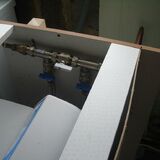
I know the back of the cupboard is pushed out a bit in the picture, but it's OK now, before anyone comments.
I found these two pictures from before the worktops were fitted. You can see that these are quite big items, which explains why mine is in a strange position (I discovered it would fit under the sink,or rather under the drainer by the sink, but I'd never be able to remove it if it breaks down
). I've had to squeeze it in a 500 wide cupboard with a 150 wide access door instead. I can reach the valves to bypass it if necessary and I use a spare length of drain pipe to 'aim' the salt tablets down into the chamber. If it ever goes wrong/needs maintenance I'll just have to put out the adjacent dishwasher to get it out (which is better than trying to remove a sink!).I know the back of the cupboard is pushed out a bit in the picture, but it's OK now, before anyone comments.
Edited by OldSkoolRS on Monday 12th July 20:06
m3jappa said:
So in reality all i need to do is tee off into the softner after the tap cold feed.
Yep, that's exactly what we have. One goes to the tap in the sink and the other to the softener which then feeds the rest of the house. And you can get quite simple little "drinking tap" kits with also built in filters too.
We have a 'Monach midi', which has been superb so far.
The added bonus of a water softner, as well easy cleaning and stop pipes from furring up, is that if you or your family suffer from extreemly itchy dry skin, this can 'cure' you (note; as soon as you go back to 'hard water' the condition returns).
The added bonus of a water softner, as well easy cleaning and stop pipes from furring up, is that if you or your family suffer from extreemly itchy dry skin, this can 'cure' you (note; as soon as you go back to 'hard water' the condition returns).
One of the reasons I didn't rush to replace ours was that it takes up a fair bit of room in a kitchen already pushed for storage space. Are there any units that could be installed (say) in the loft with an automatic hopper or feed for salt?
Actually that's a b ks question as even if it only needed topping up once a fortnight I'd soon be sick of it. Any other ideas?
Actually that's a b
ks question as even if it only needed topping up once a fortnight I'd soon be sick of it. Any other ideas?The problem is you want to fit the thing next to your rising main. (Main pressurised water inlet to your house).
You then plumb in diversions that provide regular water to your outside tap, regular water to a tap in your kitchen sink (usually) as this is often where the rising main is, and then takes the water off your softener and back and then on to the rest of the house.
This means your loos, showers, upstairs bathrooms, and heating systems are all running softened water, which is what you want, as it means they won't be caking up so badly with limescale.
Often the diversion has taps on it, much like the fittings for washing machines and dishwashers, to allow the softener to be removed without a plumber and taken away for servicing, replacement or even to a new house!
We have a Kinetico block salt softener that does not require electrical power - it all comes from the water pressure. On balance I'd recommend it - even if it isn't quite potent enough to deal with the dreadful Hampshire water. The block salt is convenient and ours is a twin-chamber unit that can recharge (flush the ion-exchange-resin-beady-whatevers with brine) one whilst using the other. There's never any danger of getting brine in your softened water supply. I imagine most softeners have features for that by now...
You then plumb in diversions that provide regular water to your outside tap, regular water to a tap in your kitchen sink (usually) as this is often where the rising main is, and then takes the water off your softener and back and then on to the rest of the house.
This means your loos, showers, upstairs bathrooms, and heating systems are all running softened water, which is what you want, as it means they won't be caking up so badly with limescale.
Often the diversion has taps on it, much like the fittings for washing machines and dishwashers, to allow the softener to be removed without a plumber and taken away for servicing, replacement or even to a new house!
We have a Kinetico block salt softener that does not require electrical power - it all comes from the water pressure. On balance I'd recommend it - even if it isn't quite potent enough to deal with the dreadful Hampshire water. The block salt is convenient and ours is a twin-chamber unit that can recharge (flush the ion-exchange-resin-beady-whatevers with brine) one whilst using the other. There's never any danger of getting brine in your softened water supply. I imagine most softeners have features for that by now...
Gassing Station | Homes, Gardens and DIY | Top of Page | What's New | My Stuff