
How to identify a load bearing wall?
Discussion


Is there any way to identify a load bearing wall without enlisting the services of a structural engineer? We want to remove the "pantry" in the kitchen, labelled as "Cupboard" in grey below by taking out where I've marked in blue, and perhaps also the short wall to the left of the hob, which is like an archway into the utility room. The walls seem to be solid block built, but it is an older property built 1955.
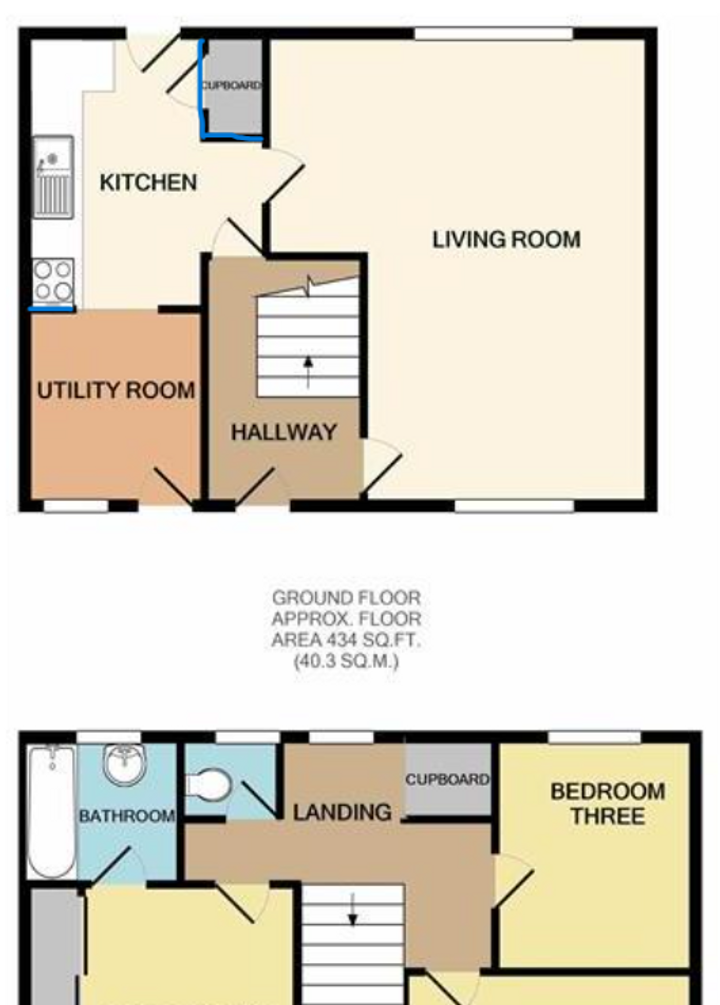
The first thing you need to know is which way the floor joist run. Parallel with a wall, very unlikely to be load bearing. Perpendicular to the wall, possibly, but more details will be required.
I’d be amazed if the pantry is supporting anything. There is a possibility the return by the utility could be, but if it is, there would likely be a visible beam above the arch, but equally the beam could be in the ceiling.
You will need to be making holes to check what is going where and what is sitting on what.
I’d be amazed if the pantry is supporting anything. There is a possibility the return by the utility could be, but if it is, there would likely be a visible beam above the arch, but equally the beam could be in the ceiling.
You will need to be making holes to check what is going where and what is sitting on what.

GT6k said:
In my 1960s house the plasterboard runs over the top of the non load bearing walls whereas the load bearing walls have the joists resting on them. I would remove some of the plasterboard at the top of the pantry wall and see if it is holding anything up.
He said the walls seem to be solid block. megaphone said:
GT6k said:
In my 1960s house the plasterboard runs over the top of the non load bearing walls whereas the load bearing walls have the joists resting on them. I would remove some of the plasterboard at the top of the pantry wall and see if it is holding anything up.
He said the walls seem to be solid block. The block-built pantry was simply butted up underneath the plasterboard before we took it out.
chris1roll said:
megaphone said:
GT6k said:
In my 1960s house the plasterboard runs over the top of the non load bearing walls whereas the load bearing walls have the joists resting on them. I would remove some of the plasterboard at the top of the pantry wall and see if it is holding anything up.
He said the walls seem to be solid block. The block-built pantry was simply butted up underneath the plasterboard before we took it out.
chris1roll said:
megaphone said:
GT6k said:
In my 1960s house the plasterboard runs over the top of the non load bearing walls whereas the load bearing walls have the joists resting on them. I would remove some of the plasterboard at the top of the pantry wall and see if it is holding anything up.
He said the walls seem to be solid block. The block-built pantry was simply butted up underneath the plasterboard before we took it out.
TA14 said:
chris1roll said:
megaphone said:
GT6k said:
In my 1960s house the plasterboard runs over the top of the non load bearing walls whereas the load bearing walls have the joists resting on them. I would remove some of the plasterboard at the top of the pantry wall and see if it is holding anything up.
He said the walls seem to be solid block. The block-built pantry was simply butted up underneath the plasterboard before we took it out.
 )
)Gassing Station | Homes, Gardens and DIY | Top of Page | What's New | My Stuff