
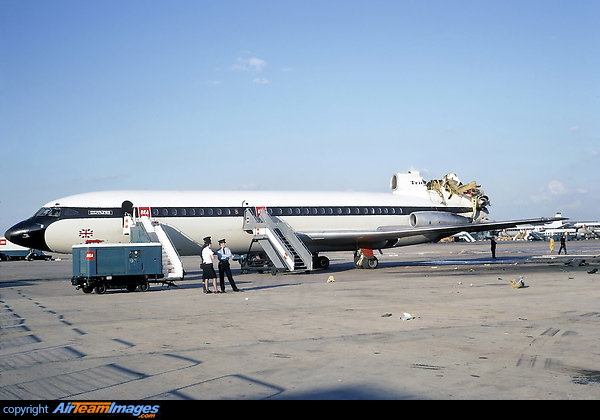
Trident Papa India- 50 years tomorrow (18 June)
Discussion


Jonathan01n said:
50 years ago was the most serious aviation disaster in British soil till this day
We will always have them in our hearts.
My Dad was a serving copper at the time, and was close by the western side of KGV reservoir when it passed almost over him about 15 secs before it impacted, and he got to the crash site about 6-7 mins after it crashed, because there was no fireball Dad wasn't sure that it had crashed or not, but guessed it had by the sudden silence.We will always have them in our hearts.
It was the 2nd air crash site he'd attended during his police service.
Link for those (like me) who want to read more about the accident:
https://en.wikipedia.org/wiki/British_European_Air...
https://en.wikipedia.org/wiki/British_European_Air...
My mum was supposed to be on that flight, she was a BEA stewardess in the 60'/70's before leaving to have me in 1974. Very sobering to think that without a roster change neither she, nor I, would be here today.
In a strange twist, years ago I had a weekend job cleaning and polishing a privately owned collection of vintage fire engines, which at the time were housed in a large building out the back of a Surrey garden centre which my mum frequented. In the collection was a Dennis, 1 AMX, which was the first fire appliance on scene at the Papa India crash.
Bit headspinny, and thoughts to everyone affected by that crash.
In a strange twist, years ago I had a weekend job cleaning and polishing a privately owned collection of vintage fire engines, which at the time were housed in a large building out the back of a Surrey garden centre which my mum frequented. In the collection was a Dennis, 1 AMX, which was the first fire appliance on scene at the Papa India crash.
Bit headspinny, and thoughts to everyone affected by that crash.
It was a very traumatic event and happened just after I had started "reggie spotting" as a teenage plane spotter. I could never look at my list of "bagged" BEA (and later BA) Trident ICs and not forget the accident that claimed Papa India and its unfortunate passengers and crew.
The accident itself led to some changes to British airliner safety regulations, including the installation of cockpit voice recorders. Even though they were available in 1972, they had not been fitted to BEA Tridents - partly on cost grounds and partly due to opposition from the pilots' union. After the accident nobody objected.
One of the teachers from my school lost his brother in the crash. It was carrying a contingent of Irish civil servants to Brussels as part of the pre EEC entry negotiations.
The accident itself led to some changes to British airliner safety regulations, including the installation of cockpit voice recorders. Even though they were available in 1972, they had not been fitted to BEA Tridents - partly on cost grounds and partly due to opposition from the pilots' union. After the accident nobody objected.
One of the teachers from my school lost his brother in the crash. It was carrying a contingent of Irish civil servants to Brussels as part of the pre EEC entry negotiations.
Worth remembering that the worst U.K. air disaster prior to this was at Llandow in March 1950. An Avro Tudor returning from the Ireland v Wales rugby international stalled as it approached Llandow airport. 80 died. Like the Trident - no fire, just a shattered aircraft on the ground.
The main cause of the accident was considered to be loading errors that moved the CoG aft and increased stall susceptibility.
Obviously the PH connection here is that Llandow went on to be an active racing venue in the 60/70s and remains a sprint/karting centre.
The main cause of the accident was considered to be loading errors that moved the CoG aft and increased stall susceptibility.
Obviously the PH connection here is that Llandow went on to be an active racing venue in the 60/70s and remains a sprint/karting centre.
Looking at a Wiki list of U.K. air accidents in the 1950/60s (in particular) the frequency of serious air accidents is scary. Seemingly hardly a month passed without a DC3 or similar ploughing into the ground somewhere in the country. Kent and the area around the old Lympne airport was one particular black spot.
445 Vickers Viscounts were produced - just under a third were lost as hull right-offs due to various degrees of accident damage...
amongst the list was a ditching off Brighton on June 14th 1952. A Morton Air Services Airspeed Consul on a chartered flight from Croydon Airport to Le Mans. 8 on board, just 2 survived.
The accident report is not for the faint-hearted. The captain had been demoted by BEA 2 years earlier for “erratic behaviour”. His previous experience flying the Consul was a single 14 minute test flight. The starboard engine failed and the plane ditched at 120 mph with the port engine still at full beans. The passengers were not formally warned of the imminent ditching but I guess they must have had a pretty good idea…
June 14/15 was the 24H Le Mans weekend that year so maybe some wealthy enthusiasts doing a quick but ill- fated trip ?
445 Vickers Viscounts were produced - just under a third were lost as hull right-offs due to various degrees of accident damage...
amongst the list was a ditching off Brighton on June 14th 1952. A Morton Air Services Airspeed Consul on a chartered flight from Croydon Airport to Le Mans. 8 on board, just 2 survived.
The accident report is not for the faint-hearted. The captain had been demoted by BEA 2 years earlier for “erratic behaviour”. His previous experience flying the Consul was a single 14 minute test flight. The starboard engine failed and the plane ditched at 120 mph with the port engine still at full beans. The passengers were not formally warned of the imminent ditching but I guess they must have had a pretty good idea…
June 14/15 was the 24H Le Mans weekend that year so maybe some wealthy enthusiasts doing a quick but ill- fated trip ?
Just ha look at the crash reports on the AAIB website. They seem to be back filing those from the 50s & 60s at the moment.
The number of fatal crashes is, relatively speaking, immense; with many caused by wing/tail plane failures that were often caused by unexpected fataguing.
Papa India's on there
Manchester fire - fantastic research on how cabin fires propagate & what can be done to mitigate. - sadly it seems some of those lessons are being forgotten when you see some of the more recent US incidents
Lockerbie
A 707 cargo failure in Africa - seems Bowing's assessment of airframe evolution & safety qualification reappeared 40 odd years later with the 737 Max issues.
The number of fatal crashes is, relatively speaking, immense; with many caused by wing/tail plane failures that were often caused by unexpected fataguing.
Papa India's on there
Manchester fire - fantastic research on how cabin fires propagate & what can be done to mitigate. - sadly it seems some of those lessons are being forgotten when you see some of the more recent US incidents
Lockerbie
A 707 cargo failure in Africa - seems Bowing's assessment of airframe evolution & safety qualification reappeared 40 odd years later with the 737 Max issues.

Oddly enough, I remember reading a Biggles story when I was kid where Biggles had use of a Boeing airliner (the cover picture showed a Boeing 247). However, in the story, the plane was referred to as a Bowing. I always assumed that the author, W E Johns, didn't want any trouble from The Boeing Airplane Co.
Eric Mc said:
Boeing (not Bowing).
Which African 707 accident were you reading? It wasn't the Dan Air one where the tailplane failed due to fatigue cracks?
Ah, the joys of predictive/autocorrect text on the phone.Which African 707 accident were you reading? It wasn't the Dan Air one where the tailplane failed due to fatigue cracks?
I can't recall which airline, it was on final approach (Nairobi, Kinshasha ??).
It could well be that one; one of the spars in the elevon's failed, despite Boeing calculating/extrapolating from previous design it would failsafe, it didn't. Aerodynamic forces caused it to pitch up (and separate from the airframe), putting the aircraft into a huge nose down pitch that was unrecoverable.
Sounds like the Dan Air Lusaka incident.
Boeing 707s did not have serious a history of fatigue failures. In fact, this Dan Air crash is the only one I can think of. The 707 was a pretty tough bird. The fact that many similar aircraft are still flying over 40 years later (E-3 AWACS and its close relative, the KC-135 and variants) is testimony to the design.

Boeing 707s did not have serious a history of fatigue failures. In fact, this Dan Air crash is the only one I can think of. The 707 was a pretty tough bird. The fact that many similar aircraft are still flying over 40 years later (E-3 AWACS and its close relative, the KC-135 and variants) is testimony to the design.
Gassing Station | Boats, Planes & Trains | Top of Page | What's New | My Stuff