
Bulleid Pacifics... an underrated icon?
Discussion


Always loved Oliver Bulleid's Art Deco air-smoothed Pacifics, and their not-so-art-deco rebuilt versions. So elegant and so blooming powerful! Saw the big 'Merchant Navy' 35028 'Clan Line' absolutely tearing into Gomshall Bank on the Guildford-Redhill line a few weeks ago - and that's a b d of a climb. Six miles of 1-in-100 with a standing start at the bottom - and well over 500 tons on the drawbar (those VSOE Pullmans aren't exactly Superleggera!). Went over the top at Gomshall doing just under 40mph, with little more than a haze at the Lemaître multi-jet blastpipe. Looked like it was barely trying. I'd so like to see what that immaculately-maintained locomotive could do if REALLY worked hard...
...and the amazing thing about this particular loco is that, since it was bought for preservation in 1967, it has never once set wheel on a heritage railway. It's based at Stewarts Lane, near Victoria, whence for 40+ years (since the ban was lifted in the early 70s) it has made its living entirely on the national network. And, as complex, unpredictable and emotional (you ask anyone who's crewed one and [s]he'll tell you all about its mood swings, especially if it hears you talk about it the wrong way!) a beast as any steam locomotive is (this one is exceptionally advanced and complex), Clan Line has always been an utter paragon of reliability as far as I am aware. NEVER heard of it sitting down on a job. Plus, it steams so well that, on these VSOE Surrey Hills circulars (Victoria-Guildford-Redhill-Victoria), I've heard more than one fireman say at the Shalford water stop that he hasn't touched the fire since Victoria... and having been on the cab myself, and looked into the firebox, it's usually been a very thin fire, not piled up to the fire door like on a Swindon or Crewe loco.
So, while the Gresley A4 receives all the attention, due to THAT record (however dubious) and its Bugatti-penned, wind-tunnel-tested streamlining, could one argue that really, it's the far more numerous Bulleid Pacifics that were/are the real greatest triumph of British rail engineering?
d of a climb. Six miles of 1-in-100 with a standing start at the bottom - and well over 500 tons on the drawbar (those VSOE Pullmans aren't exactly Superleggera!). Went over the top at Gomshall doing just under 40mph, with little more than a haze at the Lemaître multi-jet blastpipe. Looked like it was barely trying. I'd so like to see what that immaculately-maintained locomotive could do if REALLY worked hard......and the amazing thing about this particular loco is that, since it was bought for preservation in 1967, it has never once set wheel on a heritage railway. It's based at Stewarts Lane, near Victoria, whence for 40+ years (since the ban was lifted in the early 70s) it has made its living entirely on the national network. And, as complex, unpredictable and emotional (you ask anyone who's crewed one and [s]he'll tell you all about its mood swings, especially if it hears you talk about it the wrong way!) a beast as any steam locomotive is (this one is exceptionally advanced and complex), Clan Line has always been an utter paragon of reliability as far as I am aware. NEVER heard of it sitting down on a job. Plus, it steams so well that, on these VSOE Surrey Hills circulars (Victoria-Guildford-Redhill-Victoria), I've heard more than one fireman say at the Shalford water stop that he hasn't touched the fire since Victoria... and having been on the cab myself, and looked into the firebox, it's usually been a very thin fire, not piled up to the fire door like on a Swindon or Crewe loco.
So, while the Gresley A4 receives all the attention, due to THAT record (however dubious) and its Bugatti-penned, wind-tunnel-tested streamlining, could one argue that really, it's the far more numerous Bulleid Pacifics that were/are the real greatest triumph of British rail engineering?

Quite a bit to deal with here, but I shall as be brief as possible 
I have never really understood why many steam enthusiasts appear to take the view that this class of locomotive is better then that class, or SR/GWR/LMS/LNER (delete as appropriate) were "the best" when there was so much movement of staff and ideas between the companies eg:
Bulleid learned his trade at Doncaster
Stanier learned his trade at Swindon
The constituent companies of the SR were full of exiled Scotsmen as CMEs
etc etc
At the end of the day, each class of engine was built to do a job, and whether it performed well on that job was the important consideration, not whether it had a couple of pounds tractive effort more than that other company's engine built to do a similar job, and so on.
Locomotives were also designed to take into account ancillary factors, such as the type and quality of the coal that was to be used in them. GWR engines were designed to run on Welsh coal, Southern types on Kent coal and so on, and the style of driving and firing (which includes the optimum shape of the fire to get the best thermal efficiency from the locomotive) will vary dependent on the requirements dictated by that fuel source.
As regards reliability of locomotives, I think perhaps one of the most telling points is the type of locomotive that was around at the end of BR steam 1967/68 when, whilst receiving virtually no maintenance, they could still put in good performances. Taking that as the yardstick, the West Country and Merchant Navy classes (of both rebuilt and non-rebuilt in the case of the WCs) survived well until the end, as did Stanier classes that appear to have been better survivors than their Standard counterparts.
Going back to the Bulleid locomotives, it has to be remembered why so many of them were rebuilt. In brief, this was because the originals were more difficult and expensive to work on, they were much more prone to slipping than the rebuilt versions, and they also had a nasty habit of catching fire. I was standing on Exetre Central one day beack towards the end of steam when an unrebuilt WC came up from St Davids with more fire in the smokebox than it had in the firebox
By the way, that's a brief answer for me
I have never really understood why many steam enthusiasts appear to take the view that this class of locomotive is better then that class, or SR/GWR/LMS/LNER (delete as appropriate) were "the best" when there was so much movement of staff and ideas between the companies eg:
Bulleid learned his trade at Doncaster
Stanier learned his trade at Swindon
The constituent companies of the SR were full of exiled Scotsmen as CMEs
etc etc
At the end of the day, each class of engine was built to do a job, and whether it performed well on that job was the important consideration, not whether it had a couple of pounds tractive effort more than that other company's engine built to do a similar job, and so on.
Locomotives were also designed to take into account ancillary factors, such as the type and quality of the coal that was to be used in them. GWR engines were designed to run on Welsh coal, Southern types on Kent coal and so on, and the style of driving and firing (which includes the optimum shape of the fire to get the best thermal efficiency from the locomotive) will vary dependent on the requirements dictated by that fuel source.
As regards reliability of locomotives, I think perhaps one of the most telling points is the type of locomotive that was around at the end of BR steam 1967/68 when, whilst receiving virtually no maintenance, they could still put in good performances. Taking that as the yardstick, the West Country and Merchant Navy classes (of both rebuilt and non-rebuilt in the case of the WCs) survived well until the end, as did Stanier classes that appear to have been better survivors than their Standard counterparts.
Going back to the Bulleid locomotives, it has to be remembered why so many of them were rebuilt. In brief, this was because the originals were more difficult and expensive to work on, they were much more prone to slipping than the rebuilt versions, and they also had a nasty habit of catching fire. I was standing on Exetre Central one day beack towards the end of steam when an unrebuilt WC came up from St Davids with more fire in the smokebox than it had in the firebox
By the way, that's a brief answer for me
Wheelslip on the Channel Packet naming ceremony was caught on film in '41 and as it pulls away, about 1min onwards you can plainly see the traction issues it is having.
http://www.youtube.com/watch?v=UlHatKlEHU8
http://www.youtube.com/watch?v=UlHatKlEHU8
Edited by anonymous-user on Wednesday 28th August 12:38
mrmaggit said:
Many more Bullieds survive because they had steel rather than copper boiler components, so were worth less as scrap, so waited while the others got cut up.
Actually the main reason was that so many of them were sent to Dai Woodham's scrapyard at Barry. Whilst other scrapyards cut up engines virtually immediately upon receipt, those that went to Barry just sat there for many years.All steam enthusiasts around here should know the full story anyway. If you don't, Google "Barry scrapyard" for further details.
Never quite understood the thinking behind the treatment of the streamlining at the front. It looks like it would have caused more drag than anything. Almost as if they couldn't decide what to do with the front so just chopped off the sides. 
Edited by RichB on Thursday 29th August 09:19
LC2 said:
Bulleids can be a bit light footed, Wadebridge can be a bit slippy over the alps in the winter months with damp / greasy rails.
But then, I can recall the snow plow being rescued by a Crompton because it couldn't get over the alps a few years back.
On the third reading of your post I eventually realised that you weren't talking about the North Cornwall line between Wadebridge and Launceston...But then, I can recall the snow plow being rescued by a Crompton because it couldn't get over the alps a few years back.
Showing my age here ....

RichB said:
Never quite understood the thinking behind the treatment of the streamlining at the front. It looks like it would have caused more drag than anything. Almost as if they couldn't decide what to do with the front so just chopped off the sides.
More form than function was never intended to reduce drag Edited by RichB on Thursday 29th August 09:19
http://en.wikipedia.org/wiki/SR_Merchant_Navy_Clas...
it was more to do with channeling exhaust gases (early type of blown diffuser, although it I'm not sure it aided traction in the corners)
mattdaniels said:
Have often seen people mention "Bulleids" and had no idea what one was. Or more importantly how to pronounce the word. Is it "bull-eyed?"
This was dealt with in an email I received from the Southern email group lately - I've just looked but I've deleted it. But if I remember correctly:Bulleid rhymes with "no need"
Maunsell rhymes with "cancel"

A bit of Spam Can action on the Severn Valley and Great Central lines a while back...


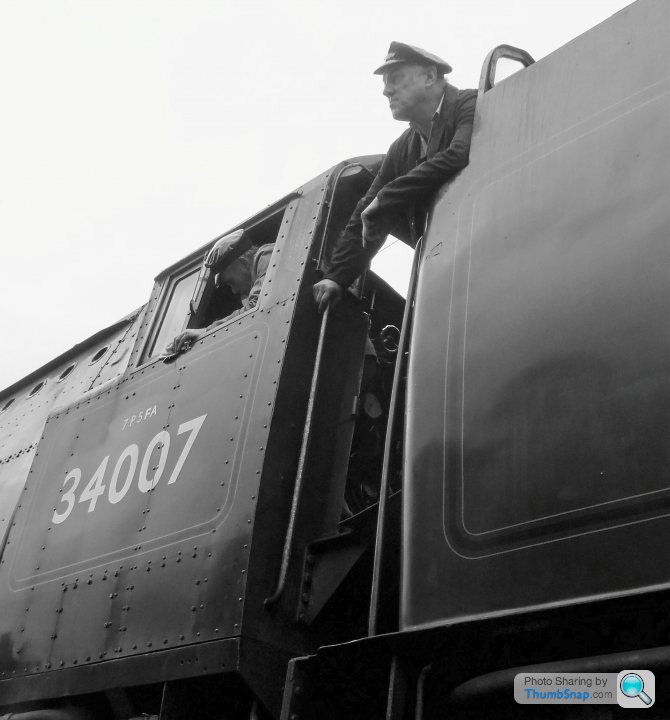


With all those bolts and rivets down the sides they were anything but streamlined...

Back in May 2006 I was on the yard shunt job at Rugby when 'Tangmere' turned up on the goods line and promptly dumped the contents of it's oil bath in the four foot... some things never change! We had to drag it into the yard to clear the goods and left it there overnight while the support crew went off up the town for a pint and a shower. The smell as it cooled down was wonderful ;-)
With all those bolts and rivets down the sides they were anything but streamlined...
Back in May 2006 I was on the yard shunt job at Rugby when 'Tangmere' turned up on the goods line and promptly dumped the contents of it's oil bath in the four foot... some things never change! We had to drag it into the yard to clear the goods and left it there overnight while the support crew went off up the town for a pint and a shower. The smell as it cooled down was wonderful ;-)
With apologies for non-Bulleid content...
Talking of Barry scrapyard, I wonder what proportion it it's contents are now back working. This is 45699 there, back in 1980, after being bought to supply spare parts.
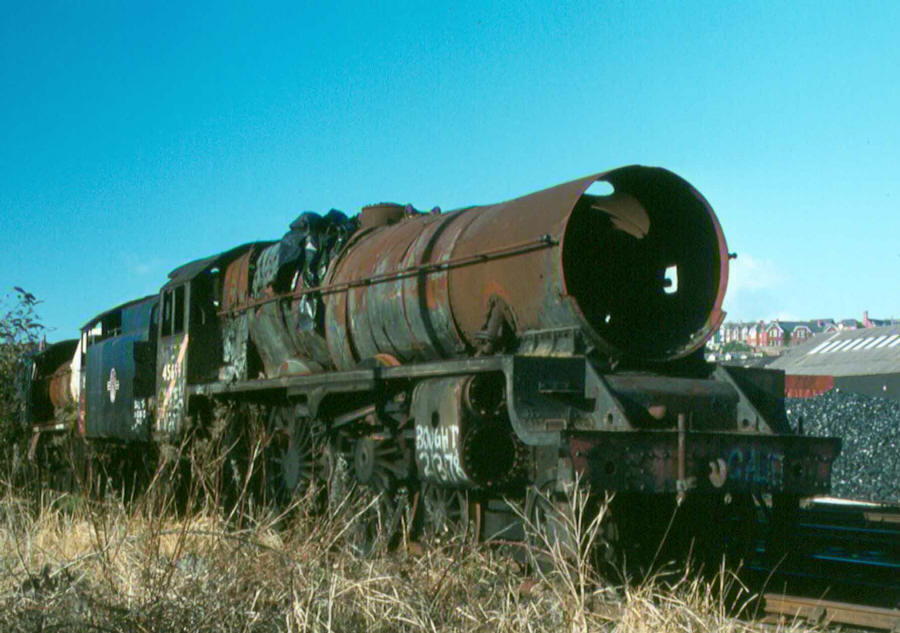
And this is what it looked like a few weeks ago, hauling the Scarborough Spa Express through Woodlesford, just down the road from me. The diesel behind it is for the then-dry fire hazard areas it passed through. Amazing what a bit of T-cut can do!

Talking of Barry scrapyard, I wonder what proportion it it's contents are now back working. This is 45699 there, back in 1980, after being bought to supply spare parts.
And this is what it looked like a few weeks ago, hauling the Scarborough Spa Express through Woodlesford, just down the road from me. The diesel behind it is for the then-dry fire hazard areas it passed through. Amazing what a bit of T-cut can do!
Oh well, if we're going to derail (*cough*) the thread - let's look at what else Oliver Bulleid designed.
I admit - I love his SR Q1 'Austerity' Class locos: a wonderful example of early C20 Modernist industrial design. 0-6-0 with a 5F power rating..:

http://en.wikipedia.org/wiki/SR_Q1_class
I admit - I love his SR Q1 'Austerity' Class locos: a wonderful example of early C20 Modernist industrial design. 0-6-0 with a 5F power rating..:
http://en.wikipedia.org/wiki/SR_Q1_class
Huff said:
Oh well, if we're going to derail (*cough*) the thread - let's look at what else Oliver Bulleid designed.
I admit - I love his SR Q1 'Austerity' Class locos: a wonderful example of early C20 Modernist industrial design. 0-6-0 with a 5F power rating..:
http://en.wikipedia.org/wiki/SR_Q1_class
And when they were first displalyed to a bunch of senior railwaymen, one quipped "Where do you put the key in?" I admit - I love his SR Q1 'Austerity' Class locos: a wonderful example of early C20 Modernist industrial design. 0-6-0 with a 5F power rating..:
http://en.wikipedia.org/wiki/SR_Q1_class
Gassing Station | Boats, Planes & Trains | Top of Page | What's New | My Stuff