
Front Cog Preferences
Discussion


Use the front derailleur and swap around to get the best ratio to keep the cadence I want to ride at, cross bike 36/46 and road bike 34/50 all running a 11-26 cassette.
But, on my singlespeed mountainbike I completely go against all sense, and just batter round in the one gear (that's all it's got), which admittedly is on the low side, so spin it on the flat sections.
But, on my singlespeed mountainbike I completely go against all sense, and just batter round in the one gear (that's all it's got), which admittedly is on the low side, so spin it on the flat sections.
Cadence is personal.
I only ever use my small ring up quite steep hills (and I run 53-40) because I feel fine in the big ring at 90/95 rpm.
The difference obviously just fitness. It's the reason why Tony Martin can push a 56-11 while I rarely need to use a 53-11. You will find as or if you get fitter that the small ring isn't sufficient most if the time, 16 mph yes, 22-25 no
I only ever use my small ring up quite steep hills (and I run 53-40) because I feel fine in the big ring at 90/95 rpm.
The difference obviously just fitness. It's the reason why Tony Martin can push a 56-11 while I rarely need to use a 53-11. You will find as or if you get fitter that the small ring isn't sufficient most if the time, 16 mph yes, 22-25 no
summit7 said:
Sur le platte
end of
little ring for big climbs, anything that is 12% or under, sur le platte
It's fitness as OKGO says, stick in the big ring until you can manage it
So in that case, why put gears on the bike at all? Or do you suggest keeping it in the big ring and cross chain like mad to a 28 tooth rear? What's the point?end of
little ring for big climbs, anything that is 12% or under, sur le platte
It's fitness as OKGO says, stick in the big ring until you can manage it
You can generate power either by turning a smaller gear faster, or a bigger gear more slowly and with more force. Sure, push the big ring if you need to build leg strength - or go to the gym and push weights; that won't necessarily make you faster if you don't have the endurance to go with it. Use smaller gearing and spin to emphasise cardio and endurance, but you also need to build some leg strength to make use of it.
If you were supposed to ride in one ring all the time, you'd not carry around the other and a changing mechanism.
Will counter the above by saying if you are sub 5' 8" then you might find a 170 crank and compact suits you better. I don't run out of gears/speed with 50/34 - 23/11. Racing my av cadence is 90-100 and normally 85-95. Some like to mash gears but for me higher cadence is the most efficient.
upsidedownmark said:
So in that case, why put gears on the bike at all? Or do you suggest keeping it in the big ring and cross chain like mad to a 28 tooth rear? What's the point?
You can generate power either by turning a smaller gear faster, or a bigger gear more slowly and with more force. Sure, push the big ring if you need to build leg strength - or go to the gym and push weights; that won't necessarily make you faster if you don't have the endurance to go with it. Use smaller gearing and spin to emphasise cardio and endurance, but you also need to build some leg strength to make use of it.
If you were supposed to ride in one ring all the time, you'd not carry around the other and a changing mechanism.
You can generate power either by turning a smaller gear faster, or a bigger gear more slowly and with more force. Sure, push the big ring if you need to build leg strength - or go to the gym and push weights; that won't necessarily make you faster if you don't have the endurance to go with it. Use smaller gearing and spin to emphasise cardio and endurance, but you also need to build some leg strength to make use of it.
If you were supposed to ride in one ring all the time, you'd not carry around the other and a changing mechanism.
Many people ride with just one gear. You have maybe seen single speed bikes around?
The point he was making is that if you're fit you push a gear at 90rpm that a less fit person could not. It's not rocket science that bigger gear and higher rpm equals more speed. Unless op was riding along at 65rpm then I would imagine its all placebo. You don't go faster on the flat pushing a smaller gear at the same rpm. You're either producing more power or you are not. The cranks are not fussy 300 watts is 300watts 90 or 75.
Lets not start on leg strength, it's not required, and a huge misconception. If you can walk up a set of stairs then you have enough 'strength' to win the tour whether or not you have the cardiovascular system or not of course is the real story. Tyler Hamilton said it best when he said it took him a while to realise but he soon realised his strength was in his blood, not his muscles (when talking about the effects of epo).
'sall'right - racers race, club riders ride.
The guy asked he got a mixed set of answers, from a mixed set of riders.
It stuns me that people ride with 40 tooth instead of 42 tooth inner rings and then moan about a chain jumping off, when they have 10 or 11 sprockets at the back to choose from
The guy asked he got a mixed set of answers, from a mixed set of riders.
It stuns me that people ride with 40 tooth instead of 42 tooth inner rings and then moan about a chain jumping off, when they have 10 or 11 sprockets at the back to choose from
okgo said:
300 watts is 300watts 90 or 75.
I have thought about this quite a bit. I can push 300w for a reasonable length of time but am happier pushing it at 90rpm. In a bigger gear at 75 my quads fatigue. I am not going any faster but ultimately will find it far more comfortable to maintain than at the lower cadence.okgo said:
upsidedownmark said:
So in that case, why put gears on the bike at all? Or do you suggest keeping it in the big ring and cross chain like mad to a 28 tooth rear? What's the point?
You can generate power either by turning a smaller gear faster, or a bigger gear more slowly and with more force. Sure, push the big ring if you need to build leg strength - or go to the gym and push weights; that won't necessarily make you faster if you don't have the endurance to go with it. Use smaller gearing and spin to emphasise cardio and endurance, but you also need to build some leg strength to make use of it.
If you were supposed to ride in one ring all the time, you'd not carry around the other and a changing mechanism.
You can generate power either by turning a smaller gear faster, or a bigger gear more slowly and with more force. Sure, push the big ring if you need to build leg strength - or go to the gym and push weights; that won't necessarily make you faster if you don't have the endurance to go with it. Use smaller gearing and spin to emphasise cardio and endurance, but you also need to build some leg strength to make use of it.
If you were supposed to ride in one ring all the time, you'd not carry around the other and a changing mechanism.
Many people ride with just one gear. You have maybe seen single speed bikes around?
The point he was making is that if you're fit you push a gear at 90rpm that a less fit person could not. It's not rocket science that bigger gear and higher rpm equals more speed. Unless op was riding along at 65rpm then I would imagine it
s all placebo. You don't go faster on the flat pushing a smaller gear at the same rpm. You're either producing more power or you are not. The cranks are not fussy 300 watts is 300watts 90 or 75.
Lets not start on leg strength, it's not required, and a huge misconception. If you can walk up a set of stairs then you have enough 'strength' to win the tour whether or not you have the cardiovascular system or not of course is the real story. Tyler Hamilton said it best when he said it took him a while to realise but he soon realised his strength was in his blood, not his muscles (when talking about the effects of epo).
Total b
 ks!
ks!Grandfondo said:
"if you can walk up a set of stairs then you have enough strength to win the tour"
Total bks!
Whilst I think that statement needs to be taken with slight dusting of salt, I can't see Mr Wiggins racking up a couple of plates a side on the squat rack. It's much more about aerobic endurance to keep spinning at high wattage.Total b
ks!Regarding cogs, it's very much a personal thing I would say, but using a standard compact I'm rarely in in the small cog unless climbing. I like to spin at around 90-95
Grandfondo said:
"if you can walk up a set of stairs then you have enough strength to win the tour"
Total bks!
From a fairly well renowned coach to various very good cyclists Total b
ks!Even up extremely steep hills, the force requirement for cycling is really low (such that untrained people can generally manage it). It's the issue of maintaining the force - which of course is a metabolic issue.
Even if your core strength is really low, the requirements in cycling are so low that there would have to be either something physically wrong with you (i.e., cycle racing is probably the least of your issues) or your bike set up isn't great. For e.g., we can sense that the forces we generate in our legs while riding are significantly higher than the forces we need to generate from our core -- yet, the forces in the leg are tiny -- for someone who is ~70 kg, the individual average leg force you need to *win* a mountain time trial in the Tour de France are about 13 kg. So, presuming that you weigh more than 13 kg and you can stand up, then up can already generate forces that are a significant greater magnitude than that required by your legs, which we know (by feel) are considerably larger than that required by our core (standing upright requires more forces).

TKF said:
Grandfondo said:
"if you can walk up a set of stairs then you have enough strength to win the tour"
Total bks!
I don't know about you but I reckon I could take this bloke in a kicking contest. Or a drinking contest for that matter.Total b
ks!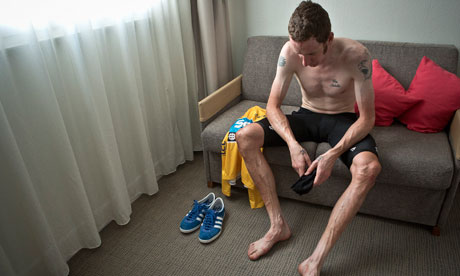
Kick boxers have skinny legs and could you take them?
okgo said:
Grandfondo said:
"if you can walk up a set of stairs then you have enough strength to win the tour"
Total bks!
From a fairly well renowned coach to various very good cyclists Total b
ks!Even up extremely steep hills, the force requirement for cycling is really low (such that untrained people can generally manage it). It's the issue of maintaining the force - which of course is a metabolic issue.
Even if your core strength is really low, the requirements in cycling are so low that there would have to be either something
physically wrong with you (i.e., cycle racing is probably the least of your issues) or your bike set up isn't great. For e.g., we
can sense that the forces we generate in our legs while riding are significantly higher than the forces we need to generate from our core -- yet, the forces in the leg are tiny -- for someone who is ~70 kg, the individual average leg force you need
to *win* a mountain time trial in the Tour de France are about 13 kg. So, presuming that you weigh more than 13 kg and you can stand up, then up can already generate forces that are a significant greater magnitude than that required by your legs, which we know (by feel) are considerably larger than that required by our core (standing upright requires more
forces).
Gassing Station | Pedal Powered | Top of Page | What's New | My Stuff