
Can you explain BB30 to me please?
Discussion


I've been trying to get my head around this as every website seems to offer BB30 as the panacea of all BB ills.
I believe I understand the point was to provide a bigger BB tube so that the frame can be made stiffer (bigger anchorage for the down tube, seat tube and chainstays), and allowance for a wider crank spindle but I don't understand the claims that there are no cups. Surely even sealed bearings need to be pressed into "carriers" even if these aren't technically "cups"?
Secondly, bearings inside or outside of the BB tube?.. which is best and why?
Thanks.
I believe I understand the point was to provide a bigger BB tube so that the frame can be made stiffer (bigger anchorage for the down tube, seat tube and chainstays), and allowance for a wider crank spindle but I don't understand the claims that there are no cups. Surely even sealed bearings need to be pressed into "carriers" even if these aren't technically "cups"?
Secondly, bearings inside or outside of the BB tube?.. which is best and why?
Thanks.
You've got the basics
A BB30 shell is not threaded but the bearings are pressed into place. No external cups are required which saves quite a lot of weight as well as reducing the Q factor. Theoretically there can be more stiffness as there is more surface area to join the bottom bracket area to the seattube, downtube and chainstays.
The reduced weight is the main difference though.
A BB30 shell is not threaded but the bearings are pressed into place. No external cups are required which saves quite a lot of weight as well as reducing the Q factor. Theoretically there can be more stiffness as there is more surface area to join the bottom bracket area to the seattube, downtube and chainstays.
The reduced weight is the main difference though.
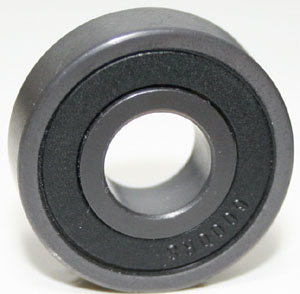
Perhaps I just don't appreciate what component consistutes the bearing itself. I've seen sealed bearings before... this kind of thing:
Images that I've seen for BB30 include this:

I'm struggling to understand where the bearing itself is in the last image.
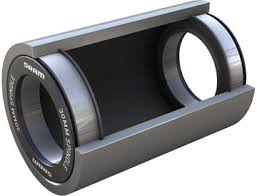
If BB30 looked like this, I would understand it although there's nowhere to install a compression tube between the two bearings in this example:
Images that I've seen for BB30 include this:
I'm struggling to understand where the bearing itself is in the last image.
If BB30 looked like this, I would understand it although there's nowhere to install a compression tube between the two bearings in this example:
Oh, the middle one is an adapter allowing you to use conventional cranks in a BB30 shell. Sorry.
So the last image is correct then. What about the compression tube? I presume the cranks are installed with an end screw to push them against the bearing? If you do this with sealed bearings without a compression tube, you force the bearings to the side (I thought - certainly that's how BMX bearings are installed).
So the last image is correct then. What about the compression tube? I presume the cranks are installed with an end screw to push them against the bearing? If you do this with sealed bearings without a compression tube, you force the bearings to the side (I thought - certainly that's how BMX bearings are installed).
Yes correct the middle photo shows an adapter.
There are different types of BB30 standard now such as BB86, BB90, BBRight
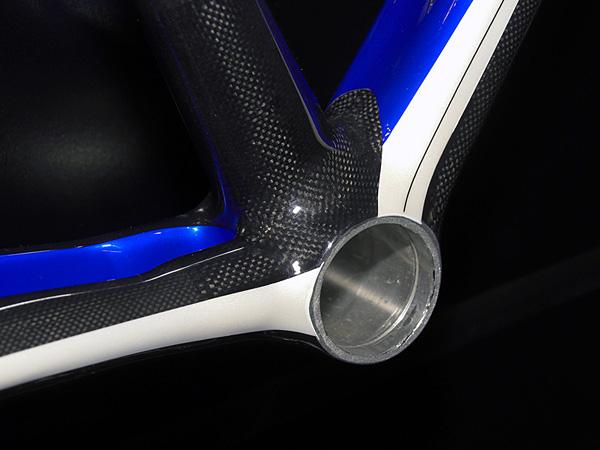
This is what a BB30 frame without bearings look like
This is what a Cannondale BB30 spindle looks like for their hollowgram cranks

The crankarms just attach to both ends
There are different types of BB30 standard now such as BB86, BB90, BBRight
This is what a BB30 frame without bearings look like
This is what a Cannondale BB30 spindle looks like for their hollowgram cranks
The crankarms just attach to both ends

Overall I see the benefit of bb30, it also looks quite nice having a hollow through axle...
However, it would appear that there are issues in it's implementation, and not just on the Boardman I've just bought...
Struggling to determine at the moment whether the typical issues are attributable to the precision of the shell machining, the accuracy of installation, or the quality of the bearings being used.
Mine seems to have started making noises after a month. The bike still has the s tty pedals it came with, so it may be them. I am however prepared to do a bit of investigating if it does turn out to be the bb, as it's something that will wind me up massively not being certain the problems are resolved.
Does anyone know the bearing standard size for bb30? I know a few firms that may be able to supply significantly lovely quality bearings if I can give them something to go on.
OP - IMO, don't let the issues all over the internet put you off, they can't be difficult to resolve, and I feel the benefits are worth it. (Stiffness, weight, vanity)
However, it would appear that there are issues in it's implementation, and not just on the Boardman I've just bought...
Struggling to determine at the moment whether the typical issues are attributable to the precision of the shell machining, the accuracy of installation, or the quality of the bearings being used.
Mine seems to have started making noises after a month. The bike still has the s
tty pedals it came with, so it may be them. I am however prepared to do a bit of investigating if it does turn out to be the bb, as it's something that will wind me up massively not being certain the problems are resolved.Does anyone know the bearing standard size for bb30? I know a few firms that may be able to supply significantly lovely quality bearings if I can give them something to go on.
OP - IMO, don't let the issues all over the internet put you off, they can't be difficult to resolve, and I feel the benefits are worth it. (Stiffness, weight, vanity)
Sway said:
Overall I see the benefit of bb30, it also looks quite nice having a hollow through axle...
However, it would appear that there are issues in it's implementation, and not just on the Boardman I've just bought...
Struggling to determine at the moment whether the typical issues are attributable to the precision of the shell machining, the accuracy of installation, or the quality of the bearings being used.
Mine seems to have started making noises after a month. The bike still has the stty pedals it came with, so it may be them. I am however prepared to do a bit of investigating if it does turn out to be the bb, as it's something that will wind me up massively not being certain the problems are resolved.
Does anyone know the bearing standard size for bb30? I know a few firms that may be able to supply significantly lovely quality bearings if I can give them something to go on.
OP - IMO, don't let the issues all over the internet put you off, they can't be difficult to resolve, and I feel the benefits are worth it. (Stiffness, weight, vanity)
Should be easy enough to measure. I imagine they're angular contact bearings though, which may well make life difficult.However, it would appear that there are issues in it's implementation, and not just on the Boardman I've just bought...
Struggling to determine at the moment whether the typical issues are attributable to the precision of the shell machining, the accuracy of installation, or the quality of the bearings being used.
Mine seems to have started making noises after a month. The bike still has the s
tty pedals it came with, so it may be them. I am however prepared to do a bit of investigating if it does turn out to be the bb, as it's something that will wind me up massively not being certain the problems are resolved.Does anyone know the bearing standard size for bb30? I know a few firms that may be able to supply significantly lovely quality bearings if I can give them something to go on.
OP - IMO, don't let the issues all over the internet put you off, they can't be difficult to resolve, and I feel the benefits are worth it. (Stiffness, weight, vanity)
OP: I've not installed a BB30 myself, but I don't think there's a need for a compression sleeve, think about how a headset works, no spacer in there....
FWIW I'm not happy with the 'standard', I've seen a fair few bikes with flaired head tubes that have needed to be binned and I can see the same thing happening with BB30/90. I prefer shimano's BB92 personally with sacrificial composite cups. Pressing bearings directly into frames seems like a bad idea.
shalmaneser said:
OP: I've not installed a BB30 myself, but I don't think there's a need for a compression sleeve, think about how a headset works, no spacer in there....
Maybe you're right but the forces are very different. I think, having read a bit more about it, that by making the shell accept bearings directly, they have had to increase it's strength (thicker walls) which all has a knock-on effect.To stop a BMX crank's spindle from creaking you have to tighten the crank arms up against the compression tube reasonably tight. Without the compression tube, the amount of force impared would damage those bearings but if the BB30 bearings are angled, as you suggest they might be, then you're right that a compression tube wouldn't be necessary.
shalmaneser said:
FWIW I'm not happy with the 'standard', I've seen a fair few bikes with flaired head tubes that have needed to be binned and I can see the same thing happening with BB30/90. I prefer shimano's BB92 personally with sacrificial composite cups. Pressing bearings directly into frames seems like a bad idea.
They have been doing this for BMX for years, although they are largely steel (CroMo) frames which has a lot more tolerance and doesn't micro-fracture like alloy (no idea how CF manages with this). I do have my suspicions about alloy frame durability over time but I will likely get bored with the bike and upgrade/sell/swap it long before that becomes an issue. 
Sway said:
Mine seems to have started making noises after a month. The bike still has the stty pedals it came with, so it may be them. I am however prepared to do a bit of investigating if it does turn out to be the bb, as it's something that will wind me up massively not being certain the problems are resolved.
Before anything, remove the pedals, clean and lube threads and reinstall. I thought mine had gone but it was only the pedals causing the noise. This was after replacing SPDS with SPD-SLs too. tty pedals it came with, so it may be them. I am however prepared to do a bit of investigating if it does turn out to be the bb, as it's something that will wind me up massively not being certain the problems are resolved.Gassing Station | Pedal Powered | Top of Page | What's New | My Stuff