
The Sonic Boom
Discussion


A sonic boom occurs 'around'(?) a plane when it reaches, matches, and starts to exceed the speed of sound. Im no expert, but it probably occurs when the sound waves made by a plane which are following the plane catch up and are heard at the same time as the sound waves which are being made by the plane.
Is this about right? Can anyone explain (my thoughts are probably crap at best) how a sonic boom comes about, and more to the point, what is actually experienced when the boom happens? For a pilot, those on the ground (assuming the boom happens when the plane goes overhead)... is there really a loud boom? And whats the loudest thing one can buy cheaply which goes the speed of sound? ;)
Is this about right? Can anyone explain (my thoughts are probably crap at best) how a sonic boom comes about, and more to the point, what is actually experienced when the boom happens? For a pilot, those on the ground (assuming the boom happens when the plane goes overhead)... is there really a loud boom? And whats the loudest thing one can buy cheaply which goes the speed of sound? ;)
From an 0online dictionary type thing
"sonic boom, shock wave produced by an object moving through the air at supersonic speed, i.e., faster than the speed of sound. Since sound is a mechanical disturbance that propagates through the air, there is a limit to its speed. An object such as an airplane, moving through the air, generates sound. When the speed of the object reaches or exceeds the speed of sound, the object catches up with its own noise; at higher speeds, it forces the sound ahead of itself faster than the noise would ordinarily travel. The piled-up sound takes the form of a violent shock wave called a sonic boom propagating behind the object. Sonic booms occasionally have mechanically destructive effects in addition to their role as noise pollutants."
So yup... Sound catching up with itself..
"sonic boom, shock wave produced by an object moving through the air at supersonic speed, i.e., faster than the speed of sound. Since sound is a mechanical disturbance that propagates through the air, there is a limit to its speed. An object such as an airplane, moving through the air, generates sound. When the speed of the object reaches or exceeds the speed of sound, the object catches up with its own noise; at higher speeds, it forces the sound ahead of itself faster than the noise would ordinarily travel. The piled-up sound takes the form of a violent shock wave called a sonic boom propagating behind the object. Sonic booms occasionally have mechanically destructive effects in addition to their role as noise pollutants."
So yup... Sound catching up with itself..
Heard one the other year , the Americans were "playing silly buggers" over the North Sea in their Strike Eagles, or such like, they broke the sound barrier & we could hear it about 10 miles West of Norwich.
Actually made the news as it was pretty loud & went on for quite a few seconds,
Actually made the news as it was pretty loud & went on for quite a few seconds,
GreenV8S said:
And whats the loudest thing one can buy cheaply which goes the speed of sound?
A whip - the classic whip crack is a miniature sonic boom.

 Is there anything you are not masterfully knowlegable about
Monkey Boy 1 said:Im guessing pilots are not allowed to break the sound barrier at airshows then? Did it sound like an earth quake, or a big bang?
Heard one the other year , the Americans were "playing silly buggers" over the North Sea in their Strike Eagles, or such like, they broke the sound barrier & we could hear it about 10 miles West of Norwich.
Actually made the news as it was pretty loud & went on for quite a few seconds,
UKbob said:
A sonic boom occurs 'around'(?) a plane when it reaches, matches, and starts to exceed the speed of sound. Im no expert, but it probably occurs when the sound waves made by a plane which are following the plane catch up and are heard at the same time as the sound waves which are being made by the plane.
Is this about right? Can anyone explain (my thoughts are probably crap at best) how a sonic boom comes about, and more to the point, what is actually experienced when the boom happens? For a pilot, those on the ground (assuming the boom happens when the plane goes overhead)... is there really a loud boom? And whats the loudest thing one can buy cheaply which goes the speed of sound?
Very basically - when an object breaks the sound barrier the air in front of it has no warning the object is coming. Therefore rather than moving out of the way gently it is displaced suddenly. This forms a shockwave which is a cone shaped area of air with varying pressure in front and behind it. When this cone touches the ground you here the classic sonic boom. If the shockwave passes over you you can feel the high pressure followed immediately by the low pressure which can cause damage to objects, people etc...
The pilot doesn't really notice it I don't think.
Experienced one sonic boom here at work when Eurofighters were doing supersonic trials over the sea in the test ranges. Whole floor looked up feeling very confused as it was quite a subtle effect.
Hope this sheds a bit of light on it - I always envisage the shock wave as the pattern ducks make when they go past you on a lake!
I'm sure EricMC will be along at somepoint and he'll explain it a lot better!
They used to be able to break the sound barrier @ air shows in the 50's & 60's. i remember my father saying about it when he used to fo to Farnborough air show, they used to put a Hunter in a steep dive & try & break the sound barrier.
The noise is a cross between a big bang & a long rumble.
Sorry it's not to discriptive, but you don't know what it is untill some time after the event. Unless you are there knowing that an aircraft is going to break the sound barrier.
The noise is a cross between a big bang & a long rumble.
Sorry it's not to discriptive, but you don't know what it is untill some time after the event. Unless you are there knowing that an aircraft is going to break the sound barrier.
Some spectacular pictures of aircraft passing the sound barrier

B1-B Spirit

F18 hornet

Like waves off a boat, shock waves spread away from a T-38 aircraft flying at Mach 1.1, or just over the speed of sound. The photograph was taken in 1993 using a specialized camera that captures density changes, and thus shock waves, in fluid flow.
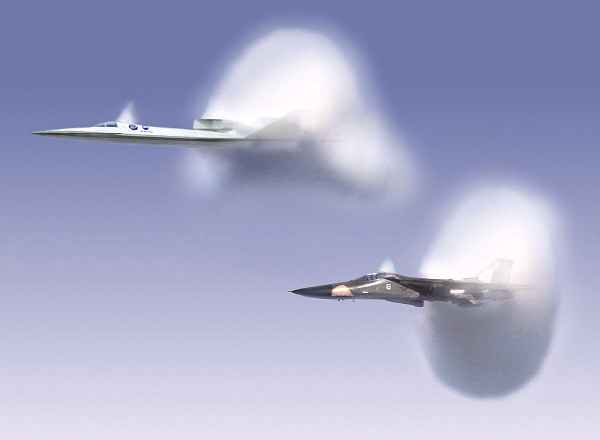
Artist's impression of ? and a real F111
B1-B Spirit
F18 hornet
Like waves off a boat, shock waves spread away from a T-38 aircraft flying at Mach 1.1, or just over the speed of sound. The photograph was taken in 1993 using a specialized camera that captures density changes, and thus shock waves, in fluid flow.
Artist's impression of ? and a real F111

Sonic booms were a pretty standard part of living in Switzerland. Because of the size and location of the country, pilots are forced to fly around populated areas. Better than that, because the country is essentially made up of a series of valleys, a sonic boom can travel for miles. The one that sticks in my mind travelled about 100km, from Glarus south east of Zurich all the way up the valley and rattled windows in the city itself.
Made for a nice distraction from school, anyway.
Made for a nice distraction from school, anyway.

UKbob said:Concorde kaboooooom
what is actually experienced when the boom happens? For a pilot, those on the ground (assuming the boom happens when the plane goes overhead)... is there really a loud boom?


Supersonic said:
what is actually experienced when the boom happens? For a pilot, those on the ground (assuming the boom happens when the plane goes overhead)... is there really a loud boom?
Concorde kaboooooom
Nooo.. that was a big Great White hitting the bottom of the boat. All passengers were promptly eaten....
I was in Orlando once when the shuttle was returning to Canaveral, a very distinct double boom. The Americans are currently researching modifying the shape of an aircraft so that the shockwave is spread out to reduce the boom and make supersonic aircraft more viable over populated areas.
The original question seemed to be confusing the boom with the noise the aircraft's engines make. The boom is nothing to do with engine noise. As has already been explained, at or above the sped of sound, an object creates a cone of highly compressed air which tends to form at the extremities of the object - the nose, wing leading edge, tail fin etc. It is this cone of compressed air which creates a bang as it pases over a listener on the ground. The people on board the aircraft will not hear it as they are travelling along with the shock cone so it never passes over them.
The Shuttle creates a double boom because it forms two shock wves, one on the nose and one on the tail fin.
The Shuttle creates a double boom because it forms two shock wves, one on the nose and one on the tail fin.
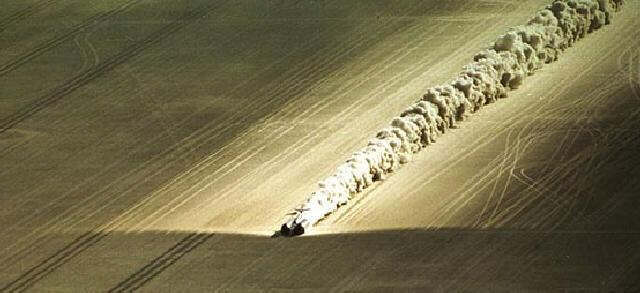
And of course I have to fly the flag and add that they have been created on the ground....
www.andrewgraves.biz/ssc_stuff/images/exCS/Shock.jpg
Cheers,
Howard
www.andrewgraves.biz/ssc_stuff/images/exCS/Shock.jpg
Cheers,
Howard
I always think that is an incredible picture.
Of course, supersonic ground running items have been raround for years, sometimes occupied by humans. I'm referring to rocket sleds which have been used to test missiles and aircraft ejector seats under controlled conditions.
The UK MoD has a rocket "railway" testing facility at Pendine in South Wales. In fact, the Thrust SSC team were allowed use the rocket rails there to test models of the SSC at supersonic speeds.
Of course, supersonic ground running items have been raround for years, sometimes occupied by humans. I'm referring to rocket sleds which have been used to test missiles and aircraft ejector seats under controlled conditions.
The UK MoD has a rocket "railway" testing facility at Pendine in South Wales. In fact, the Thrust SSC team were allowed use the rocket rails there to test models of the SSC at supersonic speeds.
Gassing Station | The Pie & Piston Archive | Top of Page | What's New | My Stuff