
Star trails question
Discussion


I am making my way down to Devon at the end of the month and staying in a remote log cabin in some wood land and thought this would be a perfect excuse to try out some star trails due to the lack of light pollution down there.
I know that stacking many different images seems to be the usual approach but I don't have photoshop so layering images is not an option. What I want to know is if i would be able to get some good trails from one exposure and how far would I realistically be able push it without noise killing the shot?
The equipment will most likely be 10-20mm sigma on a 7d.
Any help greatly received.
I know that stacking many different images seems to be the usual approach but I don't have photoshop so layering images is not an option. What I want to know is if i would be able to get some good trails from one exposure and how far would I realistically be able push it without noise killing the shot?
The equipment will most likely be 10-20mm sigma on a 7d.
Any help greatly received.
Wider the lens = longer shutter you need to get trails.
7D is capable of a long shot, you will need a cable release with shutter lock tho.
If doing 1 shot then you will want long exposure noise reduction on which will take a dark field shot straight after for the same time as the exposure.
ISO 200, f5.6-f7, shutter 30min+
I think theres some free software out there for combining shots for star trails ( usually used for astro work I think).
7D is capable of a long shot, you will need a cable release with shutter lock tho.
If doing 1 shot then you will want long exposure noise reduction on which will take a dark field shot straight after for the same time as the exposure.
ISO 200, f5.6-f7, shutter 30min+
I think theres some free software out there for combining shots for star trails ( usually used for astro work I think).
I took this with my 400D + 10 - 24mm.
 28/365 - Madness - Friday 28th January by Oliver Meads, on Flickr
The image is straight from the camera and has no changes.
The photo is a 30 minute exposure at F/5.6. Then a 40 minute wait for the camera to process and save the shot.
A couple of images of the camera, showing how cold it was.


28/365 - Madness - Friday 28th January by Oliver Meads, on FlickrThe image is straight from the camera and has no changes.
The photo is a 30 minute exposure at F/5.6. Then a 40 minute wait for the camera to process and save the shot.
A couple of images of the camera, showing how cold it was.
Edited by XG332 on Sunday 3rd April 22:20
Cheers Rob, I have the shutter cable and tripod and will have the camera set to noise reduction.
I want to use the 10-20mm as i want a nice wide landscape shot with obviously lots of sky with some sort of foreground subject. In my head I have it sorted but my head takes better pictures than what i can with the 7d most of the time and wasnt sure with stacking if a 20-30 min single exposure will be ok. Also whilst I am in the asking mode, will that length of exposure cause hot pixels or sensor damage?
I want to use the 10-20mm as i want a nice wide landscape shot with obviously lots of sky with some sort of foreground subject. In my head I have it sorted but my head takes better pictures than what i can with the 7d most of the time and wasnt sure with stacking if a 20-30 min single exposure will be ok. Also whilst I am in the asking mode, will that length of exposure cause hot pixels or sensor damage?
Dont worry about sensor damage, only if theres a sun in the shot , or lasers...
The long exp noise reduction ( dark field subtraction) is to deal with hot pixels and stuff.
The foreground may need some light on it, or flash, or paint with a torch, kinda an experiment in 1 shot easy to stuff up.
Which is why a foreground shot then mixed with layers is the best option.
The long exp noise reduction ( dark field subtraction) is to deal with hot pixels and stuff.
The foreground may need some light on it, or flash, or paint with a torch, kinda an experiment in 1 shot easy to stuff up.
Which is why a foreground shot then mixed with layers is the best option.
I used the stacking software from startrails.de (it's free) and a series of 30 second exposures, this allows you to get the foreground correctly exposed more easily and you don't need to do an hour long shot to find out that the exposure is wrong.
This also stops the long exposure noise. Just remember to shoot in Jpeg as I had to convert an hours worth of RAW.
This also stops the long exposure noise. Just remember to shoot in Jpeg as I had to convert an hours worth of RAW.
Speed addicted said:
I used the stacking software from startrails.de (it's free) and a series of 30 second exposures, this allows you to get the foreground correctly exposed more easily and you don't need to do an hour long shot to find out that the exposure is wrong.
This also stops the long exposure noise. Just remember to shoot in Jpeg as I had to convert an hours worth of RAW.
anything for mac at all? a search doesnt show anything.This also stops the long exposure noise. Just remember to shoot in Jpeg as I had to convert an hours worth of RAW.

 so ruined a 45 min shot!
There's a smoothness comes with a single frame image for sure but if you're shooting star trails you want to make sure you can actually see some stars - compare the image above with this which is also about 45mins
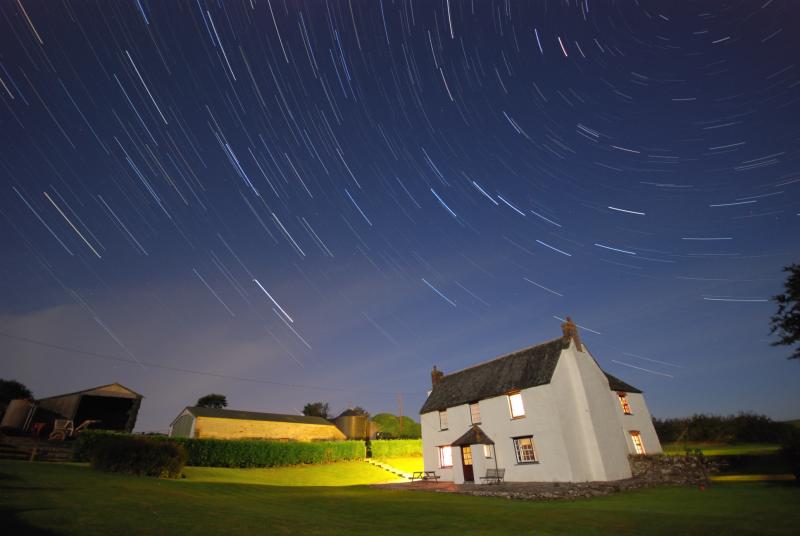
If there's any ambient light at all and you want star *trails* to feature in your final image, single frames can't compete with stacking.
However, when it's pitch dark, like looking-out-to-sea dark, a single frame can work better - darkest I've ever shot was a single frame, 26 minute exposure at ISO200 and f/2.8. It's out in a magazine in the next few days so I can't post it yet but that's a situation where stacking just wouldn't work. Even at ISO6400 my 30" exposures were borderline bright enough in the foreground so I had to just let it run and run.
ETA: no stacking programme for Mac but the startrails app will run from a memory stick without needing to be installed so can be done at work/ friend's house/ cybercafe
If there's any ambient light at all and you want star *trails* to feature in your final image, single frames can't compete with stacking.
However, when it's pitch dark, like looking-out-to-sea dark, a single frame can work better - darkest I've ever shot was a single frame, 26 minute exposure at ISO200 and f/2.8. It's out in a magazine in the next few days so I can't post it yet but that's a situation where stacking just wouldn't work. Even at ISO6400 my 30" exposures were borderline bright enough in the foreground so I had to just let it run and run.
ETA: no stacking programme for Mac but the startrails app will run from a memory stick without needing to be installed so can be done at work/ friend's house/ cybercafe
You have a few decisions to make.
RAW vs Jpg. If you take JPG, then you will have a gap between the first two photos while the camera takes a dark frame. Even a short gap can be noticeable. (see image below.)
Short Vs Long exposures. Long exposures will have a much bigger noise issue, but will give better results. However, local light pollution many limit the exposures.
Here is an example taken from a very dark site. Canon EOS300, two exposures of 45 minutes each, RAW mode.

Notice the slight gap in the middle of each star trail - this was the very short gap between the shots. Also, there was a huge amount of noise which took a lot of work to remove. I didn't have a dark frame.
I would suggest taking a 20 minute raw dark before the first image, then taking some 20 minute exposures and finally, another 20 minute dark. Average the darks to compensate for temperature changes.
Don
--
RAW vs Jpg. If you take JPG, then you will have a gap between the first two photos while the camera takes a dark frame. Even a short gap can be noticeable. (see image below.)
Short Vs Long exposures. Long exposures will have a much bigger noise issue, but will give better results. However, local light pollution many limit the exposures.
Here is an example taken from a very dark site. Canon EOS300, two exposures of 45 minutes each, RAW mode.
Notice the slight gap in the middle of each star trail - this was the very short gap between the shots. Also, there was a huge amount of noise which took a lot of work to remove. I didn't have a dark frame.
I would suggest taking a 20 minute raw dark before the first image, then taking some 20 minute exposures and finally, another 20 minute dark. Average the darks to compensate for temperature changes.
Don
--
Well this is my first attempt, a series of 30 second exposures that ran until the battery died (about 1hr 45 mins), also the lens now has condensation all over it so I guess I can't stick it out for another go!

Startrails (800x533) (2) by NigelMulford, on Flickr
Series of 30s exposures combined in the Startrails program.
Could be a long learning curve this one, but I can see the general idea is there. I was trying to get the bush as a bit of foreground but maybe it was a bit too dark!
edited to change image to a more processed one.
Startrails (800x533) (2) by NigelMulford, on Flickr
Series of 30s exposures combined in the Startrails program.
Could be a long learning curve this one, but I can see the general idea is there. I was trying to get the bush as a bit of foreground but maybe it was a bit too dark!
edited to change image to a more processed one.
Edited by FunkyNige on Sunday 10th April 19:20
Gassing Station | Photography & Video | Top of Page | What's New | My Stuff