
Why are DSLRs so big?
Discussion


In the dim and distant past I used to own an Olympus OM-10 with a few lenses. My interest in photography changed and I replaced the lot with an Olympus IS-1000. That was consigned to a drawer when I got a little Canon Ixus.
Looking to upgrade I have been checking out all sorts of cameras from compact trhough to DSLR.
One thing that I noticed is the size of DSLRs when you take the size of the sensor into account.
The cheaper DSLRs with APS-C size sensors are all larger than my old OM-10 35mm camera.
The models using a "35mm" sensors are about the size of the old medium format cameras.
Why?
Looking to upgrade I have been checking out all sorts of cameras from compact trhough to DSLR.
One thing that I noticed is the size of DSLRs when you take the size of the sensor into account.
The cheaper DSLRs with APS-C size sensors are all larger than my old OM-10 35mm camera.
The models using a "35mm" sensors are about the size of the old medium format cameras.
Why?
I guess there's a whole lot more electronics in a DSLR, including the screen. Also batteries are going to be chunkier than a double-A and a film camera doesn't need a CF card. Also bear in mind the sensor itself would be thicker than a sheet of film!
Besides all that though, larger bodies are more comfortable to hold, especially with a heavy lens (think f2.8 telephotos) hanging off the front. The leverage effect puts a lot of stress on your wrist, so the more you have to hold onto the better. (Ooh-er missus and all that )
)
Besides all that though, larger bodies are more comfortable to hold, especially with a heavy lens (think f2.8 telephotos) hanging off the front. The leverage effect puts a lot of stress on your wrist, so the more you have to hold onto the better. (Ooh-er missus and all that
)Human hands are human hand-sized. Cameras should be designed to fit a human hand, unless there's a reason not to.
A compact camera is designed to fit into a pocket/bag because the buyer of such a camera will priorities convenience of size over suitability for photo taking. An SLR with all it's lenses and gubbins is usually carried in a camera bag, so being small is not so high on it's priority list. As such it prioritises photo taking (like size/feel in your hand, accessibility of buttons and weight for steady shots etc) over size for fitting into pockets.
Horses for courses.
[Similarly, take something like the PSP portable games console, it's very slim but hard to hold but it's built like that to fit in your bag. A proper controller like the PS3 or xbox 360 controller is a lot chunkier, so harder to pack in a bag but ultimately easier to use.]
A compact camera is designed to fit into a pocket/bag because the buyer of such a camera will priorities convenience of size over suitability for photo taking. An SLR with all it's lenses and gubbins is usually carried in a camera bag, so being small is not so high on it's priority list. As such it prioritises photo taking (like size/feel in your hand, accessibility of buttons and weight for steady shots etc) over size for fitting into pockets.
Horses for courses.
[Similarly, take something like the PSP portable games console, it's very slim but hard to hold but it's built like that to fit in your bag. A proper controller like the PS3 or xbox 360 controller is a lot chunkier, so harder to pack in a bag but ultimately easier to use.]
A large part of the clue is in the name..
The mirror is a moving part and needs to move out of the way when the exposure is taken..
In order to cover the sensor it has to be a certain size - this dictates the minimum size - along with the
battery, screw drive (one capable of driving large lenses), viewfinder etc of the camera.. it's
fundamentally more of a mechanical device than an electronic one..
the Original DSLR's were film cameras with a digital back rather than a film spool.
The APS-C compact system cameras show what can be done if the traditional camera components are removed.
Simes.
The mirror is a moving part and needs to move out of the way when the exposure is taken..
In order to cover the sensor it has to be a certain size - this dictates the minimum size - along with the
battery, screw drive (one capable of driving large lenses), viewfinder etc of the camera.. it's
fundamentally more of a mechanical device than an electronic one..
the Original DSLR's were film cameras with a digital back rather than a film spool.
The APS-C compact system cameras show what can be done if the traditional camera components are removed.
Simes.
If you liked the OM then why not go for the new Olympus OMD when it comes out. It's a similar size, but has the smaller micro four thirds sensor.
http://olympusomd.com/en-GB/
http://olympusomd.com/en-GB/
For a full frame camera the distance from the sensor to the lens is going to be the same as for a 35mm film camera, so generally everything around the optics will be of similar dimension. The big difference comes at the rear, instead of the film you have the sensor and then behind that will be the LCD display, rear controls and associated interconnections, making for a deeper body. There is then a load more electronics required as well as memory card slot(s), interfaces for connecting to USB, monitor, microphone etc which you'd never have had on a film camera. If you take a DSLR to bits you won't find much spare room in there.
davepoth said:
There's no reason at all really, other than "compact camera=amateur=rubbish, therefore big camera=professional=awesome"
We'll assume this is ironic and pass on.OP - I have a big DSLR camera (and a smaller one). The BIG one is much easier to use as I don't spend my life changing settings on a menu on a small screen on the back of the camera (there are buttons under my fingers for almost everything, which after a few weeks one uses without a second thought as one does a gearstick on a car). The batteries last much, much longer, because they are (sadly) much, much bigger. It's stupidly heavy, but I can use it in all weathers and drop it from a great height without breaking it. Its warranty gives it twice the life of the smaller one...
...and that's why it's so big (and so bloody expensive)

HTH
Edited by GetCarter on Thursday 22 March 17:07
They seem to be getting smaller to me.
I've got a Pentax iST and the K-R is considerably smaller.
Way back in the dark ages I didn't buy a Pentax ME Super 35mm SLR because, despite it being ideal for me in every other respect, it was just too small and cramped to operate.
The same, to a degree, holds true of DSLRs, there's a point at which they're just small for the sake of it!
A bit like the utterly pointless 110 format SLR Pentax used to make!
M.
I've got a Pentax iST and the K-R is considerably smaller.
Way back in the dark ages I didn't buy a Pentax ME Super 35mm SLR because, despite it being ideal for me in every other respect, it was just too small and cramped to operate.
The same, to a degree, holds true of DSLRs, there's a point at which they're just small for the sake of it!
A bit like the utterly pointless 110 format SLR Pentax used to make!
M.
GetCarter said:
davepoth said:
There's no reason at all really, other than "compact camera=amateur=rubbish, therefore big camera=professional=awesome"
We'll assume this is ironic and pass on.Given that modern cameras are capable of recording HD video there doesn't seem to be a compelling argument for having the SLR mechanism in the camera anyway - a small LCD screen in the viewfinder could replace it easily.
So given that the form factor and indeed the mechanism is obsolete, why is the demand there for all full featured cameras to be enormous?
MartinP said:
For a full frame camera the distance from the sensor to the lens is going to be the same as for a 35mm film camera, so generally everything around the optics will be of similar dimension. The big difference comes at the rear, instead of the film you have the sensor and then behind that will be the LCD display, rear controls and associated interconnections, making for a deeper body. There is then a load more electronics required as well as memory card slot(s), interfaces for connecting to USB, monitor, microphone etc which you'd never have had on a film camera. If you take a DSLR to bits you won't find much spare room in there.
A Nikon F5 (35mm film camera) is rather larger and heavier than a Nikon D700 (full frame digital).davepoth said:
GetCarter said:
davepoth said:
There's no reason at all really, other than "compact camera=amateur=rubbish, therefore big camera=professional=awesome"
We'll assume this is ironic and pass on.davepoth said:
Given that modern cameras are capable of recording HD video there doesn't seem to be a compelling argument for having the SLR mechanism in the camera anyway - a small LCD screen in the viewfinder could replace it easily.
Sorry, no. I want a proper viewfinder not a television.You seem to have skipped Mr Get's very sound post. This is an Olympus E3 apparently - I don't see any wasted space:

Elderly said:
A Nikon F5 (35mm film camera) is rather larger and heavier than a Nikon D700 (full frame digital).
^^^ This.And a lot of bulk is in a battery, although Japanese legislation seems to be the driving force to make these more efficient.
Of all the things that modern kit can manage, an electronic replacement viewfinder is not (yet) one of them!
davepoth said:
GetCarter said:
davepoth said:
There's no reason at all really, other than "compact camera=amateur=rubbish, therefore big camera=professional=awesome"
We'll assume this is ironic and pass on.Given that modern cameras are capable of recording HD video there doesn't seem to be a compelling argument for having the SLR mechanism in the camera anyway - a small LCD screen in the viewfinder could replace it easily.
So given that the form factor and indeed the mechanism is obsolete, why is the demand there for all full featured cameras to be enormous?

Not that I care what you think about my big 'showoff' camera, if you can't see the value of an SLR (i.e. looking through the lens) then you're better off with your little point&shoot anyway

tim-b said:
davepoth said:
GetCarter said:
davepoth said:
There's no reason at all really, other than "compact camera=amateur=rubbish, therefore big camera=professional=awesome"
We'll assume this is ironic and pass on.Given that modern cameras are capable of recording HD video there doesn't seem to be a compelling argument for having the SLR mechanism in the camera anyway - a small LCD screen in the viewfinder could replace it easily.
So given that the form factor and indeed the mechanism is obsolete, why is the demand there for all full featured cameras to be enormous?
Not that I care what you think about my big 'showoff' camera, if you can't see the value of an SLR (i.e. looking through the lens) then you're better off with your little point&shoot anyway
M.
marcosgt said:
What about these new mirrorless SLRs? They're pretty small and have no mirror to shake the camera when you hit the shutter release, so is there really any advantage to retaining the traditional mirror?
M.
Mirror shake is not an issue these days really. Disadvantages to compacts systems cameras (not an slr as they have no mirror) include form factor, no OVF, slower AF (although this has been much improved recently) and important options are hidden in menu's due to not having enough space for buttons and dials.M.
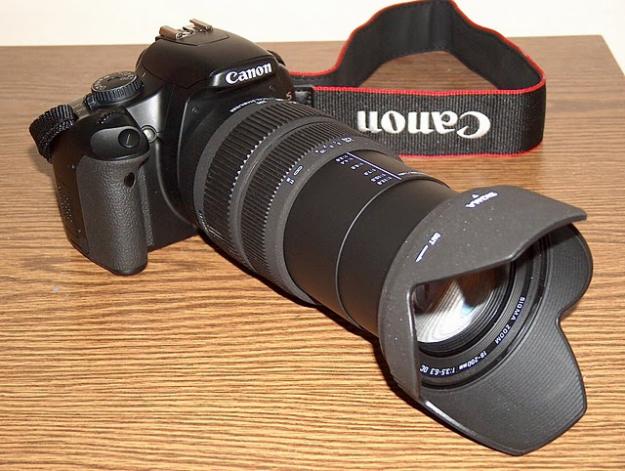
The biggest problem for me though is that the better CSC's have an APS-S sensor, but physics denotes that to have an APS-C sensor lenses have to be a certain size. This means you end up with tiny bodies with massive bulky lenses, losing all the advantages of slimming down the camera by losing the mirror.
Not so compact!
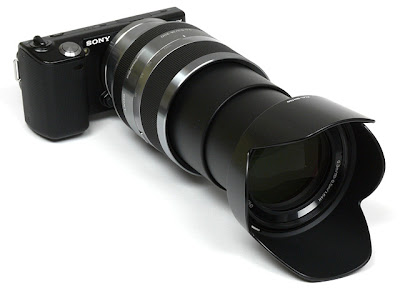
ETA: which looks like it would be easier to use (both 18-200 lenses)
Edited by jimmy156 on Friday 23 March 12:16
Edited by jimmy156 on Friday 23 March 13:04
Consider the like-for-like operational capacities by comparing a DSLR with an analogue 35mm body fitted with a motordrive and a 250 frame film cassette.
For example:
http://en.wikipedia.org/wiki/Canon_F-1
or
http://www.mir.com.my/rb/photography/hardwares/cla...
For example:
http://en.wikipedia.org/wiki/Canon_F-1
or
http://www.mir.com.my/rb/photography/hardwares/cla...
Gassing Station | Photography & Video | Top of Page | What's New | My Stuff