
Starlit landmarks
Discussion


Evening all, following a sneak preview of one of these images on the cover of last Friday's FT, here's a look at the rest of the set... so far. It's taken the best part of the year for everything to fall into place with a combination of weather, moon phasing and domestic circumstances not always working in conjunction with each other. There's a couple of older shots thrown in for good measure.
The thinking behind it started off as a technical exploration of what's possible: ask any night shooter about the ideal conditions for star trails and heavy light pollution won't feature in their response, other than advising to avoid it. As I got stuck in to the technique locally I realised it might be a refreshing (or at least different) take on some of the most photographed landmarks, places, scenes and structures further afield.
Stonehenge was big on my hitlist given the significance of its celestial alignment so it was worth the four separate trips I had to make to finally get the shot. But the clincher, the must have image was always this one of the Angel of the North. I knew from the very few other star trail shots here that with careful composition the Angel could finally wear a halo. Must've had my own guardian angel for the epic trip north as the sky cleared for me on arrival and clouded over again within a half-hour of my stack sequence finishing.
01 A Halo for an Angel

An old shot overlooking Portsmouth which I reprocessed more confidently, now I'm getting the hang of PS.
02 Star Trails: Starlight Express

Spent a night shooting with Dean back in May, before he took on the role at Evo. Covered a lot of miles for not much return in the way of quantity of shots but this was a keeper. The Independent ran it on Pg9 on Friday.
03 Linear Relationship

Nelson's Column in Trafalgar Square, from the same night as #03. A surprise result from the first major test of cutting through light and light pollution
04 Lord of the Night

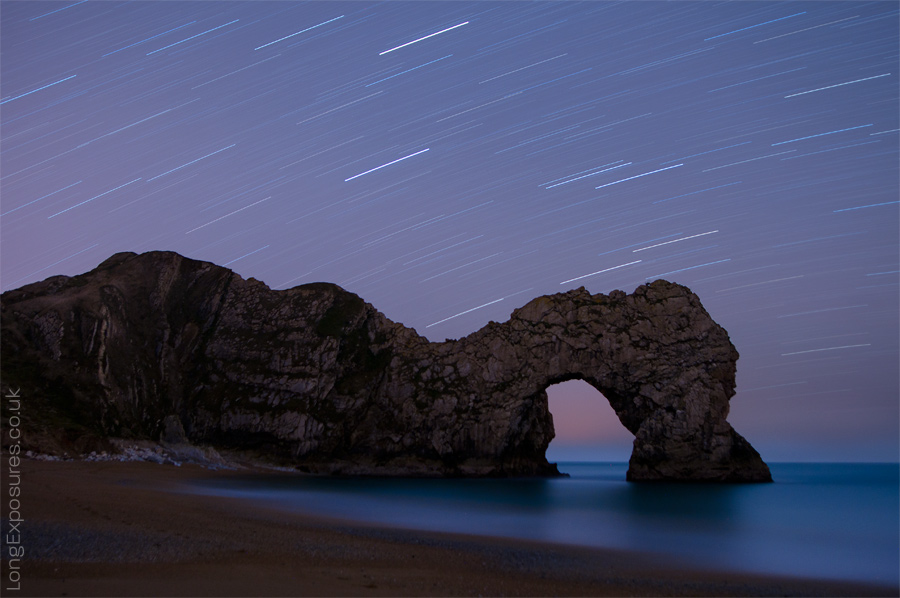
The complete opposite of everything tried so far, Durdle Door was such a challenge due to darkness rather than light. Was so dim I had to compose via a sequence of test frames as the viewfinder was giving away nothing. Nearly half an hour single exposure, this one.
05 Time
Unless you're shooting around the north star, you often don't know how the trails are going to end up. Wherever possible I aim for the area of sky with most visible stars which, here, coincided with a composition I've shot on two of my three previous trips to the stones.
06 From Afar

I found Bristol quite rude, meteorologically speaking. First trip- nada. Second trip- less than 15 minutes clear sky across two full evenings. Time to whip out the 50mm and point it high-south to get maximum trail distance in minimum time.
07 Staccato

One of many places I visited for the first time in the making of the series and the one I'm least likely to return to.
08 Arch Rivals

Having lost many shots to cloud, actively seeking a location for its emissions may seem like a strange choice but Didcot's location away from significant light pollution gave a great result with the stars.
09 Power Lines II

Different take on a rural British scene
10 Red Carpet for the Stars

The oldest shot in the series. Chose to retain the vivid orange to bring the scene to life
11 Star Trails: Power Lines

Using a UWA can distort the trails to ovals; fisheye does funny things to the foreground but gives circular trails
12 Glastonbury

My least favourite from the set. So much I'd do differently if I went back. Let's move on...
13 Outlived

Who knew the Royal Observatory, Greenwich fired a laser into the night sky to mark the prime meridian? I didn't, until a contact on flickr posted a shot from near here. Seems an obvious choice for so many reasons.
14 Meridian Tonight

Tick, tock, tick, tock. The clock on the cathedral tower records the shot's duration
15 31 Minutes

Posted recently but from last winter's crippling snow. -9º iirc
16 Silent Night

Blackpool Tower was a no go. I'd tried getting in touch to understand more about the lighting but they were unhelpful to the point of being obstructive. Instead, en route home from the angel, I headed to the Big One. Rolling in off the dark, dark sea, the clouds only became visible as they were overhead; I ran the camera for an hour in this comp and this is the most consecutive frames I ended up with.
17 Big Dipper Squared

The prediction was for rain and, unusually, the prediction was right. Still, gave me the chance to meet a PHer (cheers John) and spend St Andrew's Day in my home country. Could've been great, especially as the lights were broken. Och well.
18 It Rained

All shots were made at ISO200-500 and f/2.8 or wider (bar Wembley: f/4), usually with manual white balance and manual intervals (where the individual exposures were longer than 30sec). Occasional plane trails have been removed from individual frames outside of any stacking and all final stacks have been optimised in PS.
Any comments, constructive crit, expressions of preference and technique queries welcome (although on the latter, this urban star trail tutorial might help).
Thanks for looking
The thinking behind it started off as a technical exploration of what's possible: ask any night shooter about the ideal conditions for star trails and heavy light pollution won't feature in their response, other than advising to avoid it. As I got stuck in to the technique locally I realised it might be a refreshing (or at least different) take on some of the most photographed landmarks, places, scenes and structures further afield.
Stonehenge was big on my hitlist given the significance of its celestial alignment so it was worth the four separate trips I had to make to finally get the shot. But the clincher, the must have image was always this one of the Angel of the North. I knew from the very few other star trail shots here that with careful composition the Angel could finally wear a halo. Must've had my own guardian angel for the epic trip north as the sky cleared for me on arrival and clouded over again within a half-hour of my stack sequence finishing.
01 A Halo for an Angel
An old shot overlooking Portsmouth which I reprocessed more confidently, now I'm getting the hang of PS.
02 Star Trails: Starlight Express
Spent a night shooting with Dean back in May, before he took on the role at Evo. Covered a lot of miles for not much return in the way of quantity of shots but this was a keeper. The Independent ran it on Pg9 on Friday.
03 Linear Relationship
Nelson's Column in Trafalgar Square, from the same night as #03. A surprise result from the first major test of cutting through light and light pollution
04 Lord of the Night
The complete opposite of everything tried so far, Durdle Door was such a challenge due to darkness rather than light. Was so dim I had to compose via a sequence of test frames as the viewfinder was giving away nothing. Nearly half an hour single exposure, this one.
05 Time
Unless you're shooting around the north star, you often don't know how the trails are going to end up. Wherever possible I aim for the area of sky with most visible stars which, here, coincided with a composition I've shot on two of my three previous trips to the stones.
06 From Afar
I found Bristol quite rude, meteorologically speaking. First trip- nada. Second trip- less than 15 minutes clear sky across two full evenings. Time to whip out the 50mm and point it high-south to get maximum trail distance in minimum time.
07 Staccato
One of many places I visited for the first time in the making of the series and the one I'm least likely to return to.
08 Arch Rivals
Having lost many shots to cloud, actively seeking a location for its emissions may seem like a strange choice but Didcot's location away from significant light pollution gave a great result with the stars.
09 Power Lines II
Different take on a rural British scene
10 Red Carpet for the Stars
The oldest shot in the series. Chose to retain the vivid orange to bring the scene to life
11 Star Trails: Power Lines
Using a UWA can distort the trails to ovals; fisheye does funny things to the foreground but gives circular trails
12 Glastonbury
My least favourite from the set. So much I'd do differently if I went back. Let's move on...
13 Outlived
Who knew the Royal Observatory, Greenwich fired a laser into the night sky to mark the prime meridian? I didn't, until a contact on flickr posted a shot from near here. Seems an obvious choice for so many reasons.
14 Meridian Tonight
Tick, tock, tick, tock. The clock on the cathedral tower records the shot's duration
15 31 Minutes
Posted recently but from last winter's crippling snow. -9º iirc
16 Silent Night
Blackpool Tower was a no go. I'd tried getting in touch to understand more about the lighting but they were unhelpful to the point of being obstructive. Instead, en route home from the angel, I headed to the Big One. Rolling in off the dark, dark sea, the clouds only became visible as they were overhead; I ran the camera for an hour in this comp and this is the most consecutive frames I ended up with.
17 Big Dipper Squared
The prediction was for rain and, unusually, the prediction was right. Still, gave me the chance to meet a PHer (cheers John) and spend St Andrew's Day in my home country. Could've been great, especially as the lights were broken. Och well.
18 It Rained
All shots were made at ISO200-500 and f/2.8 or wider (bar Wembley: f/4), usually with manual white balance and manual intervals (where the individual exposures were longer than 30sec). Occasional plane trails have been removed from individual frames outside of any stacking and all final stacks have been optimised in PS.
Any comments, constructive crit, expressions of preference and technique queries welcome (although on the latter, this urban star trail tutorial might help).
Thanks for looking


Thanks all, really appreciate the comments.
For largely academic reasons I just totted up the some of the stats from the making of...
27 nights
4,200 miles in 12 different cars (well, 11 cars and a van)
1,200 shutter clicks
467 minutes (nearly 8 hours) total exposure time
12 cans of Red Bull
30 coffees
Lots of water
50+ chocolate bars (but not much fruit)
2 stops by the police
4 interrogations by security guards (but only one was hostile)
1 considered threat to personal safety
Plans are to add more to the series over time but there's no rush. Thanks again.
For largely academic reasons I just totted up the some of the stats from the making of...
27 nights
4,200 miles in 12 different cars (well, 11 cars and a van)
1,200 shutter clicks
467 minutes (nearly 8 hours) total exposure time
12 cans of Red Bull
30 coffees
Lots of water
50+ chocolate bars (but not much fruit)
2 stops by the police
4 interrogations by security guards (but only one was hostile)
1 considered threat to personal safety
Plans are to add more to the series over time but there's no rush. Thanks again.
Following Bob's query about gaps in startrails, here's a couple of 100% crops from my own stacked images. Makes more sense to post them here alongside the originals rather than in the Random thread where the question arose.
Single frame so no gaps. Processed from RAW so some sharpening (the original was soft due to using my weakest lens)

Sigma 20mm at f/2.8 (Didcot)

Shooting mode RAW+JPG
Files used JPG only
Nikon 35mm at f/2.8 (Nelson's Column)
Shooting mode RAW+JPG
Files used JPG only

Nikon 50mm at f/4 (Wembley)
Shooting mode RAW+JPG
Files used JPG only

Nikon 85mm at f/2.8 (Spinnaker Tower)
Shooting mode RAW+JPG
Files used JPG only

Although this is an unscientific approach, the biggest gaps appear to be from the frames with a tighter aperture rather than a factor of focal length. If you imagine the starlight slowly burning onto the sensor at the same time as moving across the sensor, the tighter aperture is going to make that job harder and therefore more noticeable.
Single frame so no gaps. Processed from RAW so some sharpening (the original was soft due to using my weakest lens)
Sigma 20mm at f/2.8 (Didcot)
Shooting mode RAW+JPG
Files used JPG only
Nikon 35mm at f/2.8 (Nelson's Column)
Shooting mode RAW+JPG
Files used JPG only
Nikon 50mm at f/4 (Wembley)
Shooting mode RAW+JPG
Files used JPG only
Nikon 85mm at f/2.8 (Spinnaker Tower)
Shooting mode RAW+JPG
Files used JPG only
Although this is an unscientific approach, the biggest gaps appear to be from the frames with a tighter aperture rather than a factor of focal length. If you imagine the starlight slowly burning onto the sensor at the same time as moving across the sensor, the tighter aperture is going to make that job harder and therefore more noticeable.
Gassing Station | Photography & Video | Top of Page | What's New | My Stuff